
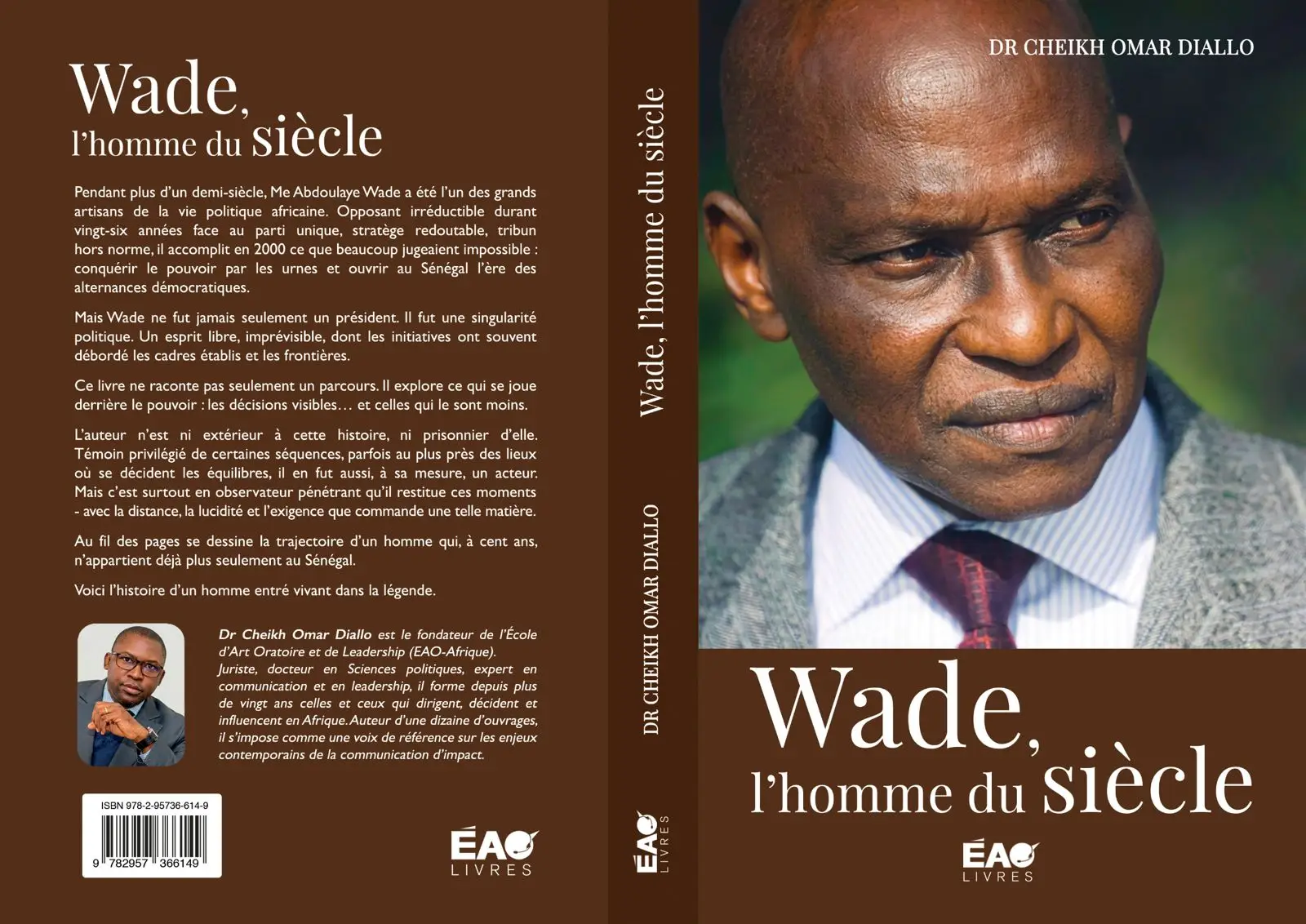
“Wade, the man of the century” by Dr. Cheikh Omar Diallo: A book between political story and tragedy of power
Dr Cheikh Omar Diallo signs with “Wade, the man of the century” a work dedicated to the former Senegalese president Abdoulaye Wade, a major figure in contemporary African political life. Through 225 pages, the author retraces the journey of a man whom he describes as having “crossed, moved and surpassed History”.
The work looks back on more than half a century of political struggle. Historical opponent of the single party for twenty-six years, Mr. Abdoulaye Wade appears as the one who achieved the “impossible” by gaining power through the ballot box in 2000 and opening the era of democratic alternations in Senegal.
“Wade has entered the legend alive,” writes the journalist-communicator and founder-general director of the prestigious school of oratory. According to him, the Pope of Sopi was never just a president. “He was a political singularity. A free, unpredictable spirit, whose initiatives often went beyond established frameworks and borders,” the author further wrote.
But the book, which will be officially presented on Saturday May 23 at the Librairie aux 4 Vents, goes beyond a simple laudatory portrait. The summary suggests a more complex, sometimes critical story, where power, loyalties, ruptures and political solitude combine. Chapters like “The law of heirs” or “The end of loyalties”, “The major detail that slowed down Karim” or even “The night Dakar burned” take the reader back to the major sequences which marked the last years of the liberal regime.
Dr. Diallo also describes a political figure with tragic appearances. In a metaphor inspired by Greek mythology, he compares Wade to Chronos, the god of time who “devoured his children”. Several of his former political companions – Idrissa Seck, Karim Wade, Ousmane Ngom and Souleymane Ndéné Ndiaye – are presented as heirs gradually pushed aside by the Wade system, until the emergence of Macky Sall, described as the one who will ultimately defeat him politically.
“Wade reigned through the ballot box and died through the ballot box,” summarizes the author, thus underlining the democratic dimension of an exceptional political destiny.
Through anecdotes, confidences and analyses, “Wade, the man of the century” attempts to decipher the backstage of power and the trajectory of a man whose influence, according to the author, goes beyond the borders of Senegal.
Arame NDIAYE
