
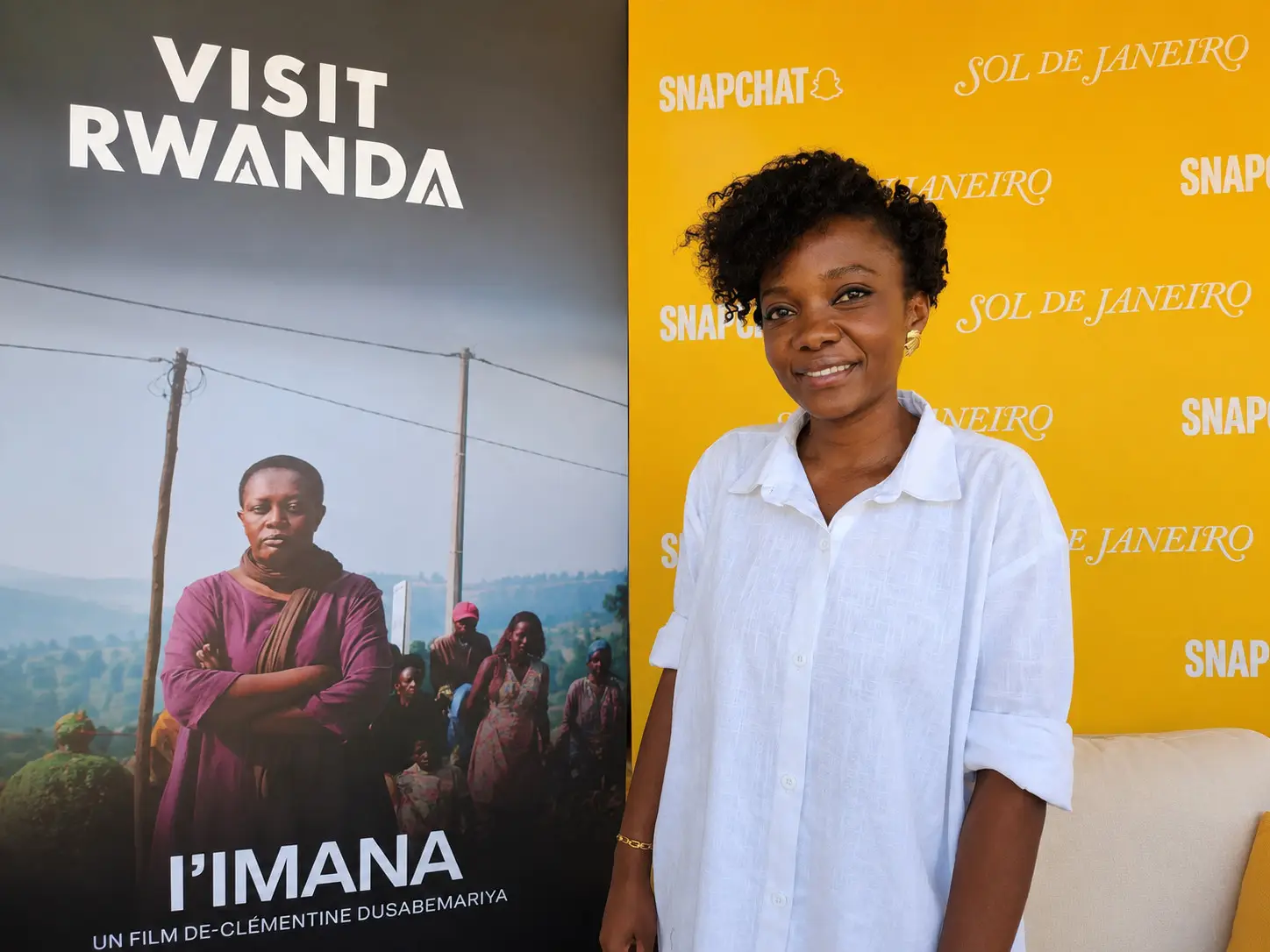
Film: “BEN’IMANA”: Saying the unspeakable, repairing the invisible
Selected in the “Un certain regard” section at the Cannes Film Festival, “Ben’imana” features a popular “gacaca” court in 2012 in a village where the pain of the genocide remains acute. Vénéranda claims to forgive and refuses to prosecute the killers, while her sister Suzanne wants things to be said and judged, just like her daughter Tina, who does not know her father. One thing leading to another, speech is freed. Meeting with Marie-Clémentine Dusabejambo, who explains the film’s approach.
Filmmaker Marie-Clémentine Dusabejambo underlines that the film was born from a long, intimate and collective journey: “We had to follow this path of discovering ourselves to consider how to represent ourselves, first in words, then in images”. For her, the whole of Rwanda had to look for “a language understandable and usable by everyone”, stumbling over “the lack of words that could convey what people felt, whatever side they were on”. Cinema thus becomes a laboratory of language and listening.
The challenge was to approach the genocide without limiting itself to denunciation or locking the characters into a simplistic duality. “Our challenge, as filmmakers, was to find these words, whether in artistic or dramatic language: how to approach this subject without falling into denunciation. It was necessary to integrate the personal dimension: how can I tell the story of the community while giving space to each voice, even those that I disapprove of? “, she notes. It’s about “taking a distance and listening to the other, their version”, the only way to understand “the emotion that accompanies the words”.
Hence the choral dimension of the film, where each character brings their share of truth and fragility. Even before writing, Dusabejambo carried out patient listening work: “This was the first work on the film: taking the time to listen, to watch, to interpret. It started with myself, because this film is really like a school, to learn from my community.” She could only hope for an authentic word if she showed herself to be sincere. If certain things have been lost over time, “the emotion runs through the decades gone by” and calls on Rwandan filmmakers to “take the time to encounter these unsaid things, to be able to interpret them”.
The question of speech also structures the staging. Dusabejambo assumes the close-ups on the mouths, the looks and the spaces of the village: “Yes, it was very important to give voice, in all its dimensions: the expressions in the eyes, the expressions of the decor and also the expressions in the spaces”.
Aesthetics of sobriety
The director’s first feature film and first film as station managers for most Rwandan technicians, “Ben’imana” is based on an aesthetic of sobriety: “The decor had to speak no more than life, more than the human body, and even the costume, it was really necessary to balance it well, so that each time there was a balance. So that was the word, whether in the costume, in the spaces, in the body. Everything had to speak and it also had to be the spoken word.”
The conflict between Vénéranda, who chooses forgiveness, and her sister Suzanne, who demands that everything be said, illustrates the complexity of this “meeting with the word”. For the filmmaker, “every time you say a word, you have to experience it, you have to live it”. Forgiveness cannot be a slogan; it must be tested by actions and by the community: “Even if we are individuals, we live in a community, and the community must also judge by actions,” she emphasizes. Freed speech is not an end in itself, but a process which exposes each person to the response of the other. The film also opens a breach into the imagination, through two ghostly figures: the grandmother, and a woman veiled in black who seems to be walking on the crest of madness.
The grandmother recalls April 16, 1973, a key moment in the institutionalization of discrimination against the Tutsis, a prelude to Juvenal Habyarimana’s coup d’état and, ultimately, the genocide. Dusabejambo thus places violence in historical continuity: “A seed that is sown and which is nourished and which grows. There was a series of stages after 73,” maintains the filmmaker. As for the veiled woman, she embodies identities broken by shame and guilt. The director invokes a proverb in Kinyarwanda: “An expression in Kinyarwanda says that pain does not kill. It makes you unhappy or bad or it turns you into an animal. », she adds.
This woman does not know where her children are, “and she carries the shame of knowing that it was her brothers who killed them and that she did not know how to protect them. It’s an identity that has been broken.” “Ben’imana” is, according to Dusabejambo, a film “about what separates us but also about what repairs us”. The child who is born is called by an expression meaning “may the nation live” or “the child will live”. “This means that there are things from the past that we cannot understand, that in any case, we cannot understand everything. What repairs us is when we tell ourselves with each decision that we must move forward.
Collective trip
There are things we can’t fix, but the decision to move forward is up to us. It’s a collective journey, but it must be anchored in the individual,” the director tells us. From this perspective, the liberation of speech has an almost therapeutic dimension, without the film being reduced to a discourse of healing. For Dusabejambo, “a word that is released is placed in the heart of someone else. When we speak, we are addressing someone. If this is not received, there is work to be done! »
The film is dedicated “to our mothers”, ambivalent figures, support and refuge, but sometimes a bulwark that blocks speech: “Yes, a mother remains a mother, loving and sometimes hurtful. Every mother can find herself in the character of Vénéranda. »
Finally, “Ben’imana” looks towards the younger generations, who refuse to carry the categories of Hutu and Tutsi: “After the genocide, that was abolished. We must understand that this would mean carrying the weight of family stories. No one wants to have that label. »
Olivier BARLET
