
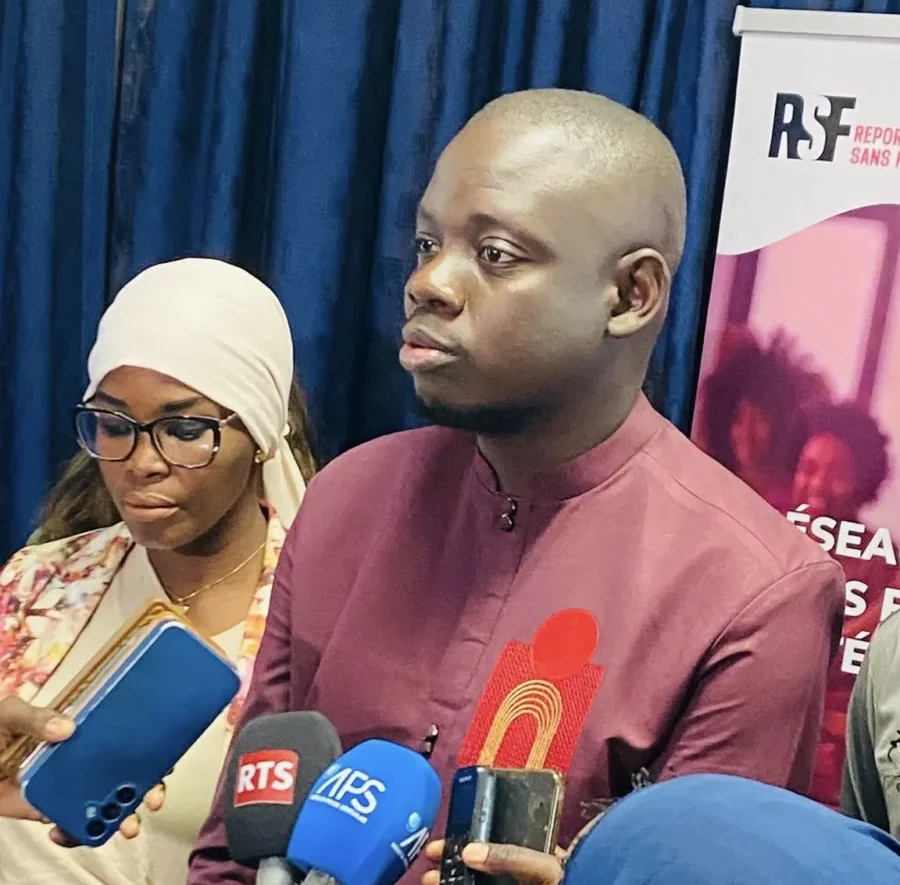
Press freedom: The Cjrs and Rsf put focal points into orbit
Faced with the increase in attacks on press freedom (physical attacks, digital attacks, arbitrary arrests, etc.), the Convention of Young Reporters of Senegal (Cjrs), in partnership with Reporters Without Borders (Rsf), has been organizing a three-day training workshop since yesterday, Tuesday February 24, for 14 journalists from the 14 regions of the country.
In a context marked by a worrying deterioration in press freedom in Senegal since 2021, particularly in a period of socio-political and electoral tensions, the Sub-Saharan Africa office of Reporters Without Borders (Rsf), in collaboration with the Convention of Young Reporters of Senegal (Cjrs), began yesterday, Tuesday February 24, a training session for 14 journalists representing the 14 regions of the country. This three-day training aims to enable journalists to acquire skills in monitoring, documentation and security. The initiative aims to establish a network of regional focal points capable of mastering the techniques for monitoring, documenting and reporting press freedom violations, identifying the different typologies of attacks, strengthening the security of journalists and reacting in a coordinated manner in the event of threats or attacks.
According to the Reporters Without Borders ranking, between 2019 and 2024, Senegal went from 49th to 94th place. This workshop should enable journalists to provide reliable information and document violations in order to better protect their colleagues and contribute to the restoration of press freedom throughout the national territory. Mamadou Diagne, president of the Convention of Young Reporters of Senegal, stressed that the media sector is undergoing profound change, with several cases of attacks recorded in recent years. As such, he indicated, the objective is to set up focal points to carry out high-impact advocacy, in order to counter this scourge and promote press freedom. “We will equip journalists so that they can be in front of the scene, document the facts and help their colleagues when they are in need.
It is for this reason that this partnership with Reporters Without Borders will be long-term, over three years, in order to achieve the objectives set for the long term,” declared Mr. Diagne. For Ndeye Diary Ba, project manager at Reporters Without Borders for sub-Saharan Africa, the objective is to strengthen the protection of journalists in Senegal. According to her, the project revolves around several axes, including protection, advocacy as well as capacity building for journalists in terms of physical security and digital security. “Thanks to these focal points, we will have information on local situations, which will make it possible to produce a national report on the state of press freedom in Senegal,” she explained, stressing that the choice made to Senegal is linked to a deterioration observed in recent years.
Bada MBATHIE
