
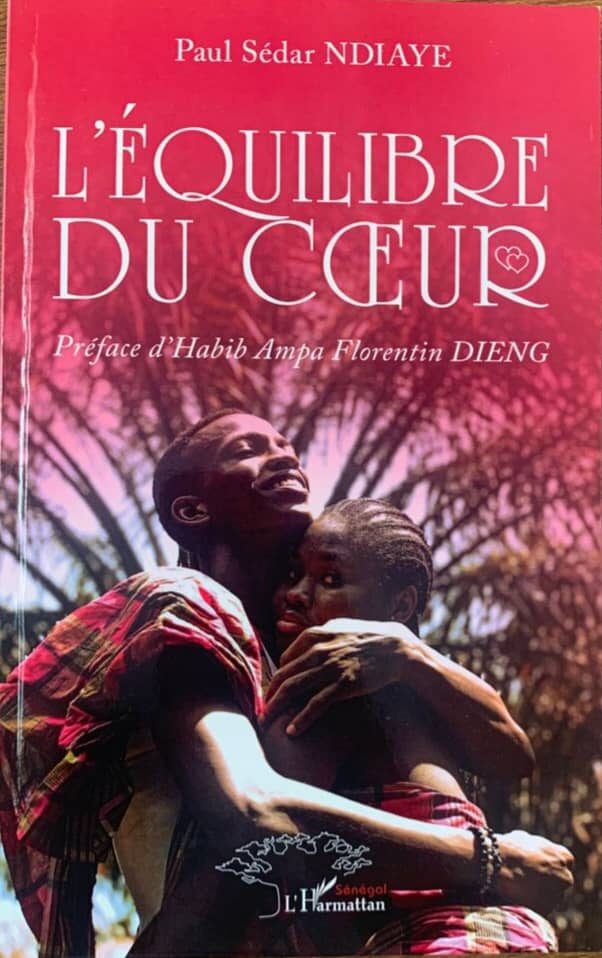
Paul Sédar Ndiaye, author “Equilibre du Cœur”: “Valentine’s Day has become the Black Friday of feelings”
He takes an ambivalent look at the celebration of Love Day on February 14 each year. For Paul Sédar Ndiaye, author of the novel “Equilibre du Cœur”, Valentine’s Day has become the “Black Friday of feelings”. He spoke on Saturday, during the presentation of his work at the Café Littéraire.
His book was certainly published on Saturday February 14, the day when lovers celebrate this natural feeling, this often disinterested and deep attachment to their other half. Far be it from him to give credit to this celebration.
“Valentine’s Day has become the Black Friday of feelings. I have an ambivalent look. On the one hand, any opportunity to celebrate love is a good one to take. But on the other hand, Valentine’s Day has become a caricature, an injunction to the consummation of love. We buy gifts to show our feelings, we show off on social networks,” said Saturday, Paul Sédar Ndiaye, author of the novel “Equilibre du Cœur”.
According to him, this is the exact opposite of what his book defends. In reality, the author believes that true love is built in everyday life, in discreet gestures, in challenges overcome, not in a day of commercial performance.
“It’s a celebration that puts enormous pressure on couples and deepens the loneliness of those who are alone. Love is demonstrated 365 days a year, and not just once a year with a credit card,” he laments.
“Balance of the Heart”: between fusional passion and self-preservation
In fact, the extraordinarily fine line between fusional passion and self-preservation is this balance that is explored in the novel “Equilibre du Cœur” by author Paul Sédar Ndiaye, a seasoned observer of human dynamics.
“It’s the balance between giving your trust and keeping your secret garden, between commitment to others and loyalty to yourself. It is also the balance between the expectations of society and the intimate needs of the couple,” he explained.
According to him, the novel does not say whether this balance is “attainable” once and for all. But, he suggests that the quest itself is what gives love its meaning. It is not a stable state, but a permanent adjustment, a patient craft.
“Balance of the heart does not consist in never falling, but in knowing how to get up together. We often think that marriage is the end of loneliness, but sometimes that’s where it all begins. Absolutely. Alassane and Yeuma are two deeply alone characters, but in different ways,” explains Mr. Ndiaye.
In reality, Alassane is alone at the height of his social success, isolated by an unhealthy mistrust that prevents him from connecting authentically. Yeuma is alone in the face of a destiny imposed on her, a solitude born of incomprehension and the weight of family expectations.
Therefore, through this work the author emphasizes that their marriage is not the fusion of two souls, but the collision of two solitudes which, paradoxically, reveal themselves to each other in the crisis.
“The real tragedy of this book is not the death of love”
“The drama of the novel is not so much their separation as their inability to transform this shared solitude into a common strength. The real tragedy of this book is not the death of love, but the fact that it never had the oxygen it needed to grow. We are taught to fall in love, but no one teaches us to stay in love,” he says.
Beyond the balance of the hearts of the two souls united by the bonds of marriage by their families; his novel shows how, in contemporary Senegalese society, human relationships are increasingly monetized.
Marriage in Senegal remains, he regrets, an alliance between two families before being a union between two individuals. This tradition, which can be a strength and a support, here becomes a source of unbearable pressure.
“The book does not plead for a break with the family, but for a redefinition of boundaries, for the creation of a safe space where the couple can build their own identity. The modern couple must learn to build a home with solid walls, but always open doors,” said Paul Sédar Ndiaye.
As a reminder, Mr. Ndiayr is also the author of an essay entitled “Téranga, the management of leadershi” and the novel “The tears of Mossane”.
Mariama DIEME
