
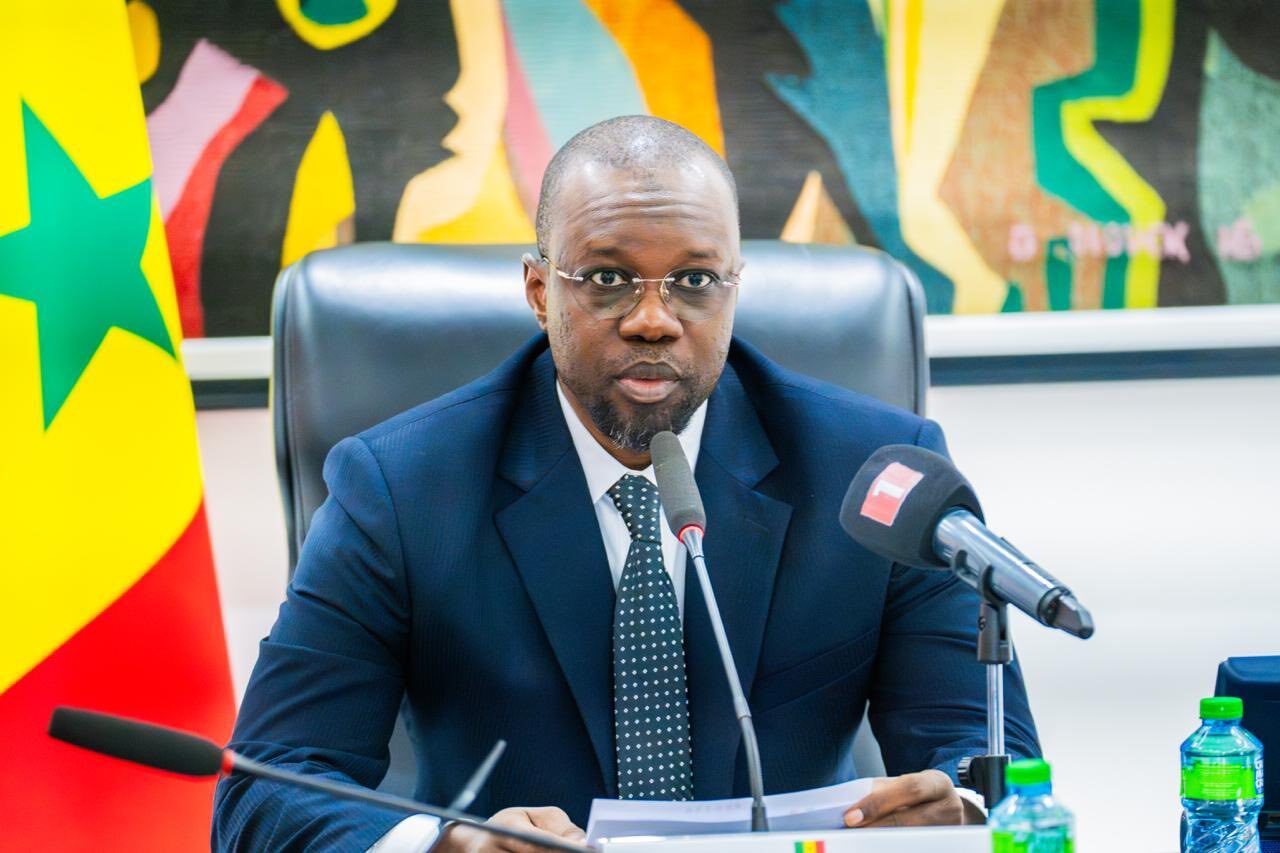
Human capital and structuring projects: Ousmane Sonko calls for accelerating reforms
Prime Minister Ousmanee Sonko insisted on the importance of human capital for social stability and economic development in Senegal. During his communication to the Council, he provided a diagnosis of the education and health sectors, while calling for an acceleration of the implementation of several structuring projects, including agropoles, the development of the Western Corniche and rural electrification.
Ousmane Sonko recalled that human capital constitutes a fundamental pillar of the economic and social life of the nation. As such, the government pays particular attention to the education and health sectors, considered major levers of human development.
In the field of national education and higher education, he drew up a diagnosis marked by several persistent difficulties. Among these are an overall shortage of personnel, a lack of infrastructure and suitable equipment, the deterioration of the school environment, as well as the inadequacy of teaching and training curricula. Added to this is the weak promotion of scientific fields, the recurring question of student scholarships, the disruption of the university calendar and the chronic instability of the school and university space.
The healthcare sector also faces significant challenges. The Prime Minister spoke of the fragmentation of health information systems, the lack of modern infrastructure integrating digital and energy solutions, as well as the insufficiency of human and financial resources. He also pointed out the obsolescence of the institutional and legal framework, the unequal distribution of personnel and resources, the dependence on imports of medicines and medical equipment, as well as the underinvestment in prevention.
Faced with these findings, the State claims to have made significant efforts to restore these strategic sectors. In this dynamic, the government is implementing the National Social Stability Pact for inclusive and sustainable growth, signed on May 1, 2025 between the State, unions and employers.
In the education and higher education sector, a five-year recruitment plan is underway in order to strengthen the teaching workforce and guarantee the continuity of public service. According to the Prime Minister, progress has also been recorded in terms of access to education, social inclusion, management of teachers’ careers and strengthening their capacities through universal diploma training and continuing education.
Concerning health, the government has initiated a reorganization of sectoral programs with particular emphasis on prevention and health promotion. This orientation is accompanied by several reforms, notably the revision of the Public Health Code, the reform of the legal framework relating to mental health and the updating of the national health map.
The Prime Minister also praised the results obtained in terms of human resources and health infrastructure, while calling on stakeholders in the education and health sectors to take a collective action in the interest of the nation.
Accelerate structuring projects
Beyond social policies, the Prime Minister drew the government’s attention to the progress of several structuring projects deemed to be priorities. These include the National Agropole Development Program, the Dakar West Corniche development project and the rural electrification project.
Concerning agropoles, he recalled that they constitute a major lever for achieving the objective of food sovereignty, promoting the industrial transformation of territories and creating jobs. However, certain difficulties related to governance, operational constraints and financial issues persist. He therefore asked the ministers concerned to accelerate disbursements and to work with the African Development Bank to quickly decide on the future of Agropole Nord.
Regarding the development project for the western corniche of Dakar, the Prime Minister underlined its strategic importance, particularly in view of the Dakar 2026 Youth Olympic Games. He deplored the cessation of work due to unpaid accounts and requested the urgent regularization of payments in order to allow the immediate resumption of the site.
As for the rural electrification project carried out by the Senegalese Rural Electrification Agency (ASER), it contributes to the objective of universal access to electricity and the reduction of territorial inequalities. The Prime Minister, however, reported blockages linked to the admission and customs clearance of imported equipment, compromising the program execution schedule. He thus instructed the ministers concerned to quickly remove these administrative obstacles.
Finally, the head of government announced that the executive will soon begin a series of public communications on major national issues. The first will focus on the renegotiation of agreements and contracts concluded in strategic sectors.
YEAR
