
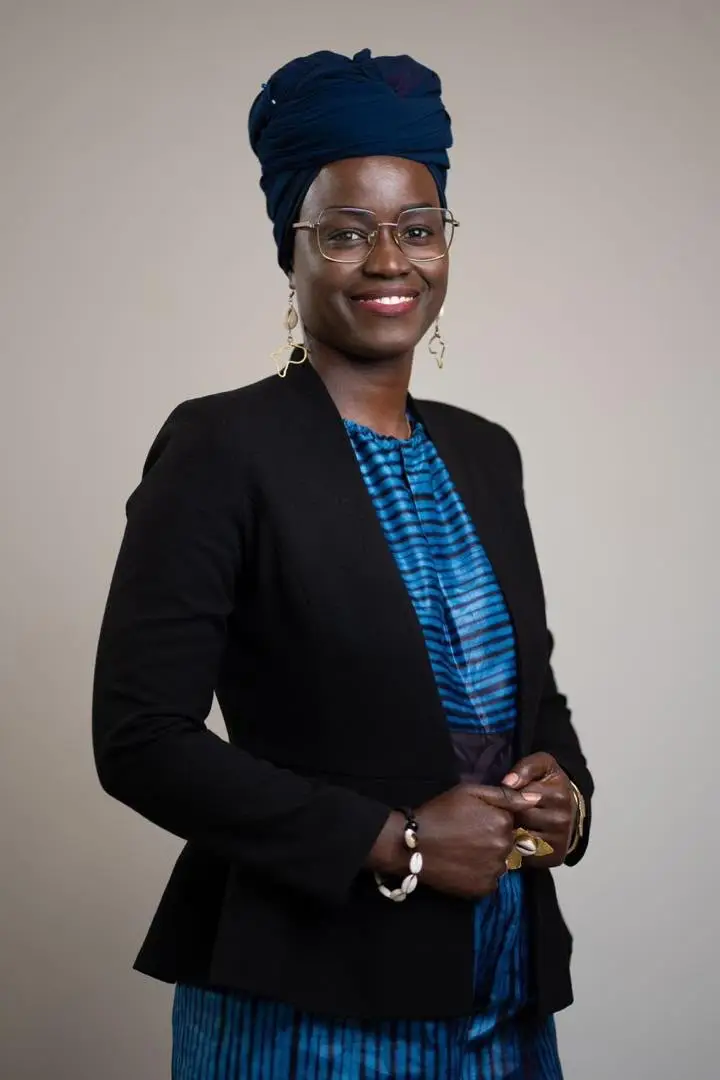
Access to care: Activist Woppa Diallo pleads for better care for women in Matam
In the Matam region, access to care is a concern for women living in rural areas. Remoteness of structures, lack of staff and evacuation difficulties often complicate pregnancy monitoring and childbirth care. For activist Woppa Diallo, women’s decision-making power must be strengthened, just as health services must be brought closer to populations.
Originally from Daande Maayo which means in French the territories located on the banks of the river, the eye of the daily Le Soleil has followed for several years the reality of the populations of Matam faced with difficulties in accessing healthcare. According to him, these difficulties are explained by the geographical characteristics of the region. Vast and sparsely populated in places, Matam presents particular constraints for the deployment of health services. The region covers an area of 29,616 km², or 14.7% of the national territory. It is the second largest region in Senegal, after Tambacounda, which extends over 42,613 km². In 2024, its density was estimated at 28 inhabitants per km².
This low coverage rate, combined with the extent of the territory, poses a challenge for populations’ access to basic social services, particularly health care. This is the whole point of Woppa Diallo’s fight. A native of Agnam, the activist has made education and the empowerment of women her fight. Founder of the Association for Keeping Girls in School (Amfe), she is also interested in the difficulties encountered by rural women in accessing health services.
For her, these difficulties are primarily linked to distance. According to Woppa Diallo, some communities in Matam are more than 30 kilometers from a health facility. During winter, access to certain areas becomes more difficult. “The distance to care in Matam is both a kilometer distance and a distance of power,” she believes while calling for fairness in the treatment of care. Of the same opinion, Falel Pam considers that one of the main obstacles to access to health care in the region is the distance of villages from health establishments.
“In the heart of Diéri, certain villages do not have adequate access to health services. In Ferlo, the situation is practically the same. The villages are very scattered. To access care, residents must go to the Ranérou health center,” he explains. For Falel Pam, the problem is also due to the concentration of main health establishments in a limited number of areas. “Hospitals are concentrated in Matam and Ourossogui, while the distance between these two departments is only 10 km. Any sick person is referred to Ourossogui.
Even some patients evacuated from Ranérou in Mauritania go through Ourossogui,” he underlines. According to him, given this situation, the Daande Maayo region deserves improvement in its health infrastructure. “The locality of Daande Maayo needs a health center worthy of the name. The populations who live in particular in Djerbivol fisherman are going through a real ordeal because they must first cross the arm of the river before heading towards the Dieri for treatment. Likewise, the inhabitants of the village of Mberla Bele in the depths of Dieri face great difficulties. At present, in Dande Maayo, between Nguidjilone and Félou, there are health posts, health huts, but no health center yet,” he emphasizes.
A lack of personnel and structures, Matam below the national average
In this context, data on the economic and social situation of Matam 2024, published by the National Agency for Statistics and Demography (Ansd), show difficulties in health coverage in the region. It appears that in 2024, Matam had 3 hospital centers, 4 health districts, 6 health centers and 90 health posts. However, the number of posts increased from 89 in 2023 to 90 in 2024. At the same time, functional health huts increased from 66 to 60.
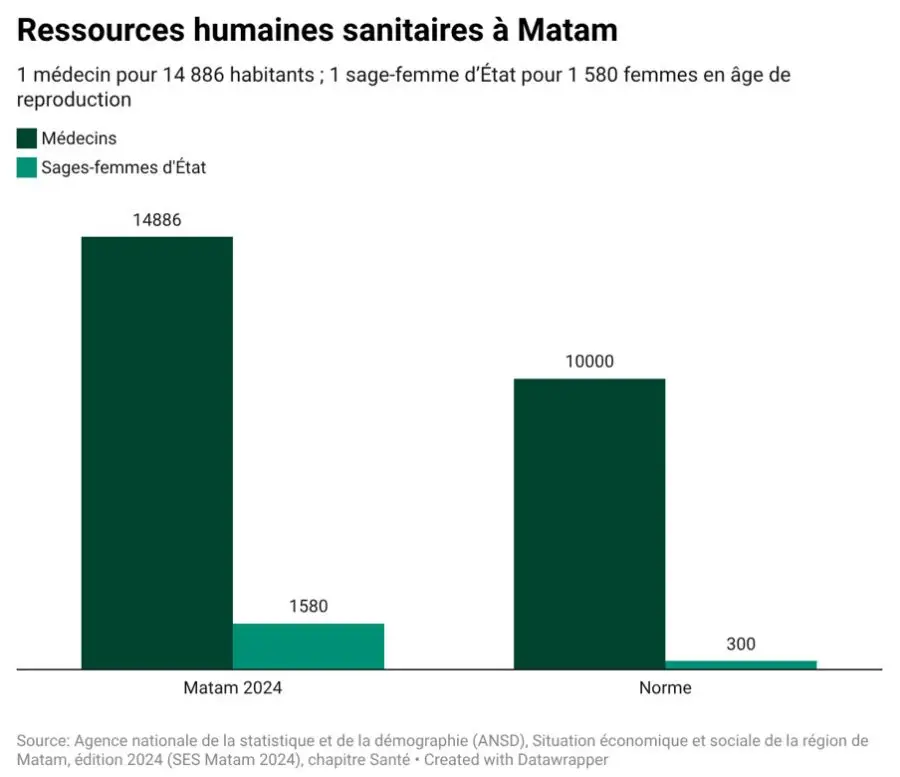
In this wake, the question of human resources is also a difficulty that populations encounter. As a result, the economic and social situation of Matam (Ses 2024) also indicates a ratio of one doctor per 14,886 inhabitants in the region, while the standard used in the report is one doctor per 10,000 inhabitants. For state midwives, “the ratio is one midwife per 1,580 women of reproductive age, compared to a norm of one per 300”. In order to better impact and connect the Matamese populations, Woppa Diallo recommends better coverage of the territory. “We need to strengthen areas like Diéri and Daande Maayo. The women who live there must be able to access care without traveling long distances,” she pleads.
The founder of the Association for Keeping Girls in School (Amfe), also considers it necessary to strengthen the means of evacuation and to create or rehabilitate local maternity wards. In this context, data from the health information system also show a gap between Matam and the national average for assistance with childbirth. In 2022, “the rate of deliveries attended by qualified personnel in health structures was 92.9% in Matam, compared to 97.3% for the whole of Senegal for an expected target of 100%”, underlines the most recent Ansd report on Matam.
The Ansd RGPH-5 data also shows 252 maternal deaths per 100,000 live births in Matam, compared to 213 at the national level. On January 20, 2025, during a Regional Development Committee dedicated to the launch of the strategic plan for reproductive, maternal, neonatal, child, adolescent and nutrition health, the regional director of Health, Dr Moustapha Faye, also highlighted the causes of maternal mortality in the region. “The causes of maternal deaths, which are numerous and multifactorial, are linked to hemorrhage, dystocia and infections,” he declared.
The regional director of Health then indicated that the region wanted to reduce the ratio of deaths to 150.” In this wake, a study published in 2025 in the African Journal of Clinical Cases and Reviews by Senegalese researchers looked at the determinants of maternal deaths at the Ourossogui Regional Hospital Center between January 1, 2020 and December 31, 2022. The researchers analyzed 57 maternal deaths recorded out of 6,612 deliveries between 2020 and 2022, i.e. a ratio of 862 deaths per 100,000 live births in this establishment.
According to their analysis, “The delay in consultation represented 48% of cases, the delay in evacuation 37% and the delay in treatment at the health structure level 15%,” they indicate. The study also notes that “86% of the deceased patients had been evacuated”. Regarding the causes of death, the authors specify that “direct obstetric causes represented 84.2% of the deaths studied”. Postpartum hemorrhages come first with “59.6% of cases”, followed by hypertensive disorders of pregnancy and their complications, which represent “19.3%” of cases.
Telemedicine as a solution?
As for the authorities, Magor sow, director of insurance at the Agency for Universal Health Coverage (Sen-CSU), specifies that the agency has set up an insurance system intended for women of childbearing age. “With regard to access to maternal care, the Agency has set up an insurance system for the enrollment and financial coverage of the care of women of reproductive age, with 80% coverage at the level of public health structures and 50% access to medicines from private pharmacies,” he explains.
According to him, between 2021 and 2024, free care for pregnant women concerned six regions of World Bank intervention, namely Kaffrine, Kédougou, Kolda, Ziguinchor, Sédhiou and Tambacounda. Furthermore, despite the existence of the 2024-2028 Strategic Health Plan, difficulties in accessing maternal care continue to affect women, particularly those living in rural areas of Matam.
However, for Woppa Diallo, the question of access to care is not limited to the provision of health, it also arises from the weight of social norms, financial difficulties and the use of traditional matrons in certain communities. “The decision to seek care often does not depend on the woman herself. She sometimes depends on her husband or mother-in-law,” she says.
According to the activist, responses must also come from the women themselves, particularly within the framework of the Badienu Gox program, which relies on women relays in the communities to support pregnant women. “Women can play an important role in supporting pregnant women. We must strengthen this program, especially in the most remote areas,” she underlines while also proposing to strengthen telemedicine. But she believes that this tool should not replace investments in structures and personnel. “We do not perform a cesarean section remotely.
Telemedicine must be a complement. It cannot replace health infrastructure and personnel. We must reduce the cost of care, but we must also bring health structures closer to populations, improve evacuations and give women the means to decide for their own health,” she invites. How could the solution to access to care also involve technologies?
Marième Fatou Dramé
This WanaData article was supported by Code for Africa and the Digital Democracy Initiative as part of the Digitalise Youth project, funded by the European Partnership for Democracy (EPD).
