
Conservation(s) and inter-temporal conversations (1/2) November 19, 2026
Editions Vives Voix and the African Archives Fund – Ababacar Samb Makharam (Faasm) are preparing for their 2026 Dakar Biennale, with the exhibition “Sutura”. Six artists, currently in residence at the Editions Vives Voix quarters (Point E), will be the posters. They will present works that dialogue with memory as well as (anti)fragility.
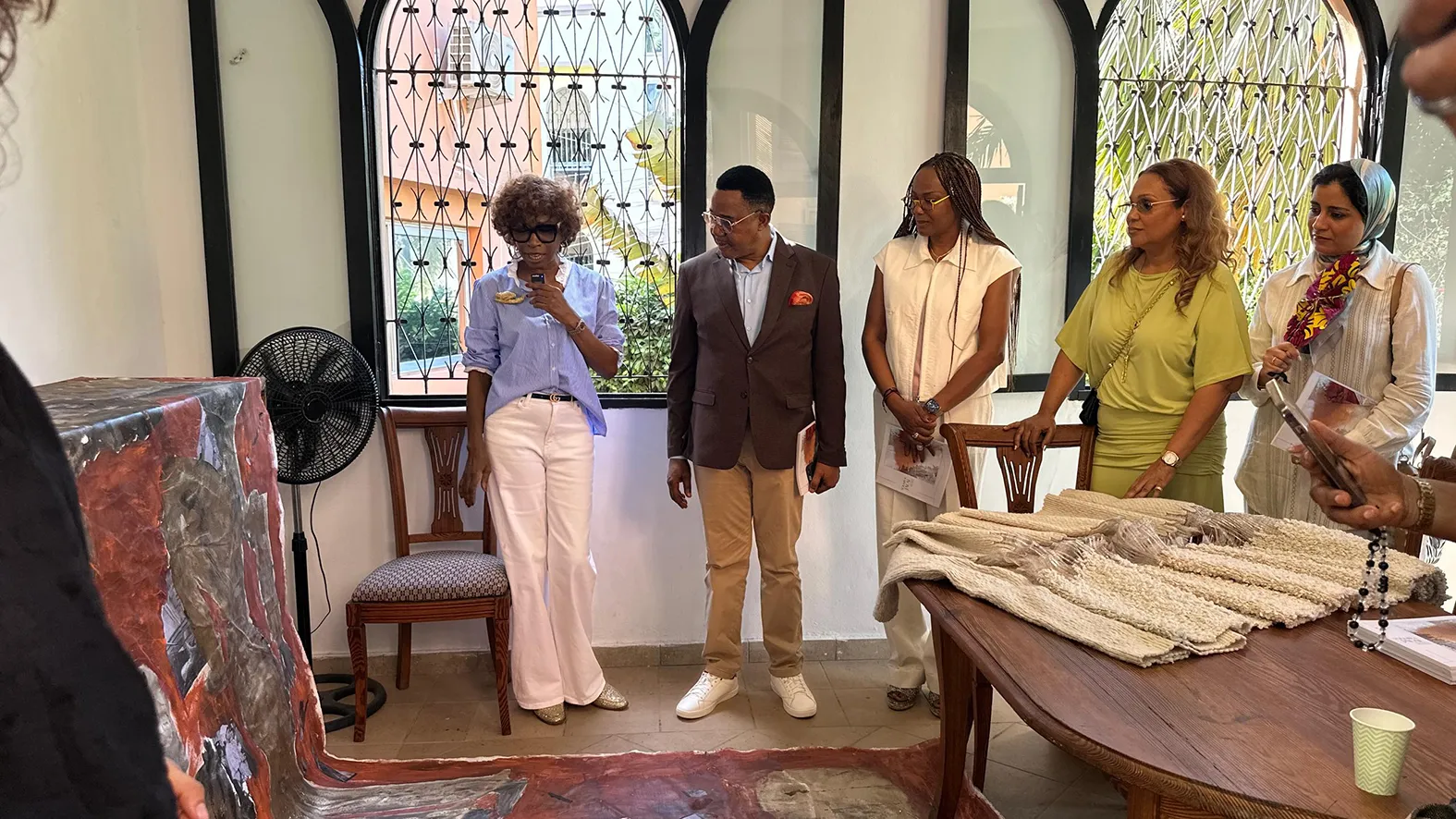
Last Saturday, at the headquarters of Editions Vives Voix in the Point E district, the 16th edition of the Biennale of Contemporary African Art in Dakar and its “Off” revealed a bit of their tones and forms. Editions Vives Voix and the African Archives Fund – Ababacar Samb Makharam, through their president, Ghaël Samb Sall, invited the press to discover the residency and the current creations of the six artists they will exhibit. The works will make up the “Sutura” exhibition, scheduled as much for the Dakar Biennale 2026 (November 19 to December 19) as for Parcourts 2026. We will thus discover the works of the Senegalese Ko Sy, the Beninese Eliane Aïsso, Géraud B. Cledjo and Eric Médéda, the Moroccan Soumiya Jallal and the Congolese Olivier Fall Masey. The latter, during the tour of the workshops, particularly attracted attention. With his name sounding Senegalese from the Center, he presented his work in front of his compatriot, His Excellency Christophe Muzungu, Ambassador of the Democratic Republic of Congo to Senegal. The DRC is also the guest country of honor for the 16th edition of the Biennale. The multidisciplinary visual artist Olivier Fall Masey is working on a work at the crossroads of our urban memories and (anti)fragility, the general theme of the Dakar Biennale 2026. He has sculpted a canoe with panels of polyurethane insulating foam, and as a highlight he has created figurines and other urban “traces and symbols” with the same polymer material.
By sculpting this boat, Olivier Fall Masey evokes ecology and celebrates the efforts of the fisherman who keeps his fish in these tanks. By using this material, a priori very fragile but remaining a powerful thermal and acoustic insulator, the Congolese artist explores (anti)fragility. This notion indicates reinventing oneself in shocks and transforming one’s weaknesses into a driving force that marks rebirth and re-emergence. It is also a painting of the city of Dakar that Olivier Fall Masey shows on A3 canvases, with a neutral background and colored foregrounds. Such as the piece presenting a speed car in its bright colors, while leaving in black and white the scenes of life and the imposing architecture of a mosque and a church. It is the symbol of wild urbanization, of unbridled and misguided gentrification. It is the symbol of a city which illusorily keeps identities stripped of their essence by various alterations, like this speed car which is a postcard in itself, but whose backfires, circuits and black smoke disrupt the quality of life on a daily basis. “My work also encourages us to think about which cities to bequeath to future generations,” explains Olivier Fall Masey, who bears the name of an ascendant Senegalese rifleman who had landed in the Congo. Like Olivier Fall Masey, all the five other artists in the residency start from the archives of the African Archives Fund for the Safeguarding of Memory – Ababacar Samb Makharam (Asm Fund) to create the works for the “Sutura” exhibition. The idea is to explore these archival images and documents as living spaces for the production of meaning, knowledge, as well as artistic creation and interdisciplinary connection. “Sutura”, a Wolof word and concept, means care, dignity, preservation of what is precious. At a time when debates on heritage and restitution are spanning the world, we wanted a founding act: establishing a direct dialogue between the territories themselves. When artists from all these countries examine our collections together, they weave a common story of our peoples and our geographies,” explains Ghaël Samb, also co-curator of the exhibition with Maïran Ma-Laügt, who spoke alongside Evelyne Diatta Accrombessi, patron who accompanied the presence of two artists from the selection.
Mamadou Oumar KAMARA
