
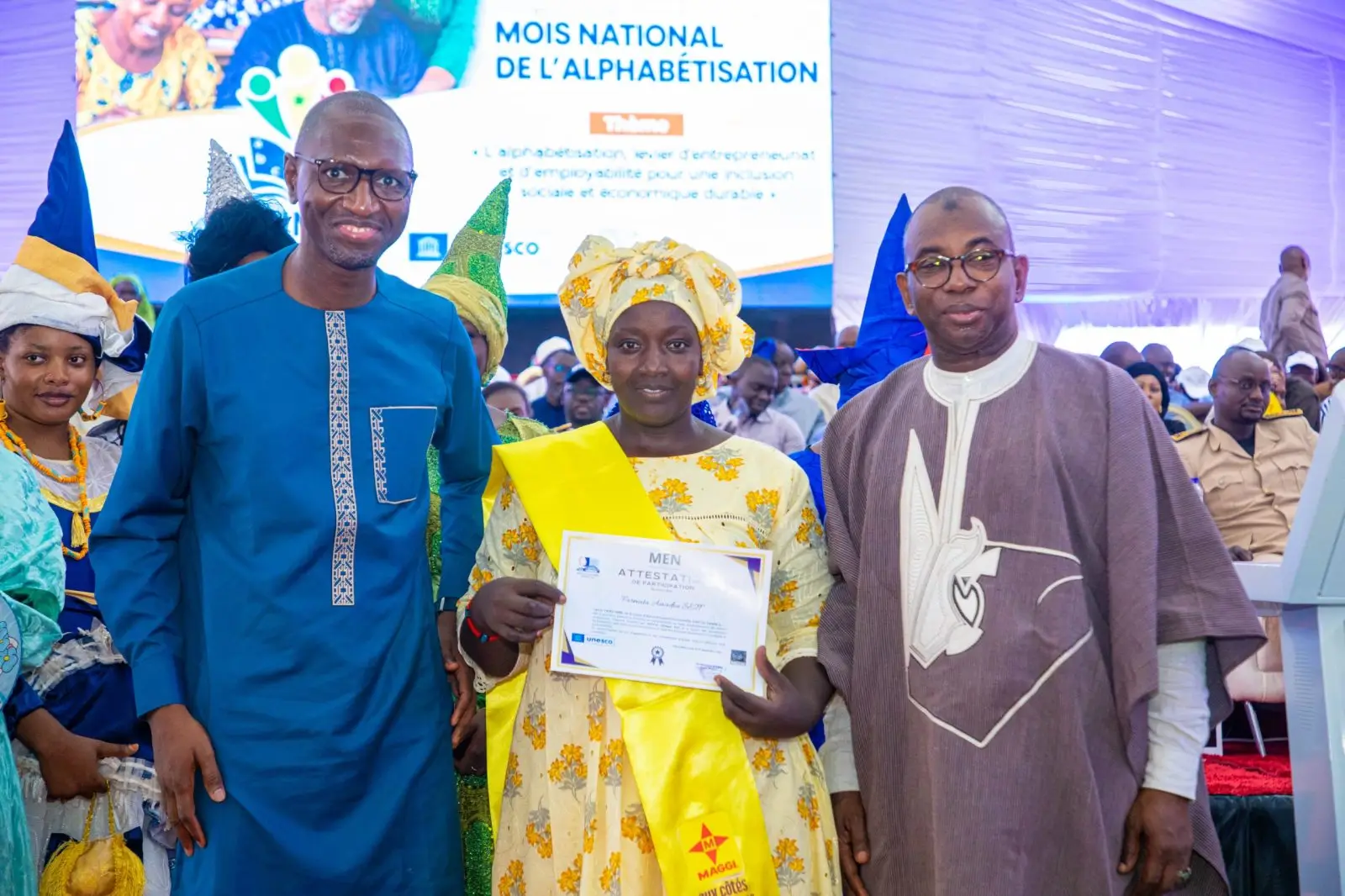
ADVERTISING: NESTLE SENEGAL THROUGH ITS MAGGI BRAND BENITS ON LITERACY FOR THE EMPOWERMENT OF WOMEN
In Saint-Louis, Nestlé Senegal, through its MAGGI brand, gives a concrete dimension to its commitment to the empowerment of women. In partnership with the Directorate of Literacy and National Languages (DALN), the company supported 100 women onion producers in a functional literacy program. An initiative that transforms learning into useful skills for their economic activities and their daily lives.
In Saint-Louis, literacy is no longer limited to learning to read and write. It becomes a real tool for economic and social empowerment. This is the whole meaning of the program carried out by Nestlé Senegal, through MAGGI, in collaboration with the Ministry of National Education and the Directorate of Literacy and National Languages. Implemented for the benefit of 100 women onion producers in the Saint-Louis region, this program is part of the 3rd edition of National Literacy Month, under the theme: “Literacy, a lever of entrepreneurship and employability for sustainable social and economic inclusion”. For Nestlé Senegal, this commitment reflects a strong conviction: the development of communities is a shared responsibility between public authorities, businesses and all stakeholders in society. From this perspective, literacy constitutes an investment in people but also in families, economic activities and territories.
From learning to economic autonomy
The originality of the program lies in its functional approach. The knowledge transmitted is not disconnected from the daily lives of the beneficiaries. They are directly adapted to their realities and their economic activities. Reading, writing and calculation thus become tools allowing women to better manage their activities, monitor their income and expenses, make more informed decisions and participate more in the economic and social life of their communities. The results obtained support this approach. According to Issa Sanogo, general administrator of Nestlé Senegal, the program has benefited 100 women with a success rate close to 100%. But beyond the figures, the manager highlights a deeper transformation: that of rediscovered confidence and the capacity of beneficiaries to better understand and conduct their activities. “Our greatest satisfaction is what we see and it is the women who give the greatest testimony: this change that this program has had in their everyday lives, this gain in confidence,” underlined Mr. Sanogo. The testimony of Aissata Racine Sow perfectly illustrates this evolution. An onion producer and beneficiary of the program, she measures the progress made between the situation before and that of today. “Before, during our women’s group and tontine projects, we were obliged to ask our children for help with writing and calculations. Now, thanks to the program, we do it ourselves. We know how to read, write and calculate and this is a great contribution to our income-generating activities,” she says. For these women, knowing how to read, write and calculate therefore represents much more than an academic skill. It is a new ability to act for themselves, to manage their resources and to take part in decisions that concern their activity.
MAGGI, at the heart of local value chains
Nestlé Senegal’s commitment also takes on its full meaning in the link between literacy and the local economy. The women beneficiaries are onion producers, an activity which is part of the economic environment of the company’s value chains. Issa Sanogo recalls that the onion produced by these women constitutes one of the raw materials which, after processing, is used in the composition of MAGGI broths. By strengthening the capacities of these producers, Nestlé also contributes to consolidating the players who participate in its value chains. “They are part of our value chains. By teaching these ladies to read and helping them improve their economic activities, they are actors in our value chains that we are improving,” he explained. This approach reflects the principle of “creating shared values” defended by Nestlé: creating value for communities while sustainably strengthening the company’s activities. The initiative is therefore part of a broader vision where economic performance cannot be dissociated from community development. For MAGGI, the empowerment of women constitutes a means of contributing to the development of local economies and the construction of a more sustainable food system.
An impactful public-private partnership
For the Directorate of Literacy and National Languages, this experience demonstrates the relevance of collaboration between the State and the private sector. Aliou Fall, Director of Literacy and National Languages, welcomes “a very good project” having experienced “very great success” through the training of 100 women. He especially emphasizes the changes observed among the beneficiaries. Some, he explains, previously knew “neither how to read, nor write, nor run their business.” Today, they say they can read, consult their cell phone, keep their documents and do their accounting. This progress gives concrete scope to the partnership between Nestlé Senegal, through MAGGI, and DALN. The program presentation document also emphasizes that this initiative illustrates the importance of partnerships between public and private actors to provide concrete responses to community development challenges. For Nestlé Senegal, this first result constitutes above all a starting point. “This first attempt, which I will call a successful attempt, gives us a lot of ambition,” says Issa Sanogo, who announces the desire to continue collaboration with the Ministry of National Education and the DALN in order to extend the program to more women and communities. This perspective is in line with the Nestlé For Good approach, through which the group intends to support actions with a positive impact in the areas of education, employability, entrepreneurship and community development.
The ambition displayed therefore goes beyond the simple learning of fundamental knowledge. “Our ambition is to make literacy an open door,” recalls Moustapha Mamba Guirassy, Minister of National Education. Each learning must be able to become a useful skill, an opportunity to act and a chance to sustainably transform one’s own life, that of others and one’s territory. For Nestlé Senegal and MAGGI, the challenge is precisely there: making investment in skills a lever for shared progress. By placing women at the heart of this dynamic, the company intends to contribute to communities that are more inclusive, more resilient and more capable of creating their own opportunities. The literacy program for onion producers thus appears to be a concrete illustration of this philosophy. By supporting 100 women, Nestlé Senegal is not just supporting apprenticeship: the company is investing in capabilities, economic activities and, through them, in the future of communities. The results obtained support this orientation and pave the way for a broader ambition: to extend impact, strengthen partnerships and make women’s empowerment a sustainable driver of local development.
