
Germany – Senegal: from Senghor to Faye, six decades of a strong relationship
Since the establishment of their diplomatic relations in 1960, Germany and Senegal have built cooperation which has continued to diversify. Over the decades and changes in context, this partnership has been renewed to invest, today, in new fields, notably industry, energy and professional training.
One of the streets of Fann-Résidence in Dakar bears the name of Léo Frobénius. Why did you name it after the German ethnologist? This is because alongside his companions in negritude, Aimé Césaire and Léon-Gontran Damas, President Senghor wanted to salute a thinker who personally influenced him. Indeed, for the president-poet, the German influence participates in the formation of a thought which seeks to “articulate reason, intuition, culture and knowledge”. And Léo Frobenius occupies a unique place there. Senghor attributed to him a contribution such that he considered that Frobenius had contributed to rehabilitating “intuitive reason” in his eyes, as the philosopher Souleymane Bachir Diagne underlined in his work entitled “Léopold Sédar Senghor: African art as philosophy” (Riveneuve, Paris, 2007).
In an interview given to Le Soleil in August 2018 on the occasion of Chancellor Angela Merkel’s visit to Senegal, the late Professor Maguèye Kassé explained that Senghor had created the Department of Germanic Languages and Civilizations at the University of Dakar in 1973 under the inspiration of Léon Frobenius. “Through his humanities, Senghor was in confrontation with German culture. He developed a particular affection for Germany, its traditions and its myths, notably the cult of the earth, of man and of nature which, according to him, would bring the Negro-African closer to the German.” A first story, little known, of the links between Germany and Senegal thus emerges: that of the meeting of ideas which accompanied that of the States.
There are dates that alone sum up the depth of a relationship. September 23, 1960 was one for both countries. A few months after Senegal’s accession to international sovereignty, Dakar and the Federal Republic of Germany (FRG) established their diplomatic relations. Germany was the third country to officially recognize Senegal as indicated by the diplomatic registration plate (003).
German development cooperation thus took root in the first years of independence. Léopold Sédar Senghor becomes the first President of the Republic, while in Bonn, Konrad Adenauer has led the FRG since 1949.
If a direct meeting between Senghor and Adenauer is not established by the available sources, the two leaders belong to a generation concerned with rebuilding, after the traumas of war and totalitarianism, a political order based on the rule of law, with the concerns and contexts specific to each.
On the institutional level, the relationship is consolidated. An investment protection agreement was signed in 1966 and cultural cooperation developed. In the midst of the Cold War, Dakar took a further step by establishing, on August 22, 1973, diplomatic relations with the German Democratic Republic (GDR). Senegal therefore maintains relations with the two Germanys, while maintaining a privileged link with Bonn. The opening of its embassy in Bonn in the mid-1970s confirmed this desire.
In 1977, Senghor went to the FRG and was received by Federal President Walter Scheel. The following year, Willy Brandt, former chancellor who became president of the Socialist International, went to Dakar. The relationship then extends to several areas: economic cooperation, culture, education and North-South dialogue. The arrival of Abdou Diouf as president in 1981 did not change this trajectory. In March 1986, he was received in Germany by Chancellor Helmut Kohl and met Federal President Richard von Weizsäcker. In October 1987, German Foreign Minister Hans-Dietrich Genscher visited Dakar. Peace, human rights and peaceful resolution of conflicts are among the themes of the dialogue. Senegal then asserts itself as a stable political partner in West Africa.
Then History accelerates. The fall of the Berlin Wall on November 9, 1989, and the reunification of Germany on October 3, 1990, put an end to the coexistence of the two German states. For Dakar, this new situation means the return to a single interlocutor: reunified Germany. This does not call into question the achievements of three decades of cooperation. Under Abdoulaye Wade, the partnership took on a more economic color. In September 2006, the Senegalese President met President Horst Köhler and Chancellor Angela Merkel in Berlin. In addition to questions of development and investment, there is now that of migration, with the search for common responses to irregular departures to Europe.
With Macky Sall, the partnership changes scale again. Received by Angela Merkel in Berlin in March 2014, the Senegalese President returns four years later to the bilateral relationship with the official visit of the German Chancellor to Dakar on August 29, 2018. Development, investments, regional cooperation and job creation are at the heart of the exchanges. In January 2020, Macky Sall was received again in Berlin. The visit of Federal President Frank-Walter Steinmeier to Dakar in February 2022 opens another sequence. He is present at the inauguration of the Abdoulaye Wade stadium in Diamniadio. In a Sahel marked by security crises, the dialogue focuses in particular on Mali and regional stability. Germany now appears not only as an economic partner, but also as an actor committed to questions of security and stability.
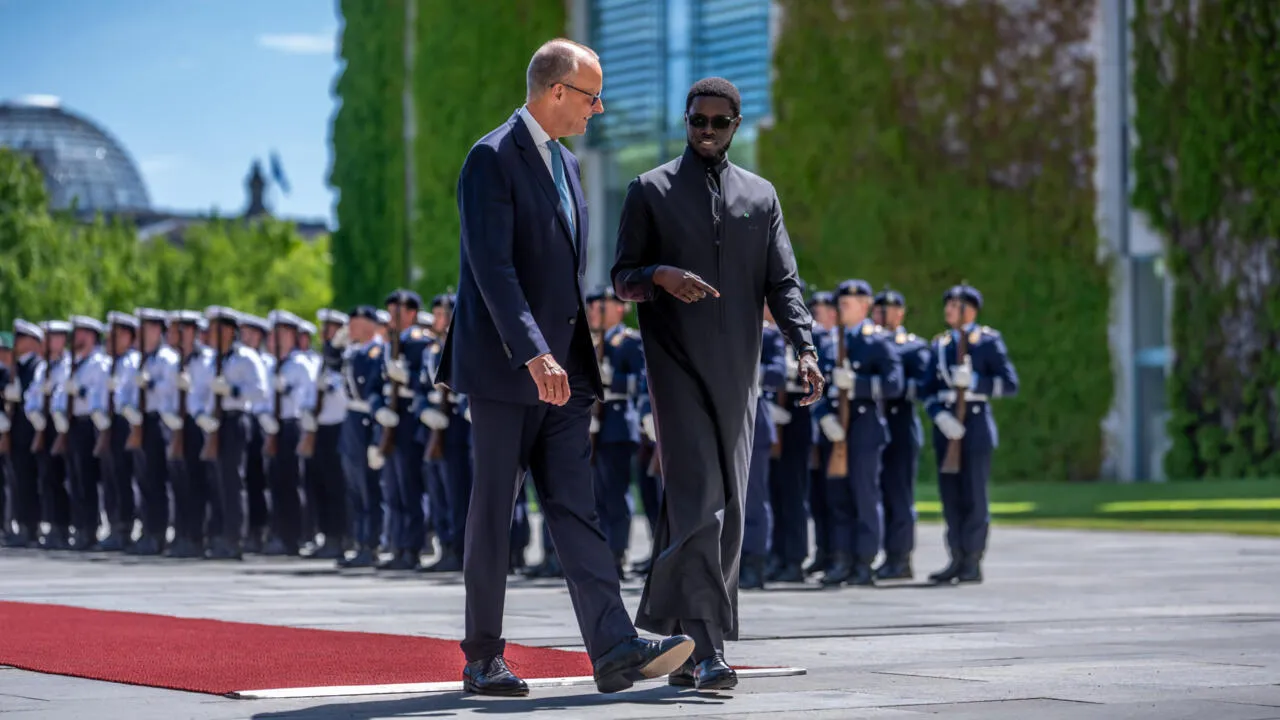
Bassirou Diomaye Faye’s visit to Berlin, from June 21 to 23, 2026, continues this long story. Received by Frank-Walter Steinmeier and Chancellor Friedrich Merz, the Senegalese Head of State places the economy, industry, energy and professional training at the heart of his agenda. The two leaders salute the solidity of a relationship based on “cordial friendship and reciprocal esteem”, as Le Soleil points out. Dakar intends to attract more German companies and include the partnership in the priorities of “Vision Senegal 2050”. Berlin, for its part, underlines the role of Senegal in the stability of the sub-region and security cooperation.
From Senghor to Faye, the German-Senegalese relationship has gone through the upheavals of History without breaking its common thread. From Bonn to Berlin, from development cooperation to economic, energy and security issues, the partnership has adapted without losing its substance. In 1968, Senghor saw in the presence of Lübke “a friendship between our two peoples”. Nearly six decades later, Faye and Merz still celebrate its strength. Times have changed.
The link remains.
Samboudian KAMARA
