
The improvised show of the troubadours “bongoman” October 4, 2026
In Soumbédioune, troubadour musicians called “bongoman” are now an integral part of the decor. They transform, in the time of a few percussions, the visitors into stars. Praise and flattery compose their verses which bring a smile to the customers’ faces.
It’s the weekend. Soumbédioune beach is overflowing. The open-air restaurants located on the water’s edge are almost full. Waiters, sellers of fish, drinks, fruit, donuts and other foods parade under brightly colored parasols. They offer their products to numerous customers, each in their own way. Everything is enveloped by the sound of the sea which sends small waves lashing the stones of the shore. It is in this atmosphere that a voice rises, followed by percussion. He is a “bongoman”, a troubadour musician usually present on the beach of Soumbédioune, where he officiates. Here, the “bongoman” slip between the rows of tables, their instruments on their shoulders or under their armpits, declaiming praises in a rhythm that is far from monotonous.
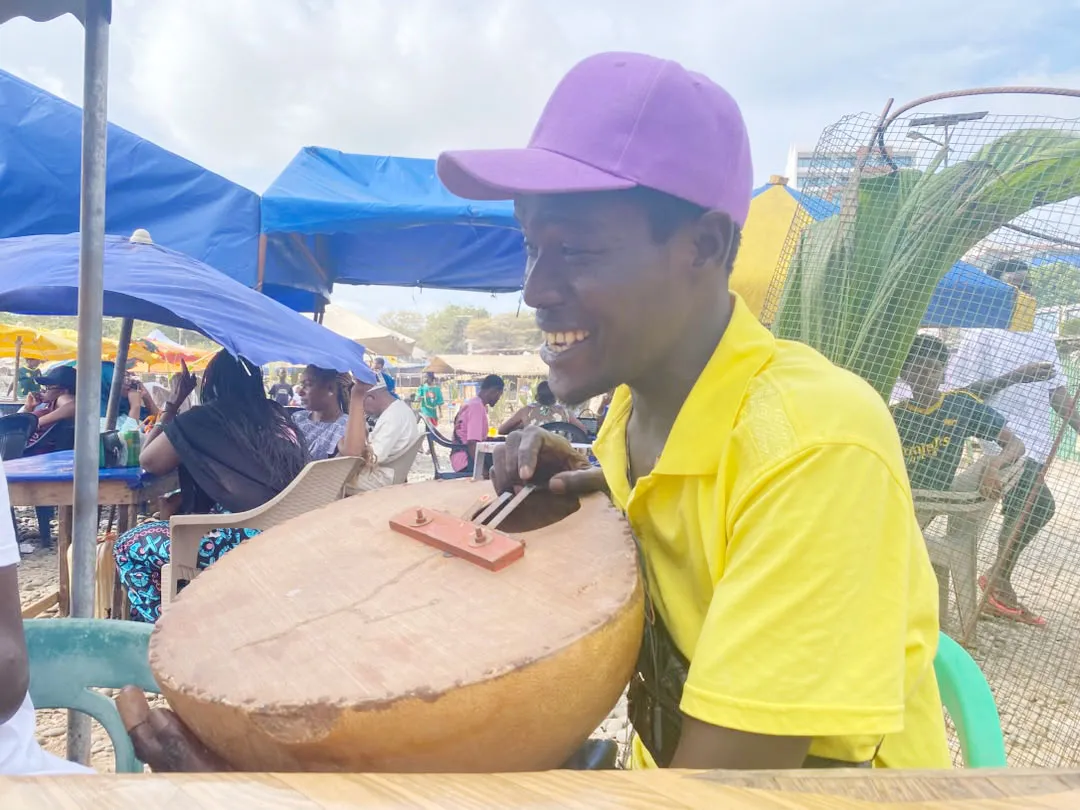
Serigne Mbaye is one of these artists. Under his purple cap, this slender man protects himself from the sun, which is still aggressive after 4 p.m. He passes a few tables before stopping in front of that of two men accompanied by two women. Shouting as much as his instrument, he magnifies the “love” that these two men have for the two ladies sitting opposite. “It’s you he loves,” he repeats. His metal rings, worn on the five fingers of his left hand, create the rhythm in contact with the dry wooden instrument. A sound that escapes through the mouth of the instrument, accompanied by strings that the “bongoman” plucks from time to time. One of the two beautiful ladies won over by his songs gives him a 1,000 FCFA note. The market is then open. Serigne sings more beautifully. It travels between bass and treble. Other 1,000 FCfa notes still land in his hand. “That’s how it is. We sing the praises of the customers and, if they like it, they give us money,” he explains, his left hand slapping the rounded bottom of his instrument.
Her current “benefactors” are Khoudia and Awa, who have come with two men they present as their friends to relax. “We come here to free ourselves from the stress and fatigue of the week. With the “bongoman”, we regain a smile and a good mood,” says Khoudia, elbows on the table covered with a blue tarpaulin. “That’s why we’re inclined to give them money.” They give you happiness after all,” said Aida, her face showing freckles. In Soumbédioune, fish has long been the star. Grilled or braised, it is served with fries, sauce and salad or served with rice. However, the “bongoman” stole the show. They transform, in the time of a few percussions, the visitors into stars. Which arouses various feelings. For Adja, a fifty-year-old, their presence is disturbing. “They come to you unexpectedly and can even make vulgar remarks,” said the lady, in a dry tone.
Serigne Mbaye specifies for his part. “We don’t go to just anyone. The face reflects what is in the person’s heart, we observe it first. It is only then that we decide to go to the person or not,” says the “bongoman”, who is a mason by profession.
Happiness to buy
Launched into this activity which is his “heritage”, he sees it as a profession that must be respected. “I leave Guédiawaye at 7 a.m. and arrive here around noon. I work until 8 p.m.,” he reveals, his bright yellow polo shirt popping in the sun. In this interval, everything is done to make visitors to Soumbédioune happy and, in turn, raise money.
“Currently, we earn around 10,000 FCfa per day. Even if, before, we could have more, up to 50,000 FCfa. We give thanks to God, this allows us to live,” rejoices Serigne, visibly the only “bongoman” present in Soumbédioune this Sunday morning. Around 5 p.m., the sound of the crashing waves intensifies. It adds to the cries of children in the water and the music from the amusement park next door. The wind, stronger, makes those who are more chilly tremble and ruffles their hair. Headwear or wigs are at his mercy. Nabou, with the wind in his hair, holds back his mane. She flattens her wig with both hands from the part. She has just paid her tribute, with her two friends, to Serigne Mbaye. 2,500 FCfa: that’s what they offered him. “We give them this money with cheerfulness, because they relieve us. It’s practically therapeutic, what they do,” explains the lady, aged around twenty, who has just finished tasting two dishes of “C’est bon” with her friends.
For one of the latter, Juline Rofé Faye, the arrival of the “bongoman” is quite distracting. “We came to eat and swim, but they offered us much more. So we lose nothing by offering them a few tickets in return,” declares the young lady, leaving the shade of the parasol and heading towards the ocean. Soumbédioune draws its essence from fish, from this water. Sold raw or cooked, it serves as a source of livelihood for many men and women. But around his business, the “bongoman” also do well by charming, with poems, lovers of seafood.
Lamine SARR (Intern)
