
“Makila”, in the den of the barbarity of child soldiers August 31, 2026
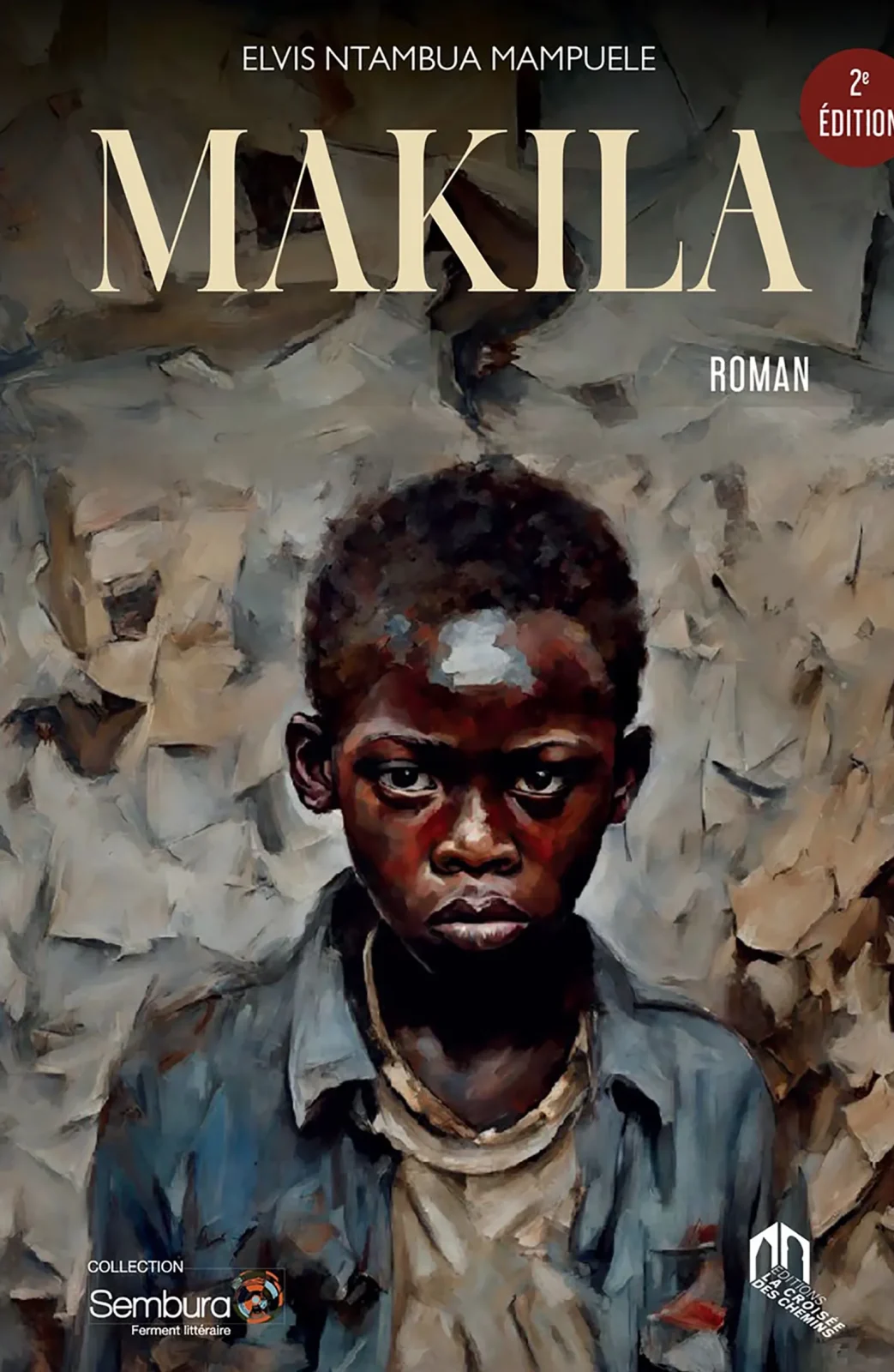
At eleven years old, Tshituala is not old enough to carry a rifle. He still has the feeling of running behind a childhood, of believing in home, in family and in ordinary days. The war doesn’t give him that time. In “Makila”, Elvis Ntambua Mampuele pushes the reader into the bowels of a Congo ravaged by conflicts and makes the journey of a child soldier a dive into the mechanics of dehumanization. Between fiction and history, the novelist tells the war less as an event than as a machine capable of manufacturing executioners with children. Published in 2024 by La Croisée des Chemins, in the Sembura collection, the novel has 314 beautiful pages.
You have to enter “Makila” like you enter a room that you already know will not be lit. The Congo that welcomes the reader is not that of postcards nor that of great speeches on the riches of its subsoil. It is a territory disfigured by war, a rich country whose land feeds desires and whose children pay the price. From the first pages, Elvis Ntambua Mampuele establishes this contradiction. The earth is fertile, but childhood is sterilized. Wealth exists, but human life loses its value. The country has everything except peace. The title gives the measure of the disaster. “Makila”, in Lingala, means “blood”. A brutal word, which alone carries death, sacrifice and violence which the novel wants to keep track of. Blood is a narrative material. It connects the dead to the survivors, the victims to the combatants and the collective history to the intimate history of Tshituala. And Tshituala is only eleven years old. This is where the novel is most difficult to watch. The war does not ask him his age. She doesn’t ask him if he wants to be a soldier. She enters his life, tears away family landmarks and gradually transforms a child into a combat instrument. Enlistment a dispossession. His childhood is stolen from him before a weapon is put in his hands. The novel thus attacks a convenient illusion which consists of looking at the child soldier only as the one who carries the weapon. Behind the fighter, there is the child who is forced, terrorized, manipulated and displaced. But there is also another, more disturbing reality. This child ends up participating in the violence himself. “Makila” refuses to simplify this contradiction. Tshituala is a victim, but the war seeks precisely to make him something other than a victim. This is where Mampuele’s writing takes on its real significance. Barbarism does not fall from the sky. It can be learned. It takes hold in bodies, in reflexes and especially in the way we look at death. The child discovers a universe in which killing can be a condition of survival. War is then a reverse school. The boy who was supposed to learn to read the world learns to read war. This shift is at the heart of the novel. She also explains why the novel cannot be reduced to a story about child soldiers. It talks about how a violent environment ultimately reshapes the individual. The reader witnesses a production. That of a child whom weapons, affiliations and conflicts transform to the point of blurring the boundary between the one who suffers and the one who causes suffering. Elvis Mampuele places this individual trajectory in a much larger story.
The great story goes down to the flesh
His novel is anchored in the realities of eastern Democratic Republic of Congo and depicts a country caught in armed conflicts and identity struggles. But the author does not transform his story into a historical chronicle. He chooses fiction to approach a human truth that dates, reports and press releases are not enough to tell. Tshituala’s father constitutes, in this regard, an important figure. He too lives in a world torn by war. Violence therefore does not only destroy those who bear arms. It penetrates families, modifies relationships between generations and ends up contaminating the future before it can even be imagined. When Tshituala switches to the world of fighters, he enters a world which has its own codes, its own balance of power and its own morality. The child must learn to obey. He must understand who commands, who threatens, who kills and who can be killed. His identity is gradually covered by that of the fighter.
The change is terrible because it affects something fundamental: the name. This is the whole logic of the child soldier: transforming a person into an instrument. And this transformation is all the more chilling because it does not happen in an instant. She is progressing. She settles down. It trivializes the unacceptable. What should have caused fear ends up becoming ordinary. Murder, in reality, is an instruction. A child who grows up around weapons ends up considering weapons as part of the landscape. A child who sees death learns to look at death differently. A child who is told that only the strongest survive ends up integrating this rule as a truth. However, the novel does not transform his character into a monster without depth. This is precisely where its interest lies. Tshituala remains crossed by contradictions. Even in the midst of violence, a part of him continues to look at the world differently. He can still be attracted by beauty, by love, by the possibility of a human relationship. This persistence of the child beneath the fighter prevents the character from being reduced to the figure of an executioner. This is also what makes barbarity more unbearable, because there is still something to save. The word in the title then returns with new force. Makila, blood is that which flows on the battlefields. But it is also that of an interrupted lineage, that of dispersed families, that of a sacrificed generation. Blood becomes the material of a collective memory. The author’s Congo is a character in itself. A magnificent and battered territory, rich and ravaged, coveted and dispossessed. This is where the political dimension of the story appears. Beyond the child soldier, there is a whole system. Behind the rifle held by a child, there are adults who command. This distinction is essential, because it avoids making Tshituala the ideal culprit. The real scandal is precisely this of a society which manages to create the conditions in which a child ends up killing in order not to be killed. Literature then intervenes where political discourse sometimes fails. She gives a face. An age. A voice. It transforms a “child soldier” category into an individual destiny.
Duty of violence
This precision is enough to shift the gaze, because it forces us to measure what stolen childhood really means. At eleven years old, you should have the right to make mistakes without dying. To run without fleeing. To play without learning to aim. To grow up without having to choose between killing and being killed. In Makila, all this disappears. Elvis Ntambua Mampuele thus chooses to confront his reader with a question that goes far beyond the Congo: what remains of a child after having been forced to live like a man of war? The novel rather shows the traces left by this violence, the wounds which do not disappear with the end of the fighting, the difficulty of finding a place among those who have not lived through the same experience. The child soldier does not necessarily leave the war when he leaves the battlefield. He can continue to carry it within him. It is this internal war that “Makila” also makes visible. Violence has a memory. It survives weapons, displacements, changes of territory. It is inscribed in bodies and in consciousness. The book asks the reader to understand how war works or how it enters into a childhood. In the den of this barbarism, Elvis Ntambua Mampuele places a child. An eleven year old child. And it is precisely because he is still a child that his story is unbearable. “Makila” is the story of a war that takes hold of childhood, distorts it and tries to teach it to love violence. The novel then leaves a question behind it, heavy as a weapon abandoned after battle: when a child has been made by war, who will have the courage to teach him peace again?
“Makila”, in Lingala, means “blood”. A brutal word, which alone carries death, sacrifice and violence which the novel wants to keep track of.
By Amadou KéBé
