
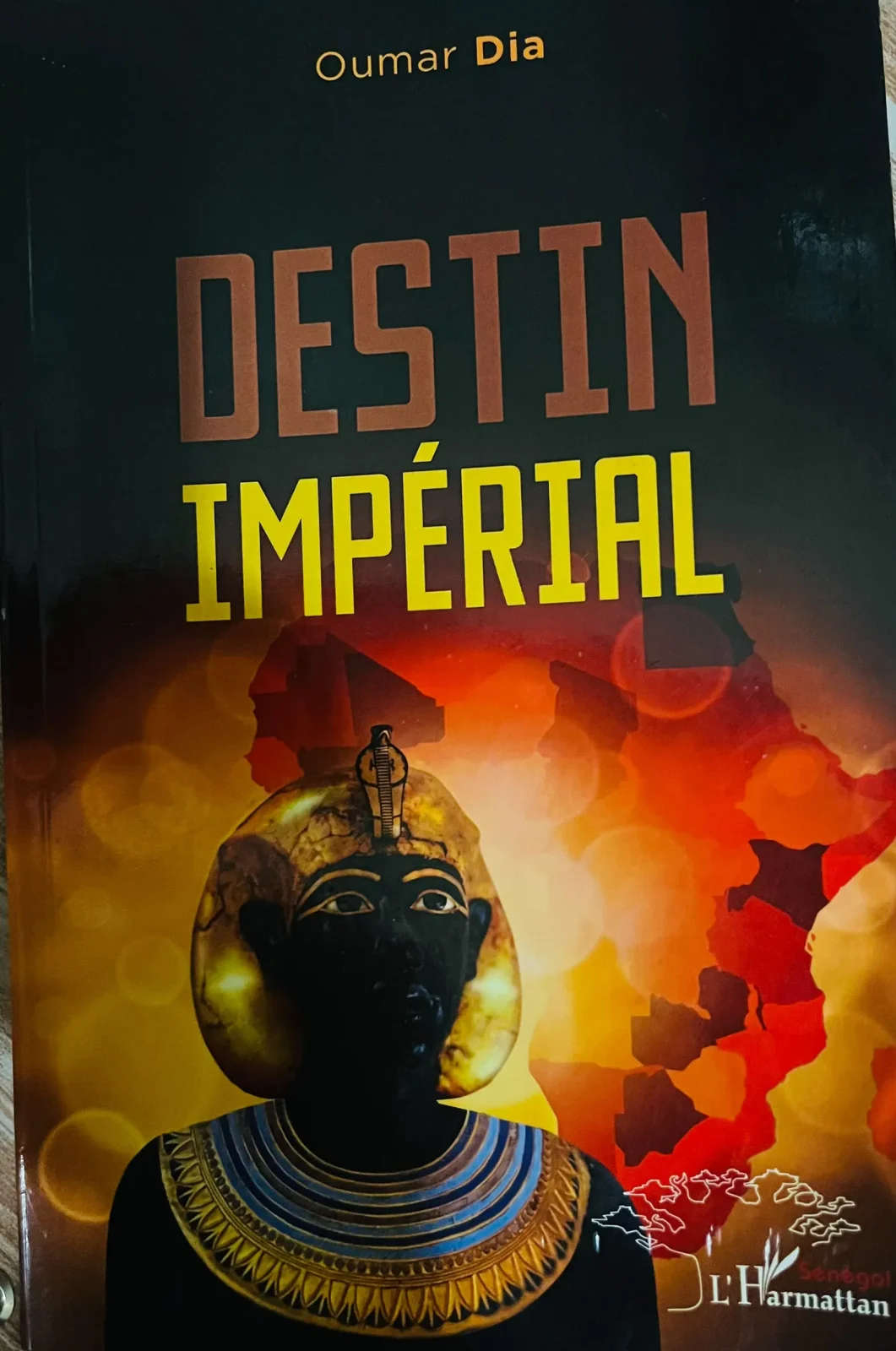
Oumar Dia in the wake of an old African ambition September 1, 2026
With “Imperial Destiny”, published in 2024 by L’Harmattan, Oumar Dia delivers a 625-page work which is at once a political essay, a prospective reflection and a meditation on power. Electronics engineer, trainer and self-taught, the author brings science, technology, artificial intelligence, education, African unity and history into dialogue. A teeming intellectual enterprise, which invites us to discuss less a fixed doctrine than a certain idea of the future of the continent.
An Africa of more than a billion inhabitants, rich in resources, crossed by energies, languages and intelligences, but still fragmented when it comes to influencing the progress of the world. It is in this contradiction that the reflection of Oumar Dia opens in “Imperial Destiny”, 625 pages devoted to the place that Africa intends to occupy in the world to come.
We must therefore give him the freedom of his ambition. His book does not set itself the modest task of adding a few pages to the abundant literature devoted to African difficulties. He would like more. The work lives up to its title.
Because it is a question of destiny, but of a destiny which would not fall from the sky. At Oumar Dia, the future does not wait. He prepares himself, organizes himself and conquers himself.
Africa cannot hope for a new place in the concert of powers without reviewing its structures, training its skills and developing the scientific and technological means of its ambitions.
The author’s journey helps us understand this way of thinking.
Self-taught born in Podor
Oumar Dia is an autodidact born in Podor, at the same time electronics engineer, laboratory man, trainer and writer. This multiple profile is found in “Imperial Destiny”.
The author does not think as a specialist locked into a field. He moves from one question to another, convinced that the major African problems communicate with each other.
Political weakness is not separate from economic weakness. Technological dependence has consequences for sovereignty. Insufficient training limits the capacity for innovation. And the absence of real scientific power ends up weighing on the whole.
At the center of the work is African unity. The theme is old. He nourished the great speeches of Pan-Africanism, inspired generations of intellectuals and animated the continent’s political struggles.
But Oumar Dia gives it a particular orientation. Unity is not only a matter of common memory or fraternity between peoples. It must produce institutions, capacities and collective strength.
The author thus evokes a “macronational unity” based on States called to be “merged and meshed”.
The thought naturally refers to Cheikh Anta Diop. For the author of “The Economic and Cultural Foundations of a Federal State of Black Africa”, the political unity of the continent was no more a simple sentimental aspiration.
It constituted a condition for the survival and development of Africa in a world organized around large groups.
Oumar Dia is, in his own way, an extension of this question. The contexts have changed. The challenges too.
The professor’s world was marked by independence, the Cold War and the first hopes of African integration. That of Oumar Dia is crossed by the digital revolution, artificial intelligence and the global battle around technologies.
But the same concern runs through these two horizons: can a politically fragmented Africa really control its destiny?
Where Cheikh Anta Diop placed the question of the federal state at the heart of his project, Oumar Dia places more emphasis on contemporary instruments of power.
Unity remains necessary, but it must now be accompanied by a scientific and technological capacity commensurate with the changes of the century.
One of the most current aspects of “Imperial Destiny” is sovereignty. For a long time, the latter was thought of through the territory, the army or the institutions. These dimensions remain essential.
But the contemporary world has added other fault lines. Who produces the technologies? Who controls the data? Who designs artificial intelligence systems? Who owns the infrastructure necessary for the circulation and processing of information?
Behind these technical questions lies a considerable part of the autonomy of States. Oumar Dia sees this as a major challenge for Africa.
The continent cannot be satisfied with importing technologies produced elsewhere.
Unity, this old idea that never dies
It must train the skills capable of understanding them, adapting them and, above all, designing new ones.
Artificial intelligence, for example, does not constitute a simple IT tool here. It appears to be one of the territories where part of the future balance of power is already being prepared.
“Those who master the most advanced technologies will have a considerable economic, scientific and strategic advantage,” he says.
In the work, the author also places an important place on training and the acquisition of multidisciplinary skills. He refuses, in essence, the idea of knowledge fragmented into hermetic territories.
The engineer, the scientist, the economist and the political decision-maker must be able to understand each other and work together.
This question of training recalls, here again, a concern dear to Cheikh Anta Diop for whom, no African renaissance can do without a scientific elite capable of supporting the development of the continent.
One of the most unique aspects of “Imperial Destiny” lies in the meeting of registers rarely brought together.
On the one hand, the author talks about science, electronics, advanced technologies and artificial intelligence. On the other hand, the work gives space to mystery, the supernatural and a certain prophetic dimension.
This coexistence is surprising. It can also destabilize a reader accustomed to clearer boundaries between scientific rationality and other forms of thought.
Ambition and its dizziness
But it contributes to the identity of the book. But Oumar Dia does not want an Africa that would access modernity by getting rid of what constitutes the depth of its imagination.
For him, technology does not imply the erasure of memory, even less the abandonment of the great spiritual figures who shaped African consciousness.
On the contrary, he seeks to reconnect with their thinking, their relationship to the sacred and their conception of power, in an approach where faith remains the foundation.
“Imperial Destiny” is a book that thinks big. This is its first quality. Thinking together about African unity, education, science, technology and power means not being satisfied with immediate answers. Oumar Dia prefers to open up perspectives.
But a vision, no matter how stimulating, always meets the ground in the end. How can we politically bring together states with sometimes divergent histories, institutions and interests? How to finance true scientific sovereignty? How can we prevent the technological revolution from further widening inequalities? How to transform a continental ambition into institutions capable of functioning? These questions constitute the area of friction between the dream and its realization.
Amadou KEBE
