
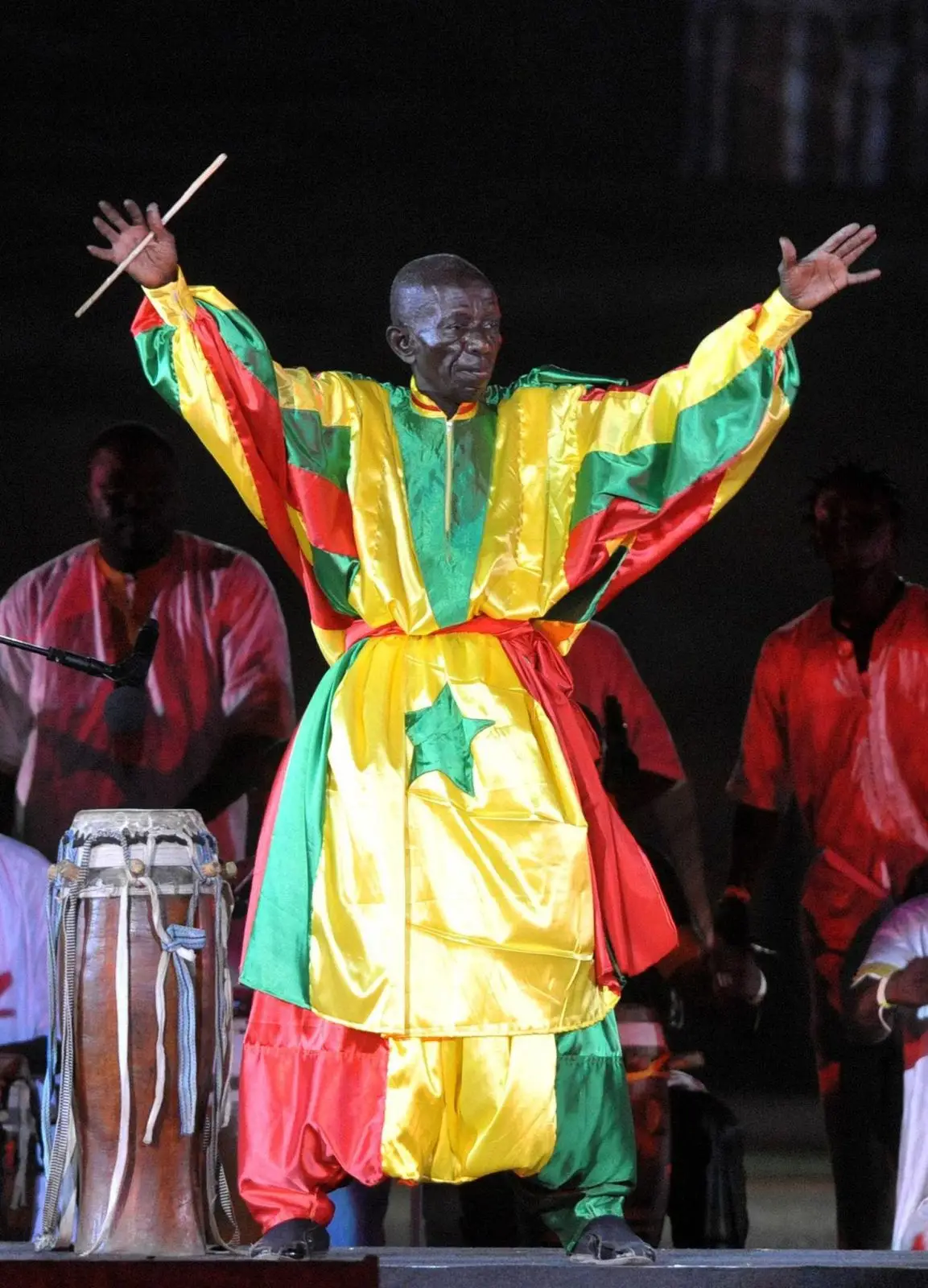
From the sabar to the big international stages, the exceptional legacy of Doudou Ndiaye Rose August 19, 2026
August 19, 2015 remains a significant date in the history of Senegalese culture. That Wednesday, Dakar lost one of its greatest ambassadors: Doudou Ndiaye Rose, whose real name is Mamadou Ndiaye. The master of the sabar died at the age of 85, after falling ill, at the Aristide-Le Dantec hospital.
Born in Dakar and from a family of griots, Doudou Ndiaye Rose devoted his life to the drum. Very early on, he learned about percussion and made the sabar his instrument of choice. Over the years, he became an essential figure in traditional Senegalese music and established himself as an outstanding conductor.
Nicknamed the “drum major” and the “mathematician of rhythms”, he was renowned for his ability to lead dozens of percussionists simultaneously and to construct rhythmic architectures of great complexity. His art went beyond the borders of Senegal and contributed greatly to making sabar known on major international stages.
Read also: PAPE MALICK THIAM, AUTHOR OF THE BOOK DOUDOU NDIAYE COUMBA ROSE
His career is punctuated by prestigious meetings. Doudou Ndiaye Rose has notably collaborated or shared the stage with international artists such as Miles Davis, the Rolling Stones, Peter Gabriel and Dizzy Gillespie. He also takes part in major cultural events, including the celebrations of the bicentenary of the French Revolution in Paris in 1989.
His name remains closely associated with major national events. He notably left his mark on official ceremonies and parades, becoming over time a true percussion institution.
His talent and work have earned him international recognition. In 2006, UNESCO classified it among the “Living Human Treasures”, thus recognizing the exceptional place it occupied in the transmission and preservation of Senegalese cultural heritage.
Doudou Ndiaye Rose was also a smuggler. He created a percussion school in Dakar and trained several generations of drummers. He also innovated by forming a female percussion orchestra, helping to expand the practice of drumming beyond traditional frameworks.
But it was on August 19, 2015 that his own rhythm stopped. The news of his disappearance fell in the afternoon and plunged the Senegalese cultural world into consternation. Just the day before, he had appeared publicly at the funeral of his friend and traveling companion, the percussionist Vieux Sing Faye, who died on August 18, 2015. Twenty-four hours later, Doudou Ndiaye Rose also disappeared.
The next day, August 20, 2015, Dakar paid him a final tribute. After the funeral prayer, he was buried in the Muslim cemetery of Yoff.
Eleven years after his disappearance, August 19 remains the date when Senegal lost a drum legend. But the rhythm of Doudou Ndiaye Rose continues to resonate in the sabar, in the orchestras he inspired and in the generations of percussionists to whom he passed on his knowledge.
YEAR
