
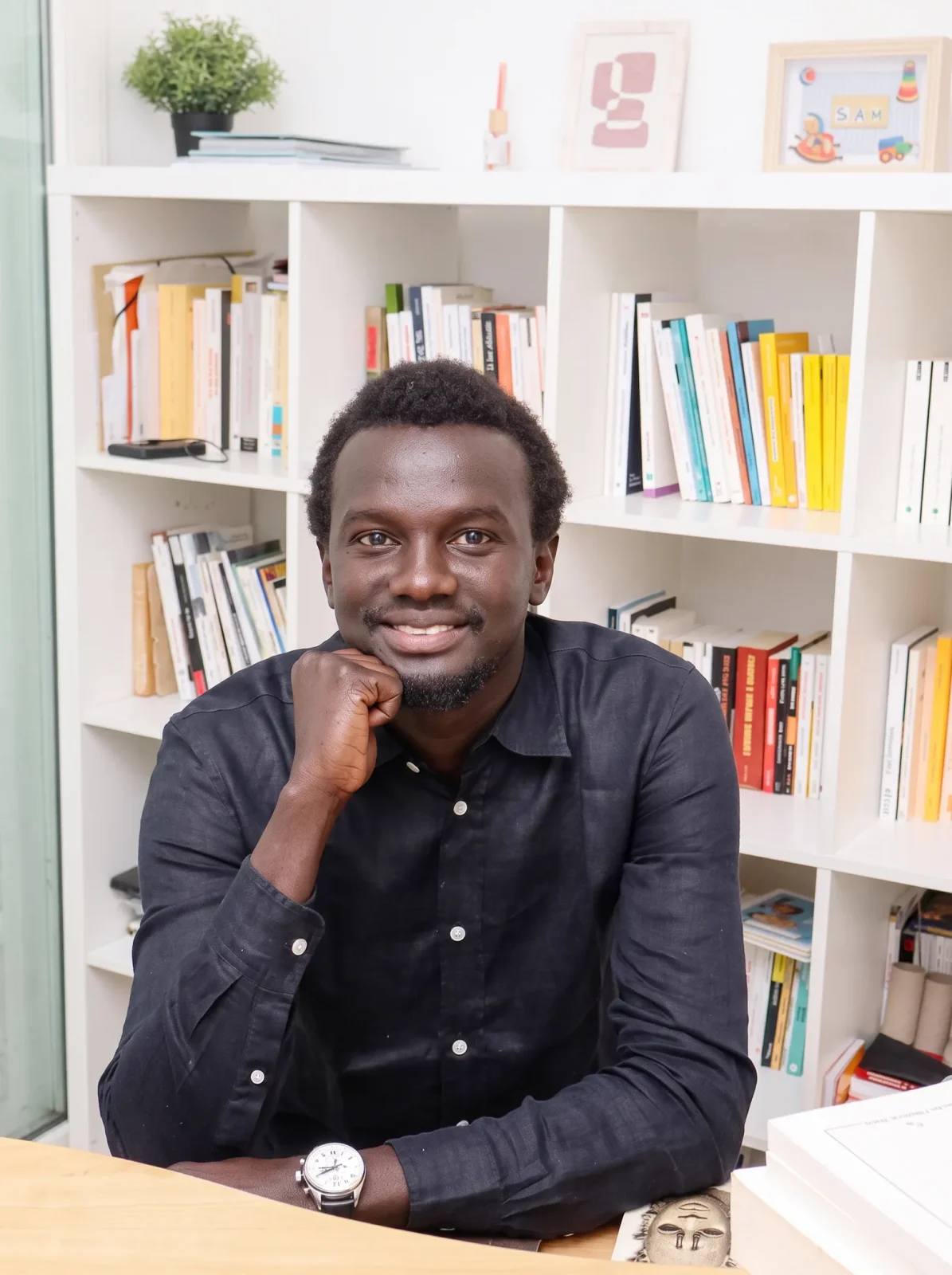
Elaz Ndongo Thioye, a life under the sign of the poem August 23, 2026
Elaz Ndongo Thioye has this curious habit of never leaving an idea alone. One book leads to another, one conversation opens another door, one question ends up producing three. Baudelaire spoke of this “childhood rediscovered at will” to define genius. With Elaz, it seems above all a way of remaining curious, of still being surprised and of taking things seriously without taking oneself too seriously. This portrait tells of a man who has read a lot, remembered a lot and who continues to ask questions as if no one had yet taught him that one day he had to stop.
For Elaz Ndongo Thioye, poetry ended up blurring the boundaries between the man and the one who writes. When we ask him who he is when he is not a poet, he begins by laughing. “To play the game, I would say that I am the father of a little boy (Sam) and I hope to be a good husband to my wife,” he pledges. The rest comes with a more professional precision, because he is a professor of Modern Literature in the academy from Orléans-Tours for three years, doctoral student in semiotics at the University of Limoges.
In social life, he also claims his taste for humor, just to bear, like Baudelaire, “the horrible burden of Time which breaks (our) shoulders”. This entry resembles him. It mixes seriousness with jokes and daily family life with the big questions which run through his work. Poetry, however, remains the big thing. Not necessarily the one he would have chosen. The one to which he found himself linked. “This moment has not yet arrived”, he replies when asked when he understood that poetry would be more than a passion. He holds to this word, passion, which he reduces to its etymological meaning: “action of undergoing, of suffering”. And he blurts out, with disarming simplicity: “Without any figure of speech, I endure poetry. So much the better ! »He still doesn’t know which of the two chose the other.
“The truth is, I don’t know if it was me who chose poetry or if it chose me. Never mind ! “At the beginning, there was mainly grief. He put his emotions out without even knowing that a literary genre was welcoming them. Over time, he understood that poetry was “the only literary genre that could contain and transmit” what he needed to evacuate. The young man was writing before even knowing exactly what he was becoming; To understand this relationship, we must return to Louga.
“Louga is the city of my heart,” he says. The city of childhood, the one that shaped the “man” that he became. He began writing there in middle school, with rap texts scribbled in his notebooks. He speaks of a “childhood kingdom,” summoning Senghor. This kingdom has not remained behind him. “Poetry, or writing in general, very often emanates, in a conscious or unconscious way, from old memories of this kingdom “, suggests Sam’s dad. Louga thus occupies a place that goes beyond nostalgia. It represents a first library, made up of places, faces, sensations and memories even before books take their full place. Elaz studied Modern Literature at Ucad up to a degree before continuing in linguistics and semiotics. These disciplines sharpened his attention to language. “My training in Linguistics and Semiotics has certainly added added value to my writing in the sense that it gave me the flair to pay more attention to words and their meaning. »
But academic knowledge must remain in its place. “In my writing laboratory, I always try to submit all these academic disciplines to the great service of the Poem. The opposite would be anti-poem,” he philosophizes. This formula of the “writing laboratory” says something of his temperament. There is the work of the word, the reflection on the meaning, the rhythm and the construction of a textual genetics.
A missed goodbye
His books recount the transformations of this relationship. Douces cacophonies still carries the hesitations of the beginnings: “We venture, we seek ourselves, we explore ourselves, we doubt, we make mistakes”. With “Cantiques crépusculaires”, he gave himself more freedom, in particular by loosening the weight of rhyme to work on the richness of rhythm. “Three times, I failed to say goodbye to the poem” takes the form of a river poem and establishes more clearly the themes of death, memory, remembrance and forgetting. We then measure the progress we have made.
The first book still belongs to learning. The second seeks freer music. The third confronts deeper questions, those that touch on disappearance and memory. The title of this third collection contains an element of confession. After each book, Elaz Ndongo Thioye thought about stopping writing. “It was hardly a marketing stunt but a sincere and persistent feeling.” His relationship with poetry has long been “very conflictual.” However, the divorce never took place. ” But I’m still writing and that’s good news. Our conflict is becoming more and more peaceful,” reassures the poet.
“In The Alphabet of the Void”, his fourth collection published this year, he pushes this contradiction to its final consequences: “the poem is a tomb of memories / and torture between two hells: / always remain a poet / or / cease to be one”. This hesitation gives his journey an almost existential dimension. Leaving poetry would perhaps mean leaving part of what allows us to understand the experiences we go through. But remaining a poet supposes accepting the demands of the poem, its wounds and its questions. Between the two, Elaz Ndongo Thioye continues to write. His son bears the first name of the one he lost. The past thus enters the present without claiming to replace the absent. It is rather a matter of maintaining continuity.
Poetry plays this role for him. It welcomes the dead without enclosing life in mourning. His conception of spirituality is also open. He distinguishes faith from institutional religion as it can be perceived in collective imaginations. “Spirituality unites more than it divides,” he says. This phrase is in line with his poetic ambition which is that of starting from a singular experience to reach something universal. His readings have also nourished this sensitivity. However, he refuses to designate a writer as a unique influence. “I prefer to talk about encounters”. He cites Césaire and Senghor for their rhythm, Christian Bobin for “his ability to always reveal the beauty in simple things”, Jean Grosjean for his spirituality, Jean-Marie Kerwich for his mysticism.
He also claims “enormous respect” for the Senegalese poets of his generation who, according to him, do not seek to betray the poem. His view of contemporary Senegalese poetry is both affectionate and demanding. “It is a very dynamic poetry with good poets”, he believes. But a question concerns him: why does this abundant production exert so little influence on society? He mentions several reasons. Some proclaim themselves poets when they are published.Publishing houses and book stakeholders, according to him, give too little space to the promotion and monitoring of texts.The State, finally, does not pursue sufficiently strong policies for books and reading.
“With the involvement of the three sectors that I have just cited, poetry would be better.” There then remains this sentence, borrowed from his brother Ouzin Karbala Thiombiano and placed on the back cover of Cantiques crépusculaires: “if poetry is sacred, it is to the poet what prayer is to the faithful.” It could serve as a key to his entire journey. Poetry resists him, hurts him, consoles him, reminds him of the dead, forces him to look at life with more attention. He wanted saying goodbye to him several times. He even wrote about the possibility of ceasing to be a poet. But the poem remained.
Amadou KEBE
