
The story of a festival that became heritage highlighted June 9, 2026
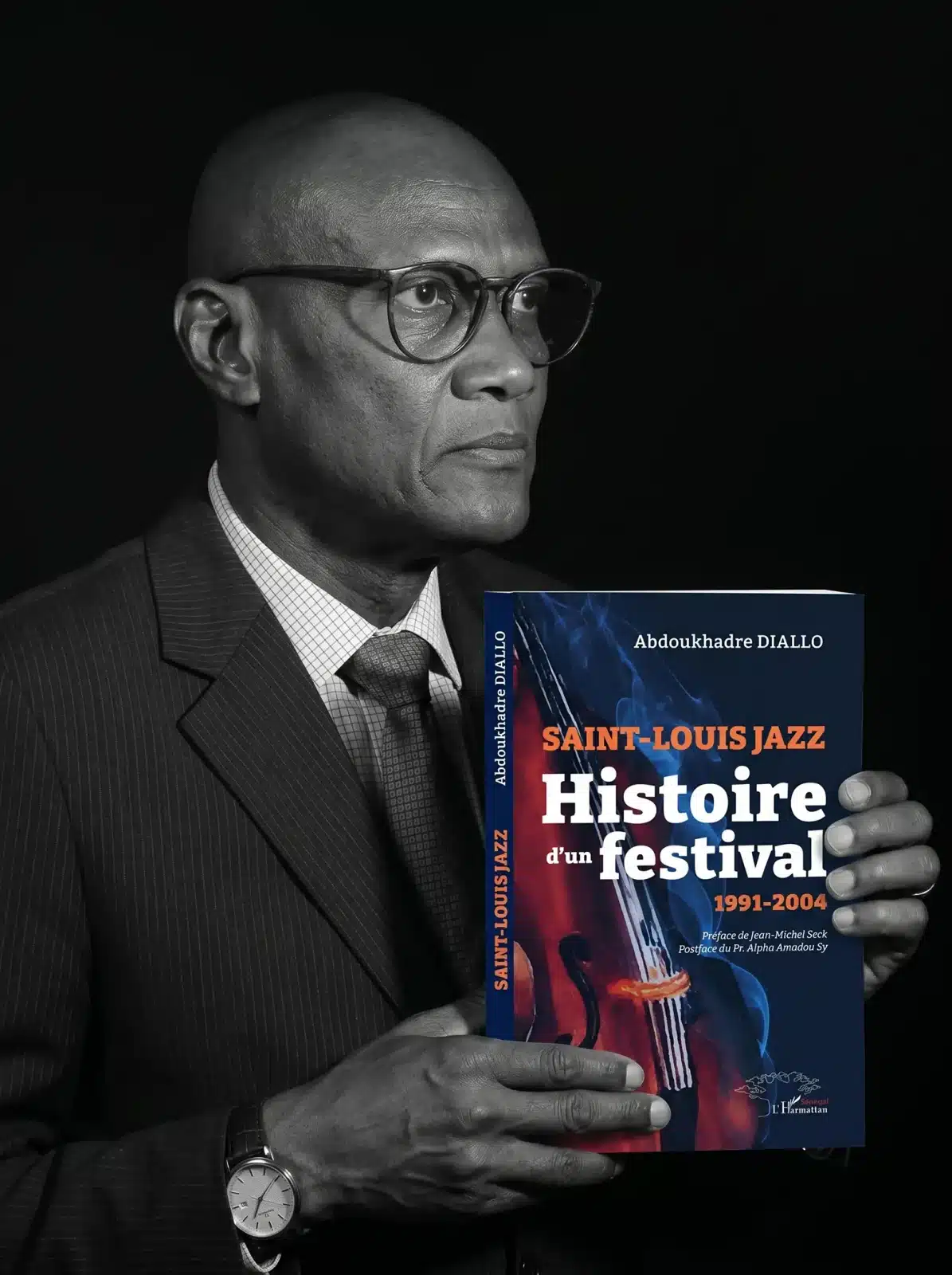
Born from the initiative of the Jazz Festival Initiative Group (Grif) in 1991, the Saint-Louis Jazz Festival has today become an essential jazz event in Africa and around the world. Through his book “Saint-Louis Jazz, history of a festival 1991-2004”, Abdoukhadre Diallo returns to the beginnings and the evolution of this “miracle which takes place every year thanks to the energy and imagination of a handful of enthusiasts”. He insists on the need to preserve and perpetuate over time this event which has succeeded in weaving bridges between styles, generations and continents.
He accustomed his readers to collections of poems. This time, Abdoukhadre Diallo went out of his box to attempt an essay, through his work entitled “Saint-Louis Jazz, history of a festival 1991-2004” whose preface bears the signature of Jean Michel Seck. As a jazz lover, he recounts slices of emotion, going back to basics to explain how this festival was established in the cartography of the Saint-Louis cultural landscape and then established itself as a cultural event of international scope.
Who better than him to talk about this flagship event which, since 1991, has transformed the 300-year-old city into the capital of jazz. Founding member of the Jazz Festival Initiative Group (Grif), secretary general of the Saint-Louis Jazz association, general director of the Saint-Louis International Jazz Festival, Abdoukhadre Diallo is one of those who carried this festival, helped it to be born, painfully, rocked it and accompanied its first steps and gave it its letters of nobility.
Festival anchored in the socio-cultural reality of Saint-Louis
According to the author of “Saint-Louis Jazz, history of a festival 1991-2004”, the Saint-Louis Jazz Festival was launched in 1991 thanks to the initiative of young Saint-Louisians, notably Pape Laye Sarr, Xaban Thiam, Ousmane Alioune Sarr, Moulaye Seck and Abdou Khadre Diallo grouped around the Initiative Group for the Jazz Festival (Grif).
They created this event with the aim of stimulating the attractiveness of their dear city, which was already a crossroads of jazz passions thanks to the flourishing of jazz orchestras (Saint-Lousien Jazz, Star Jazz, Amical Jazz, Quintet Baby) carried by artists like Pape Samba Diop Mba Gana Mbow, Dioury, Aminata Fall.
“In 1991, the Grif, with the support of Professor Driss Mackward, Ousmane Tanor Dieng then Secretary General of the Presidency of the Republic, organized a jazz evening at the Chamber of Commerce in the presence of 250 spectators. The birth certificate had just been signed,” says Abdoukhadre Diallo.
The group “Le Walo Afro” of the Valfroy brothers and pianist Xaban Thiam hosted this first edition. How far we’ve come!
In 1992, there was a second edition, during which the association included in the program activities around the festival such as the craft fair, traditional no-knock wrestling, “tanebeer”, “takusaan ndar” and regattas on the great river.
The festival had an international scope during the third edition which took place from April 15 to 18, 1993, with Roy Haynes, sacred monster of jazz, Archie Shepp, the Sclavis-Texier-Romano trio, Doudou Ndiaye Rose and Vieux Mac Faye. Unfortunately, it was not a success.
However, the criticism was well received, writes the author, and led to the creation, in 1994, of the Saint-Louis Jazz Association with the aim of “reshaping the festival and anchoring it in the socio-cultural reality of Saint-Louis”.
From 1994 to 2002, the Saint-Louis Jazz Association was chaired by Marie Madeleine Diallo, who then handed over to Abdel Kader Pierre Fall. However, the signing of an agreement with the French Cultural Center in 1998 allows the association to administer the festival.
To further professionalize the organization, affirms Abdoukhadre Diallo, a management made up of permanent staff with the support of the Support Program for Cultural Initiatives with funding from the European Union was created a year later.
The author explains throughout the pages how the image of the festival has been built and strengthened over the years through an artistic program that is both prestigious and daring.
Abdoukhadre Diallo goes back in time and reveals big names: Archie Shepp, Herbie Hancock, Liz McComb, Roy Haynes, Randy Weston, Lucky Peterson, Aminata Fall, Ali Farka Touré Africando, Mc Coy Tyner, Ray Lema, Gilberto Gil, Femi Kuti, Youssou Ndour, Yandé Codou Sène, Manu Dibango, Wasis Diop, Souleymane Faye, Pape Niang, Hervé Samb… Impossible to put them down cite all.
These names that made the festival
Thus, explains the author, Saint-Louis Jazz has become the largest jazz festival in Africa due to its ambitious and daring artistic programming, the enthusiasm of the international media and the provision of the presidential plane by President Abdou Diouf during the fourth edition.
“This fact has a popular significance rarely equaled for music perceived, rightly or wrongly, as reserved for the most informed of the elites,” writes Abdoukhadre Diallo.
However, he recognizes, the Saint-Louis Jazz Festival has not always been a smooth ride for the simple reason that funding was never secured despite promises. Which, he believes, has always forced the association to resort to a bank loan to cover the purchase of plane tickets and advances on artists’ fees.
Likewise, he adds, the festival has often struggled to raise sufficient funds from private sponsors.
The author does not hide the events that surround each edition: the craft fair, a major place of exchange in the economic life of the northern axis, the training, the masterclasses, the entertainment professions which allowed Senegalese technicians to take charge of an important part of the technical aspect of the festival.
Not to mention the production of films and reports produced on the festival which participated in the promotion of the immense tourist potential of the city of Saint-Louis. According to the author, millions of people discovered Saint-Louis through these films and reports.
The Saint-Louis jazz festival also involves cooperation with other festivals, notably Jazz à Vienne, Jazz in Mauriac, Jazz à Montauban and the Jazz à Ekaterinbourg festival, in Russia.
It is also a twinning with Dinant Jazz Nights to facilitate the emergence of jazz musicians from Saint-Louis at the international level.
And an interconnection between three festivals: Guinea Jazz Festival, Ouaga Jazz and Saint-Louis Jazz with a view to harmonizing the dates and artistic programming of the different festivals and establishing economies of scale.
The author considers that Saint-Louis Jazz is “a miracle that takes place every year thanks to the energy and imagination of a handful of enthusiasts, but also thanks to institutional and private partners.”
A bridge between styles, generations
It is also a “bridge between Africa and America”, which “was nourished by the most innovative European jazz and was mixed through African Project and the Saint-Louis Jazz Orchestra of which Ablaye Cissoko remains the most emblematic musician”.
Supported by major figures of jazz, Saint-Louis Jazz, which was held successively at the Peyrissac establishments which today houses Sonatel, at Place Faidherbe and at the Quai des arts, has thus acquired its letters of nobility and succeeded in registering itself in the cartography of the greatest jazz festivals in the world like those of Montreux, Marciac, Antibes Juan-les-Pins or Vienne.
He has also succeeded in “building bridges between styles, generations and continents”, demonstrating, over the years, that jazz is accessible, that it is far from being an elitist universe as some think.
Thus, underlines the author, the Saint-Louis Jazz Festival remains for Senegal “an excellent vector of successful cultural diplomacy”.
Hence the urgency, according to him, that “the expertise of madness which reached the members of the Grif be perpetuated beyond time”.
For Professor Alpha Sy, Abdoukhadre Diallo has recorded, for posterity, his mastery of this sequence in the history of jazz in Saint-Louis. According to the philosopher, the author fulfilled his mission well.
And, in his opinion, it is now up to cultural actors, academics, researchers and political decision-makers to make better use of this contribution, to preserve and enrich this heritage that is the Saint-Louis Jazz Festival.
By Samba Oumar FALL
