
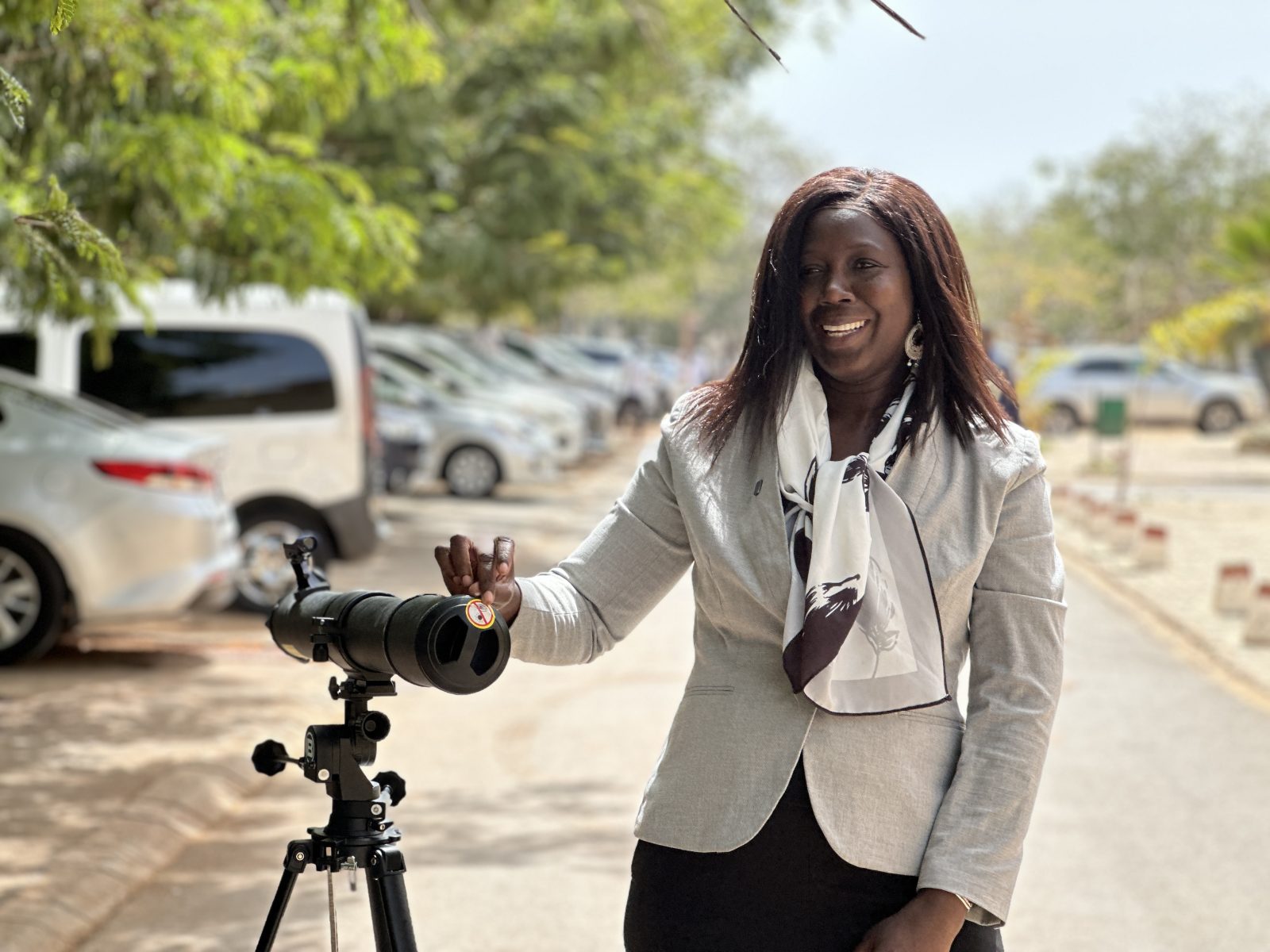
(Video) Salma Sylla, the woman who won the stars May 12, 2026
From Kaffrine’s eyes raised to the sky to the lecture halls of Ucad, Salma Sylla’s trajectory commands admiration. On May 2, she made history by becoming the first woman to obtain a doctorate in astrophysics in Senegal. Portrait of a luminous researcher who, far from locking herself in her ivory tower, places her telescope at eye level and fights for science to become everyone’s business.
“Life is beautiful, destiny departs from it. Nobody plays with the same cards. The cradle lifts the veil, many are the roads it reveals. Too bad, we weren’t born under the same star. » This verse from the Marseille rap group IAM, taken from their hit “Born under the same star”, resonates as a striking parallel with the trajectory of Salma Sylla. Because if millions of people grew up under the same sky as her, the paths have branched. While some have experienced the fate of a wandering star, condemned to wander in a universe that is not theirs, Salma has conquered hers. This conquest came to fruition on May 2, 2026, in the amphitheater of the Cheikh Anta Diop University (Ucad) in Dakar, where she defended her doctoral thesis entitled: “Study of transient phenomena in astrophysics: impact flashes and binarity in the RR Lyrae stars”. Words that make the uninitiated dizzy, but whose meaning is clear: Salma Sylla is now the first Senegalese Doctor in astrophysics.
“May 2, 2026 represents a fundamental day in my scientific career, because it is the day when we validated the work of a lifetime. What had a deep impact on me was the relief I felt, buoyed by all the support I received. All the players in the space field were present, such as Professor Gayane Faye, Maram Kaïré…” she said, smiling.
Pioneer
An event celebrated as a founding act in science, but not only that. Indeed, the resonance also goes to the past, to Kaffrine, where it all began. While she was at her grandparents’ house, young Salma literally had her head in the stars. “Since I was little, I have been fascinated by space. I was in the Kaffrine region with my grandparents, at a time when electricity was rare. At night, we stayed in the open air, and I looked at the sky trying to count the stars. Astronomy has always fascinated me. Even in college, in Thiès, I read books about space. It was at university that I made the connection, after attending an international conference where I met a Belgian astrophysicist, Professor Katrien Kolenberg. At that moment, I realized that there was a discipline that encompassed everything that fascinated me. The inspiration came from there. I discussed it with my mentor, Professor Ababacar Sadikh Ndao, who encouraged me. Unfortunately, I could not embark on a doctorate in astronomy at the time, because the conditions were not yet met in Senegal. “, she confides moved.
Salma Sylla’s journey is that of a woman who has never stopped moving forward. After her S2 Baccalaureate at the Malick Sy high school in Thiès, she joined the Faculty of Science and Technology at Cheikh Anta Diop University in Dakar where she obtained an engineering diploma in telecomputing. Salma then worked for ten years in the Department of Computing and Information Systems at Ucad, a decade seemingly far from the stars, but which forged a rigor that research would reward. In 2011, she returned to her studies and obtained a Diploma of Advanced Studies at the Institute of Applied Nuclear Technology, with a dissertation on light-emitting diodes in optical imaging. The doctorate in astrophysics was only a matter of time.
Now a pioneer, she measures the weight of this title. “It’s a responsibility. A role model must always set a good example, but also open up opportunities. Leading the way is a moral duty. I have to show young girls that they can do it, if they want to,” she says.
Popularize science
Astronomy is a complex science, but Salma Sylla is convinced that it can speak to everyone. During our visit to the Faculty of Science and Technology at Ucad, she gave a beautiful illustration of this: after our interview, she offered an observation of the sun through her telescope, distributing solar glasses to curious people who passed by, taking the time to explain the visible phenomena to a group of students gathered around her. “Astronomy concerns everyone. It must be inclusive and accessible, especially for children and young girls. The more we advance in scientific circles, the fewer women we see there. This must be remedied. If we want to advance astronomy, women must be fully integrated, through training and prizes that motivate them,” she says, also pleading for closer collaboration with amateur astronomers. “They are passionate, they observe the stars and record valuable data. When it comes to interpreting them, that’s where scientists come in.”
This dynamic remains, however, suspended on one condition: having the necessary infrastructure. For her doctoral research, Salma had to go abroad due to the lack of an astronomical observatory in Senegal, even though a project is underway. In the meantime, she is taking advantage of her passion, and trying to pass the torch to create vocations, particularly among young girls who are still looking for their path. “You have to learn, love scientific subjects, and also know one fundamental thing: science is not the prerogative of an elite category. Whatever our origin, we can get involved in science. My message is that science is there for everyone. We need women in science. I encourage young girls to choose science subjects, because unfortunately, the representation of women is minimal in high scientific circles. Don’t be afraid, the opportunities are there,” she says.
The astronomer observes the stars. And when she scrutinizes her telescope to look at the others in the sky, Salma Sylla will be like facing a mirror. Because the stars she sees will be like a reflection of her own light, incandescent, luminous, illuminating.
Oumar Boubacar NDONGO (Text) and Djamil THIAM (Photo)
