
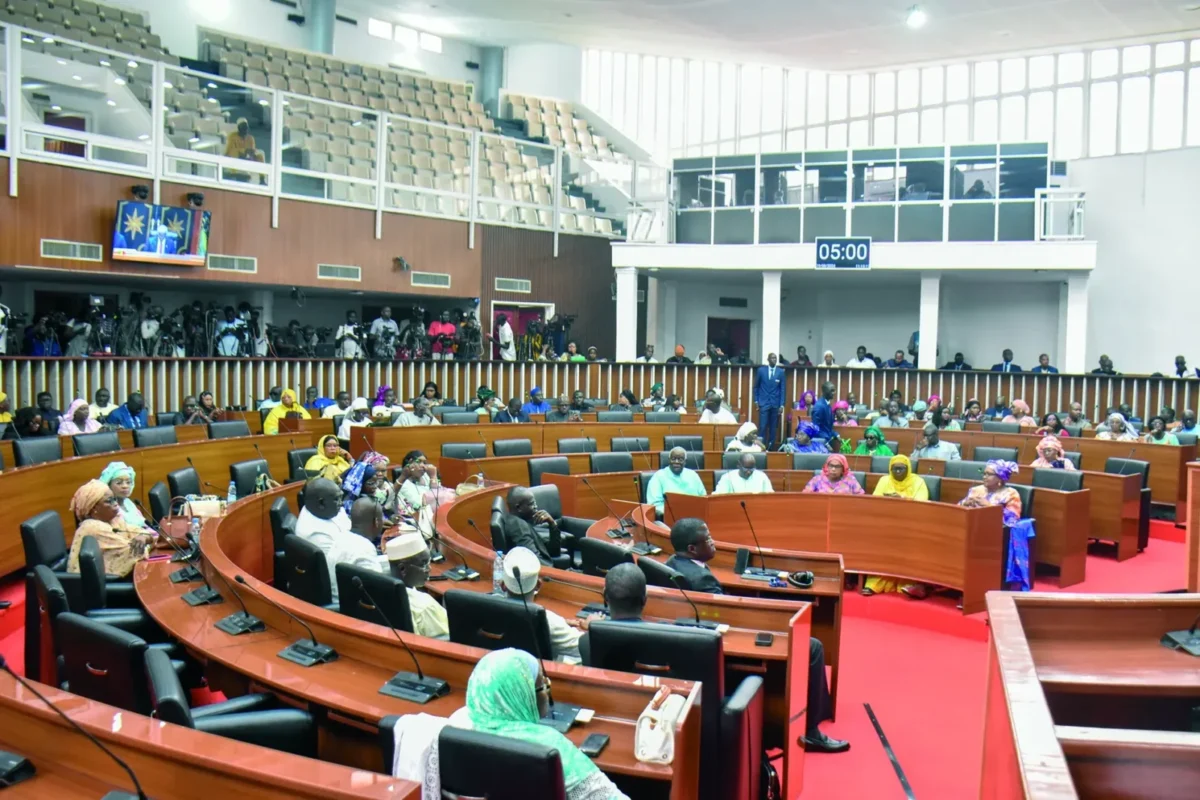
Absenteeism of deputies: a reform to put an end to empty seats in the hemicycle
The National Assembly of Senegal is preparing to considerably toughen sanctions against absentee deputies, through a bill modifying article 118 of the Internal Regulations, adopted Wednesday in the Law Committee and expected in plenary session this Friday.
Supported by deputies Mohamed Ayib Salim Daffé and Aïssata Tall, the reform aims to “restore the credibility” of the parliamentary institution, in a context of recurring criticism of the empty seats observed during work in the hemicycle.
In his report presented to the Law Commission, rapporteur Yongar Dione insisted on the requirements of “exemplarity”, “transparency” and “accountability” of elected officials. According to the authors of the text, parliamentary attendance constitutes an obligation directly linked to the exercise of the mandate.
The reform provides for a stricter control system for absences, with a system of progressive sanctions. MPs absent without valid justification could in particular see their parliamentary allowances suspended after several repeated absences.
The text also introduces a contradictory procedure: before any sanction, the MP concerned must be informed of the grievances held against him and can present supporting documents.
But the most debated provision concerns the possibility of an “automatic resignation” for parliamentarians accumulating a high number of unjustified absences, mentioned around ten sessions. Such a measure could result in the loss of the parliamentary mandate.
Several elected officials expressed reservations about the constitutionality of such a mechanism, believing that a mandate given by the people cannot be withdrawn by a simple internal disciplinary procedure.
The promoters of the reform, however, maintain that this provision already exists in the current regulation, but that it required greater precision and legal supervision.
The text recognizes several reasons for legitimate absence, including illness, parliamentary missions, legal obligations, cases of force majeure or certain serious family events. A specific regime could also be applied to deputies from the diaspora due to constraints linked to geographical distance.
SG
