
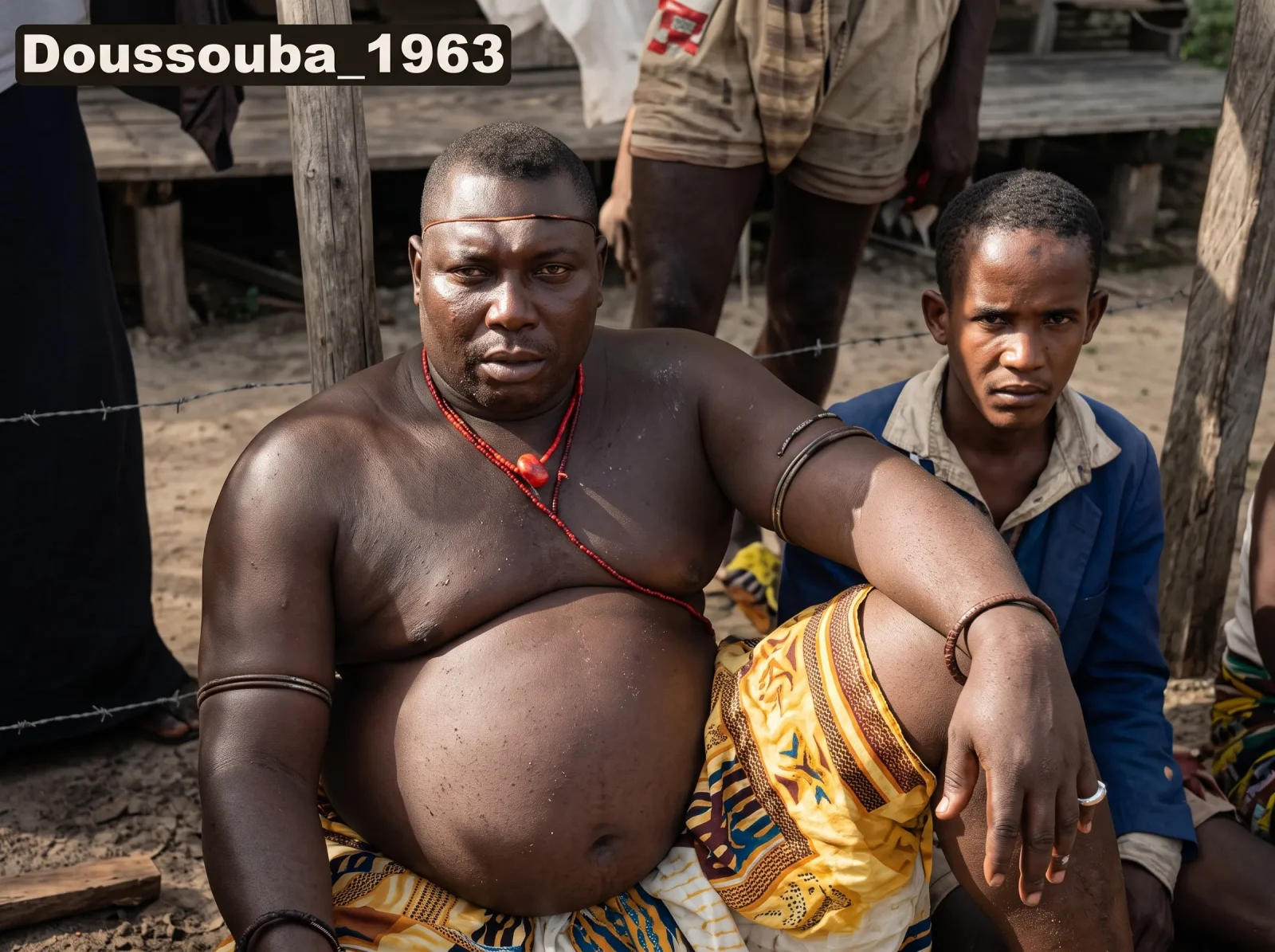
When Fodé Doussouba reigned over the arena (1/2) September 1, 2026
From Fouladou to the arenas of Dakar, Fodé Doussouba reigned as absolute master over Senegalese wrestling in the 1950s. A 138-kilo colossus with sharp technique and a mystical aura, this invincible king of “mbapatt” fell only once, one evening in April 1958. Unknown mentor of legendary figures like Falaye Baldé, this giant with a heart d’or has etched his name in the history of traditional Senegalese wrestling. Return to the journey of an extraordinary champion whose memory today demands its rightful place.
It is enough to pronounce his name in Pikine to see memories resurface of another era of Senegalese wrestling, that of “mbapatt” (traditional wrestling without striking) and the great popular tournaments where the fights were recounted long after the fall, and where the words of the elders almost constituted archives.
Fodé Baldé, known as Fodé Doussouba, the champion of the 1950s, left a real mark on the arena. Born in Salikégné (border village with Guinea-Bissau), about thirty kilometers from Kolda, he died in 1985 in Pikine. In civil status, his name was Fodé Baldé; Doussouba, his mother’s name, had become his champion name.
Read also: Fodé, the shadow behind Falaye Baldé (2/2)
Salikégné, his native village, also has a unique history. According to the family story, the locality was created by Mandingos around 1900; its name would be formed from “Sali” (prayer) and “Kégné” (sand). It is in this region that Fodé begins to make a name for himself.
In 1951, he dominated tournaments in Kolda and the surrounding area. His ambition subsequently led him beyond the borders of Senegal: he made a notable visit to Gambia, then to Guinea-Bissau.
The young champion had already acquired great notoriety when he headed for Dakar, preceded by a detour via Tambacounda thanks to El Hadji Touré. Once in the capital, he had several places to stay: Tilène, then Yoff at El Hadji Mbor Gningue (son of Birame Gningue), before settling permanently in Pikine. His house there will become, over the years, a place of memory, even of pilgrimage.
When he arrived in Dakar, Fodé Doussouba immediately impressed with his physique: 138 kilos. But to reduce it to its mere stature would be to miss the point. His relatives and the elders whose memories we have collected insist on his immense technical range: he excelled in holds like the “nodiou” (a technique of grabbing and pulling by the neck or the loincloth), the “khatarbi” (a blocking action combined with a pivot), the “caxabal” (tripping), the “mboot” (the hip or the backpack technique) and the “mbooti” (a small sweeping hip).
Behind the giant hid an outstanding technician.
ASSAULT ON DAKAR
Its power was coupled with a mystical reputation which contributed to its legend. Some of his brothers say that he had a ring with which he identified the gris-gris buried by his adversaries. These stories belong to the memory and beliefs of the time, but they bear witness to the image he had constructed: that of a wrestler difficult to reach, to understand and above all to beat.
His reputation grew quickly and, in less than two years, he cleared the air around him. His cousin Sadio Baldé estimates that he fought more than a hundred fights alongside the generation of Bécaye 1, Doudou Baka Sarr, Madou Ndiongue and Diakhate.
His wife, Maïmouna Bâ, states that Fodé had dominated several renowned opponents, including Bécaye 1, Doudou Baka Sarr and Nguiring-Nguiring Cissé, a Hausa wrestler with an impressive build. She remembered her worry before this fight, fearing that this strong fellow would put her husband in difficulty; Fodé had finally gained the upper hand.
Another source reports that in 1958, he also dominated Modou Pouye in Ndiarème (Diourbel).
His journey remains, however, surrounded by some gray areas. Testimonies differ in particular on his confrontations with Doudou Baka Sarr: some close to the latter report two fights, resulting in a victory for Doudou Baka in the first and a draw in the second, while Maïmouna Bâ strongly maintains that the two wrestlers had only faced each other once and that her husband had won.
In the absence of written documents, the controversy remains. One thing, however, is hardly in dispute: Fodé Doussouba had imposed his law.
In Dakar, the question was no longer whether he was a champion, but who could stop him.
It was then that eyes turned to Demba Thiaw Diène, Yoff’s darling child. Born in 1918, the latter had abandoned wrestling to devote himself to fishing in Kayar. Faced with the undivided domination of Fodé, the Lebou dignitaries saw in him the ideal profile to take up the challenge.
Ndiaga Samb, a Yoff notable respected for his wisdom, now deceased, said that the Lébous had mobilized to find the one who could put an end to this hegemony.
Demba Thiaw, who did not really know Fodé, first wanted to see him at work. Taken to the Senegalese Arena after being received by the dignitary El Hadji Ngom Ndoye, his verdict was clear: he believed he could beat him several times and in different ways.
A mobilization then formed around him which, in Ndiaga Samb’s stories, took on an almost epic dimension: all of Cape Verde was put in battle order, with 121 Lebou villages and 23 Safefene Serer villages mobilized to support this challenge.
The meeting is set for April 18, 1958.
That day, the myth collapsed. Demba Thiaw manages to mow down Fodé with his left foot; the giant falls on his right side, his two hands touching the ground.
For witnesses, the fall was enough to confirm the feat. The colossus, previously presented as invincible, has just experienced the only defeat of his sporting career.
Maïmouna Bâ recounted that, in the night before the fight, Fodé had woken her up to tell her that he was going to fall, while specifying that his fall would not be clear.
The champion did not give up however and demanded his revenge in 1959. This second confrontation ended in a draw, according to Ndiaga Samb.
Eyewitnesses say that Demba Thiaw saw three Fodé Doussouba in front of him and that he was advised to aim for the one on the left; a story which comes from the mystical memory of ancient battles, but which those close to Demba Thiaw report with certainty.
After this episode, his name remains that of an extraordinary champion. Samba Baldé compared him to Double Less, another great champion, finding him even more physically impressive.
But Fodé’s story is not limited to his weight or his results: it is also told through details that give flesh to the character.
When he beat an opponent, he called the photographer to immortalize the fall and avoid any subsequent dispute, a practice which earned him the nickname “Fodé Kharal Photo”.
At a time when images of combat were rare, having the fall photographed definitively sealed the verdict.
Abdoulaye DEMBELE
