
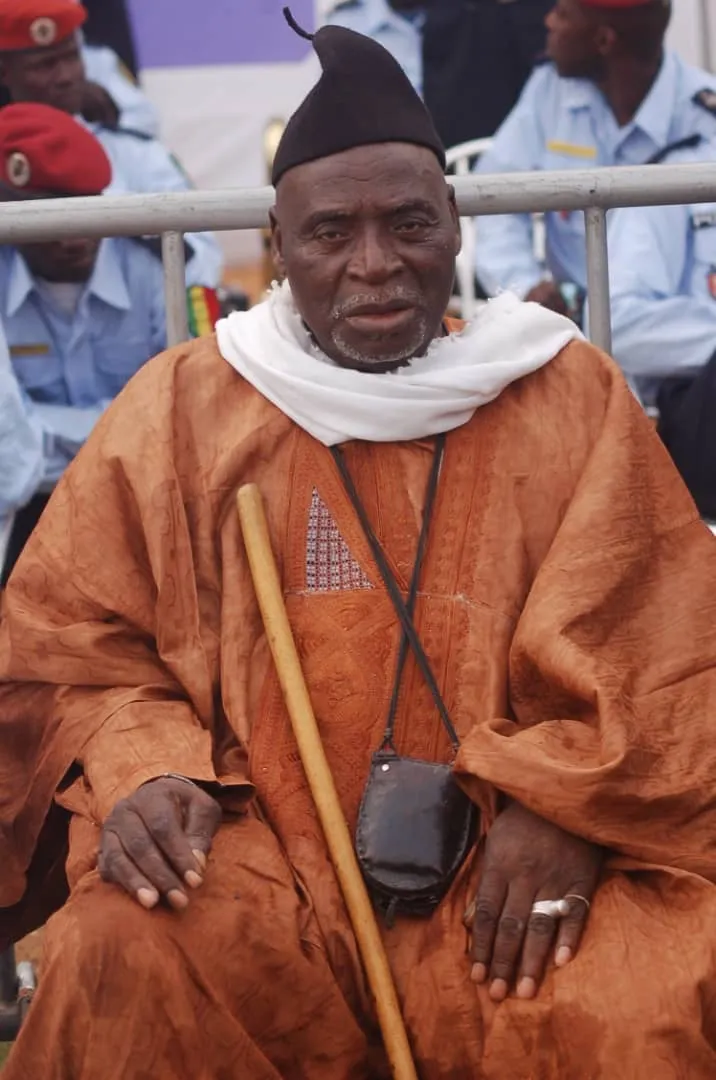
Fodé, the shadow behind Falaye Baldé (2/2) September 1, 2026
His strength also lay in his mystical arsenal. The “nguimb” he wore was not the one we know today. According to Aliou Baldé, the gris-gris were directly integrated inside the small loincloth so as to remain invisible, making this equipment an integral element of his mystical preparation.
But behind the feared champion was a man of great generosity. Samba Baldé insists on this lesser known facet of his elder. According to him, Fodé had “a heart of gold”. When a wrestler was experiencing financial difficulties, he did not hesitate to offer to confront him in order to allow him to receive a fee, thus encouraging him to approach promoters. Samba Baldé notably cites his fight against a champion named Ngary as an example of this unusual solidarity.
Today, his name survives through the increasingly rare stories of those who knew him. His journey remains, however, difficult to reconstruct with precision; which underlines the fragility of sports memory when it is not documented. Unlike Double Less or Falaye Baldé, whose sons extended the name, Fodé did not have a direct heir capable of taking up his torch.
Read also: When Fodé Doussouba reigned over the arena (1/2)
This did not, however, prevent young members of the Baldé family from taking an interest in wrestling: among them, Fils de Fodé (resident of the Falaye Baldé stable in Pikine), as well as Séga Baldé and Yemzo Baldé (the latter being presented as an outstanding technician), unfortunately cut down at a very young age by an electrocution.
Thus, the name of Fodé continues to circulate in the “mbapatt” and discussions of enthusiasts. If the next generation has not reproduced his exploits identically, his memory remains intact.
In Pikine, just behind the National Arena, is the champion’s family home. For those close to him, this geographical proximity calls for a symbolic gesture: they would like the National Arena to bear the name of Fodé Doussouba, thus offering him a definitive place in the official memory of the Senegalese struggle.
Because Fodé Doussouba is one of those champions whose journey goes beyond simple statistics. He was the 138 kilo colossus from Salikégné, the one who traveled through Casamance, Gambia and Guinea-Bissau before coming to challenge Dakar and then losing to Demba Thiaw.
He was also “Fodé Kharal Photo”, the wrestler with the “nguimb” sewn with amulets, the feared champion and the generous man.
Time has passed, witnesses disappear, archives remain rare and versions sometimes diverge. But one certainty remains: Fodé Doussouba had a profound impact on his era.
And if the myth fell one evening in April 1958 under the left foot of Demba Thiaw, the legend has never died out. She continues to live in Salikégné, in Pikine, within her family and in the stories of the elders.
Fodé Doussouba remains, quite simply, one of the greatest masters in the history of the arena.
The myth fades, the legend remains
Before becoming a feared wrestling champion, Ousmane Baldé, alias Falaye Baldé, crossed paths with an elder who would mark his destiny: Fodé Doussouba. Coming from Fouladou, this exceptional champion not only reigned over the arenas; he also opened the way for a whole generation of wrestlers from Casamance and Guinea-Bissau.
Some champions are remembered for their feats of arms; others, discreetly, for the champions they helped to create. Fodé Doussouba belongs to this second category. His name is closely linked to that of Ousmane Baldé: Ama Baldé’s father would perhaps not have had the same career without this decisive meeting.
In the mid-1950s, in Salikégné (in the Kolda region), traditional wrestling gave rhythm to the lives of the people. After the harvests, the villages are transformed into arenas. Fodé Doussouba already largely dominates the debates there.
It is into this world that a young man from Gabou (Guinea-Bissau) arrives, in 1956, to work in the peanut fields. Ousmane Baldé, aka Falaye Baldé, is not yet the legend he will become, but his physique and his skills attract attention.
This is no coincidence: for the Baldés, wrestling is a family affair; his grandfather, his father and several of his uncles were great champions. “My parents had been wrestling for ages. I have wrestling in my blood. I didn’t break into this traditional sport,” he said during his lifetime.
In Gabou, he had already achieved an extremely rare feat during post-harvest tournaments: remaining undefeated for almost two months. In Salikégné, he quickly confirmed this reputation by defeating the local champions.
Among the informed observers is Fodé Doussouba. The meeting between the two men will change the course of their respective stories.
FOTÉ, THE Smuggler TO DAKAR
When Falaye arrives at Fodé Doussouba, wrestling is not his primary objective: his parents have authorized him to go and cultivate peanuts. But the passion for wrestling ends up taking over.
Fodé Doussouba, for his part, had other ambitions: after having proven himself in Fouladou, he passed through Tambacounda then joined Dakar, the great horizon for wrestlers of the time. He quickly thinks about taking Falaye with him.
But bringing the young wrestler to Dakar is not easy: Falaye’s mother is firmly opposed to it, wanting her son to finish his harvests. Fodé insisted, and departure was finally granted with a delay of one week.
On November 22, 1957, Falaye Baldé set foot in Dakar. The traditional communicator Ibou Ndiaye “Niokhobaye”, a witness to this period, confirms the determining role of Fodé Doussouba. “It was Fodé Doussouba who brought Falaye to Dakar. »
Better yet, he adds, he brought him to the capital “at the same time as Barabara, who was nicknamed the professor of the arenas. Barabara, Falaye, Mbita Baldé, Demba Baldé and Souleymane Baldé were all wrestlers in Falaye’s entourage. They all discovered the Senegalese capital thanks to their eldest, Fodé.”
Thus another side of Fodé Doussouba emerges: that of a champion capable of serving as a guide and bridge between young talents from the South and the legendary arenas of Dakar.
His legacy can also be read in the journey of those he accompanied, first and foremost Falaye Baldé, father of Jules, Pathé, Papa and Ama Baldé.
His story thus tells, implicitly, that of Fodé: that of a charismatic champion whose greatest feat was perhaps, in the end, to have contributed to the birth of others.
Abdoulaye DEMBELE
