
Dakar, anchor point of contemporary African art On Thursday, November 19, the 16th edition of the Dakar Contemporary African Art Biennial opened at the Old Courthouse (located at Cap Manuel) and continues until December 19. This year, 76 artistic proposals from the Official Selection, in addition to a Grand…
On Thursday, November 19, the 16th edition of the Dakar Contemporary African Art Biennial opened at the Old Courthouse (located at Cap Manuel) and continues until December 19. This year, 76 artistic proposals from the Official Selection, in addition to a Grand Témoin, a Carte Blanche and a Tribute Artist section, are confronted with the gaze of an audience made up of enthusiasts of contemporary creation from Africa, its diasporas and the world.
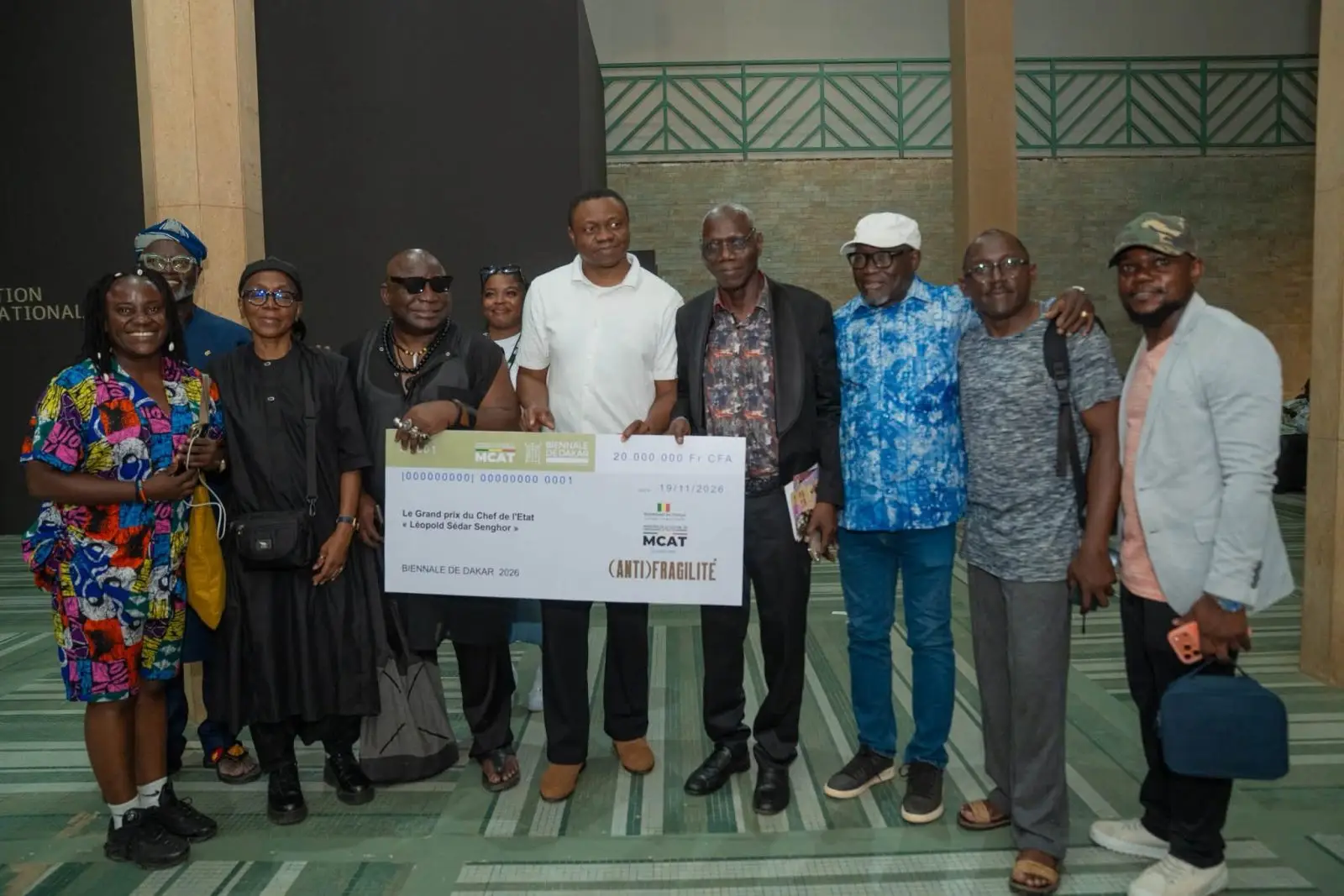
The whole of Dakar of the arts wore some of its best smiles, Thursday November 19, 2026, at the celebration of contemporary African creation. At the Old Courthouse of Dakar (Cap Manuel), early in the evening, the 16th edition of the Dakar Contemporary African Art Biennial was officially opened by the Head of State, Bassirou Diomaye Diakhar Faye. On the theme “(anti)fragility: arts of repair and strategies of backlash”, the Dakar Biennale 2026 will offer its audiences 79 artistic proposals from the Official Selection, which celebrate the creative genius of Africa and its diasporas.
There are 76 proposals from the IN Section, i.e. 54 for the International Exhibition and 22 for the Design Section, all received at the Old Courthouse. In addition to these 76 proposals, there are also three special invitations, consisting of a Great Witness, a Carte Blanche and a Tribute Exhibition. The Great Witness of this edition is the Moroccan Faouzi Laatiris, a major visual artist and figure of the School (of Fine Arts) of Tetouan, while the Carte Blanche is awarded to the illustrious Serigne Mbaye Camara, a Senegalese visual artist and an emblem of the second generation of the Dakar School.
The tribute exhibition “The Wisdom of Trial” honors the late Abdoulaye Niokhor Bob known as Ngoor (1973-2017). This section is a posthumous celebration and recognition of an exceptional artist who left in the prime of his life, but whose work still contributes to the influence of contemporary creation. A singular materialist and convinced spiritualist, his approach explored the fragility, the urgency of the creative gesture and urban memory. The exhibition will be hosted at the National Gallery of Art, being the only event to be hosted outside the Old Courthouse.
Of our contemporary creative geniuses
For the canonical exhibitions, three spaces will receive the biennialists. The Senegal Pavilion, which is being installed in a unique way at the Old Palace of Justice (Supreme Court Hall) and is curated by the artist Amadou Kane Sy, is titled “The Voice of Inaudible Temporalities”. A showcase of contemporary Senegalese creation, the national pavilion welcomes works imbued with the sap of our terroirs in their most intimate, essential and fertile ways, while allowing a glimpse of prospective paths. There you will find works by Ican Ramageli, Papisto Boy, Pape Samb and the women of Nguiéniène.
The other national space is that of the guest country of honor. The Pavilion of the Democratic Republic of Congo, “Fourth time: Time as living matter”, curated by the artist Steve Bandoma, offers a journey through Congolese history and artistic creation, from founding legacies to contemporary questions. The exhibition constructs a reading based on four essential notions: memory, resistance, invention and a fourth, consciousness, which shifts the experience towards the visitor himself. The exhibition at the State Collection, curated by Kalidou Kassé, is titled “Sunu heritage: Trajectories and memories of public collections in Senegal 1960-2026”. The selected works are considered as artistic forms, historical documents, institutional sediments and operators of collective memory. Present in the palaces of the Republic, assemblies, ministries, jurisdictions, universities, heritage structures, monuments, squares, facades and spaces of civic life, the works compose a cultural geography of the national territory.
Mamadou Oumar KAMARA
