
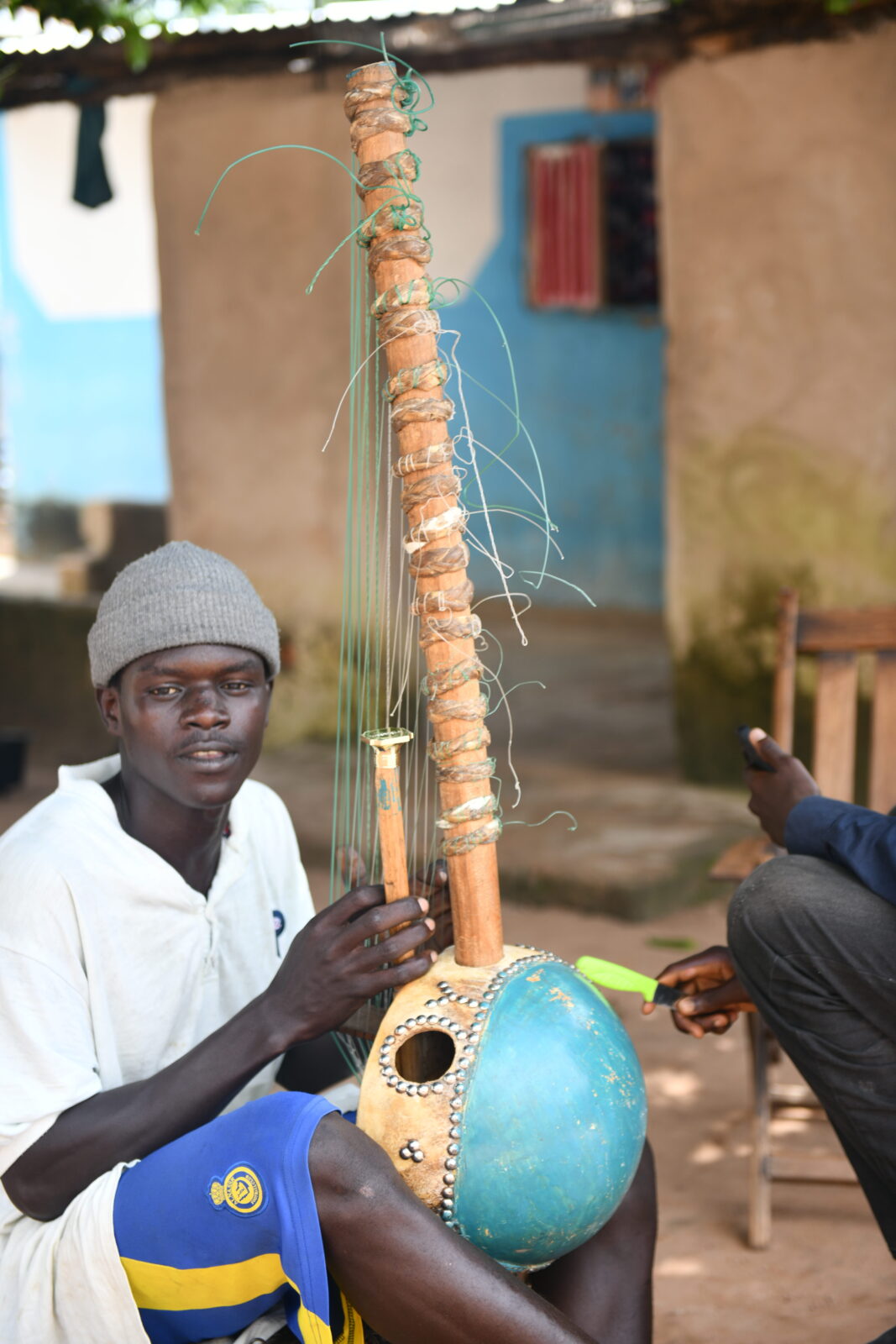
Rites and customs in Sédhiou: Darsalam, a capital of the kora (1/2)
In Goudomp, in the commune of Tanaff, the village of Darsalam founded by griots two centuries ago is an attraction for visitors. A very evocative name which means in Arabic, “house of peace” or “haven of peace”. In Darsalam, the sky looks gray on this October morning. The clouds hover over the village while the sun struggles to shine through. A dead calm reigns in this town located on both sides of the Rn6 and more than fifty km from Goudomp, the departmental capital. Darsalam gets its fame from the fact that it hosts a community of griots. From a layout point of view, all concessions built on American slopes or in round huts are identical. Darsalam has the reputation of being a quiet village leaving only room for the notes of kora which spring from the concessions to invade the public square with its sweet melody.
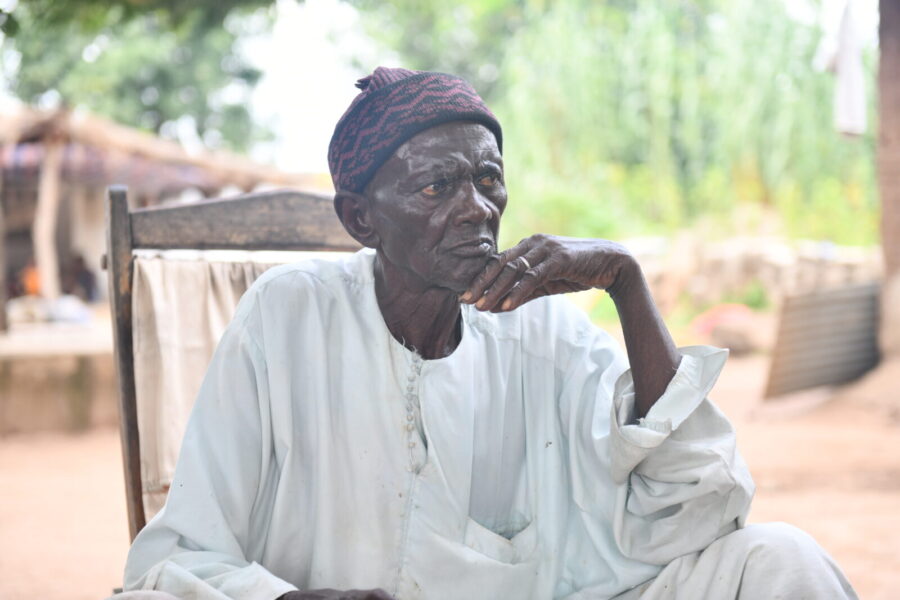
An environment conducive to reflection and creation. On this day, residents take refuge under the veranda of large houses or in the protective shade of trees. In the large house of the district chief, the women are busy with their daily tasks. Some children are playing in the courtyard while the old people are sitting near the big door of the chief’s house. As for young people, they are absent. The village chief, Cissao Kanté, inhales the fresh morning air which tickles his thick, white mustache, walking with soft steps. Age has taken possession of his body.
Face melted, the old man has already spent 84 years of life. Witness to the history of Darsalam, he informs that the village was founded by the Griotte family of Diébaté, while the Gassama officiated as imams. However, the Diébaté stole the spotlight from the Gassama with their art of strumming the strings of their koras and the power of soothing words. From their wanderings across what is the vast Casamance, the Diébaté left Kabou Tambato in the Gabou region of Guinea-Bissau to settle in Darsalam with the religious family of the Gassama. But thanks to the kora, the Diébaté family, of Mandinka ethnicity, made the village famous to the point that people even forget that this old land is also that of the marabouts. Today, Darsalam, which had only two families, has grown to 3,000 people and welcomes other ethnic groups including Balantes and Manjaks.
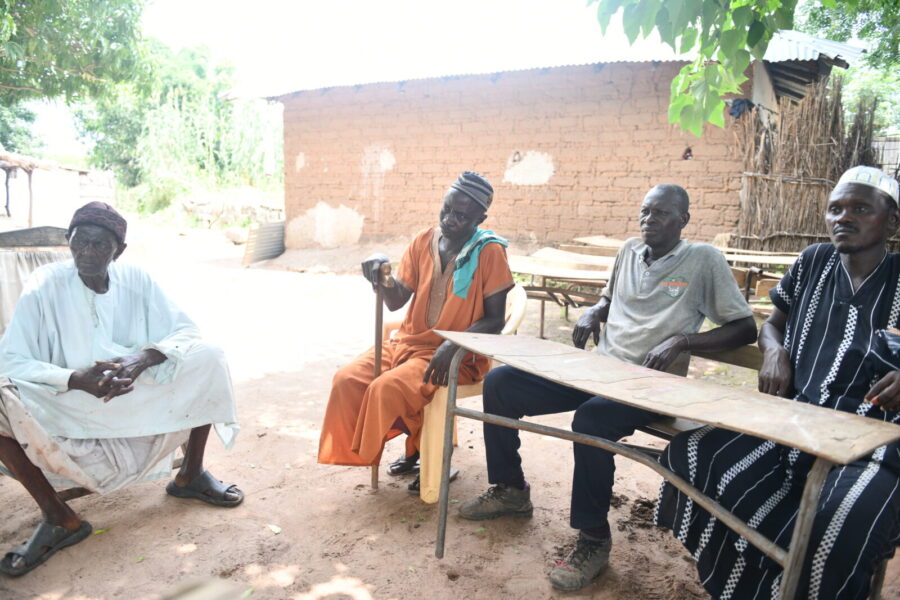
Equipped with a committee of elders, they regulate village life for a harmonious life in a community known as being very united for the collective good. Agricultural land Darsalam is also an agrarian land with a population active in agriculture and fishing. Receiving his guests, the patriarch summons the village elders. Among them, the close friend of the village chief, Lamine Diébaté. Verbal, he makes the presentation. “We came together. We were the griots of the Gassama maraboutic family,” said the sixty-year-old with salt and pepper hair. He confides that his village is renowned for being the best in terms of music, notably thanks to the use of the kora. He expresses his pride in belonging to the griot caste, serving his community.
If at one time, the members of this group devoted themselves exclusively to the transmission of the good word and the art of distilling the beautiful notes of the kora, today, they are also active in tertiary activities. “Our primary function is the transmission of the word and the making of the Kora in addition to playing it,” he says, not without emphasizing that no one plays the kora like them. And as Djibril Tamsir Niane wrote, “they are the bags of words”, “the bags which contain secrets that are centuries old”. In terms of support, they consider the action of the Ministry of Culture which could have exploited their village to make it an obligatory passage for tourists to be of little significance. “Europeans stayed in Darsalam to learn the kora. The State should therefore support us to sell the destination,” says Lamine. In this land of peace and soothing life, the kora constitutes the heritage and cultural identity of the region. Not a single young person who cannot hold the kora, because they are used to playing it very early. “We are the best Korists in Senegal,” he says, a bit amused.
La Kora, heritage and local identity
“There is a secret in the kora. It is exclusively reserved for griots. Someone else can play the kora, but it won’t have the same effects. There is also a mystical battle behind this tool,” the old man informs. Having been ill for several years, Lamine Diébaté no longer leaves the village to play. Despite his state of health, he continues to play his passion inside his vast compound with his large family. In this house of the large Diébaté family where it all began, parents and children are under the numerous mango trees in the compound. This is the largest Morello cherry family in the village. On the large door of the dealership, the announcement is quite revealing of their identity. “Creation kora… Diébaté counda, Boulicounda”, we can read on the pediment of the door. Inside, women and children, young and old, are busy around musical instruments. In her fifties, Nialing Kouyaté married one of the members of the Diébaté family. Surrounded by a group of ladies, she has in her hands one of the iron instruments, called “neo” in Mandinka and which accompanies the notes of the kora. “There are many artists in the village. They move a lot. All our parents do just that.
We practice market gardening. But, as soon as we are asked, we leave everything to leave. We don’t wait for invitations,” she says in a burst of laughter typical of the griots’ joie de vivre. In addition to being active in market gardening, cultural events allow them to earn a decent living by sowing happiness wherever they go. Like her, almost all the women in the family are involved in musical entertainment, accompanying the men on their wanderings, notably to Cap-Skirring.
Darsalam, a beautiful harmony
Whoever mentions the village of Darsalam, in the department of Goudomp, immediately thinks of the virtuosos of the kora. If its fame rests on its traditional artists, the locality also remains a deeply religious town, where mastery of the Holy Koran is widespread. The griots would have arrived there alongside marabouts, for whom they served as intermediaries by relaying their words to the populations. The village chief’s family, the Kanté, does not belong to the griot caste: they come from a line of marabouts, like the Gassama. The patriarch’s son, Oustaz Ousmane Kanté, is a Koranic master. At the head of two “daara” (Koranic schools), he supervises more than a hundred “talibés” (learners) from the village and surrounding areas.
“The families of griots, marabouts and other inhabitants live in perfect harmony. Everyone plays their role. I have 120 talibés, some of whom come from griot families. We are good neighbors,” says the forty-year-old. However, he calls on the State of Senegal to support the modernization of the “daara” in order to continue the mission of religious education. According to him, the Koranic masters of Darsalam do not benefit from any support or subsidies. The parents of the students do not contribute, so these teachers work on a voluntary basis. “We have no salary, yet we are educators like the others. We pass on knowledge to children,” he insists. Despite the absence of health centers and access to drinking water, residents say they live with dignity. The village nevertheless has electricity thanks to the power plant installed by the Organization for the Development of the Gambia River (Omvg).
Samba DIAMANKA (text) and Assane SOW (photos)
