
Fishing: players in the sector call for better supervision of agreements
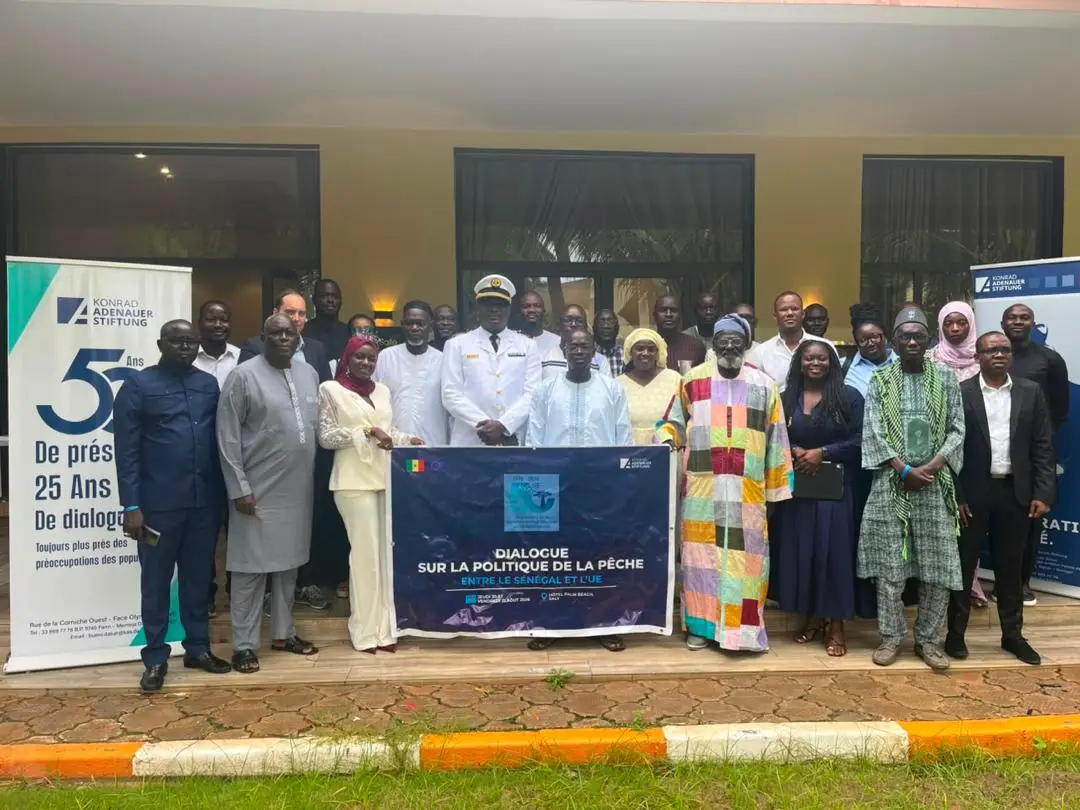
A round table devoted to dialogue on fishing policy in Senegal closed yesterday in Saly. This seminar, organized by the Konrad Adenauer Foundation, was an opportunity for stakeholders in the fishing sector to discuss fishing agreements with the European Union, licenses and the difficulties encountered by stakeholders in artisanal and industrial fishing.
A meeting brought together, from August 19 to 21, several players in the fishing sector in Saly. This initiative from the Konrad Adenauer Foundation allowed those responsible for the sector to discuss the situation of fishing in Senegal, the difficulties encountered by professionals and Senegal’s relations with the European Union. For the representative of the president of the High Council for Social Dialogue, Alpha Youm, holding this meeting allows the different stakeholders to have the same level of information on the sector.
“We are very satisfied to be here because we have a framework which allows us to have visibility on the fishing sector, to identify the problems and difficulties encountered by artisanal fishing and industrial fishing, as well as the partnership,” he declared. According to the latter, fishing is a sector that “brings growth and creates jobs” which must be restructured. “Among the main recommendations, there is the strengthening of the resources devoted to maritime security and the continuation of dialogue between those involved in artisanal fishing and those in industrial fishing. It is an obligation to restructure the sector,” declared Alpha Youm, while calling for a review and “improvement of the partnership between Senegal and the European Union, in the interest of the country”.
Conditions for new agreements
For his part, Massal Fall, veterinary fisheries biologist and teacher-researcher in the Fisheries and Aquaculture and Resource Conservation department, considers that fishing agreements between Senegal and the European Union have evolved considerably.
“Fishing agreements have undergone several changes over the years, particularly with regard to the conditions of access to resources and their supervision,” he explained. Therefore, the researcher believes that the question of production surplus is important in the conclusion of a fishing agreement. In this wake, the agreement between the EU and Senegal is no longer advantageous for the Senegalese state, he thinks. “We can only negotiate agreements when we have production surpluses. When you no longer have this production surplus, you cannot sign fishing agreements,” he argued. In this context, Massal Fall believes that Senegal must exercise caution in granting new licenses and concluding agreements with foreign partners. For him, priority must be given to the needs of the population and the preservation of fishery resources. “Even beyond the European Union, theoretically, Senegal cannot sign any agreement with any third state,” he declared.
For his part, economist Moustapha Dème noted several difficulties affecting the sector, including overfishing, fleet overcapacity, overinvestment and illegal fishing. “Today, there are not enough fish for the Senegalese, despite this fishing potential,” he lamented. According to him, a significant part of the resources landed is intended for foreign markets, while the needs of the national market remain important. The economist deplores the export of fishery products as they are, particularly small pelagics frozen whole, then subsequently processed in other countries. “Women processors could have accessed this material, transformed these products and allowed Senegal to export elaborate, transformed products, which create national wealth, added value and consolidate jobs,” he maintained.
Marième Fatou Dramé
