
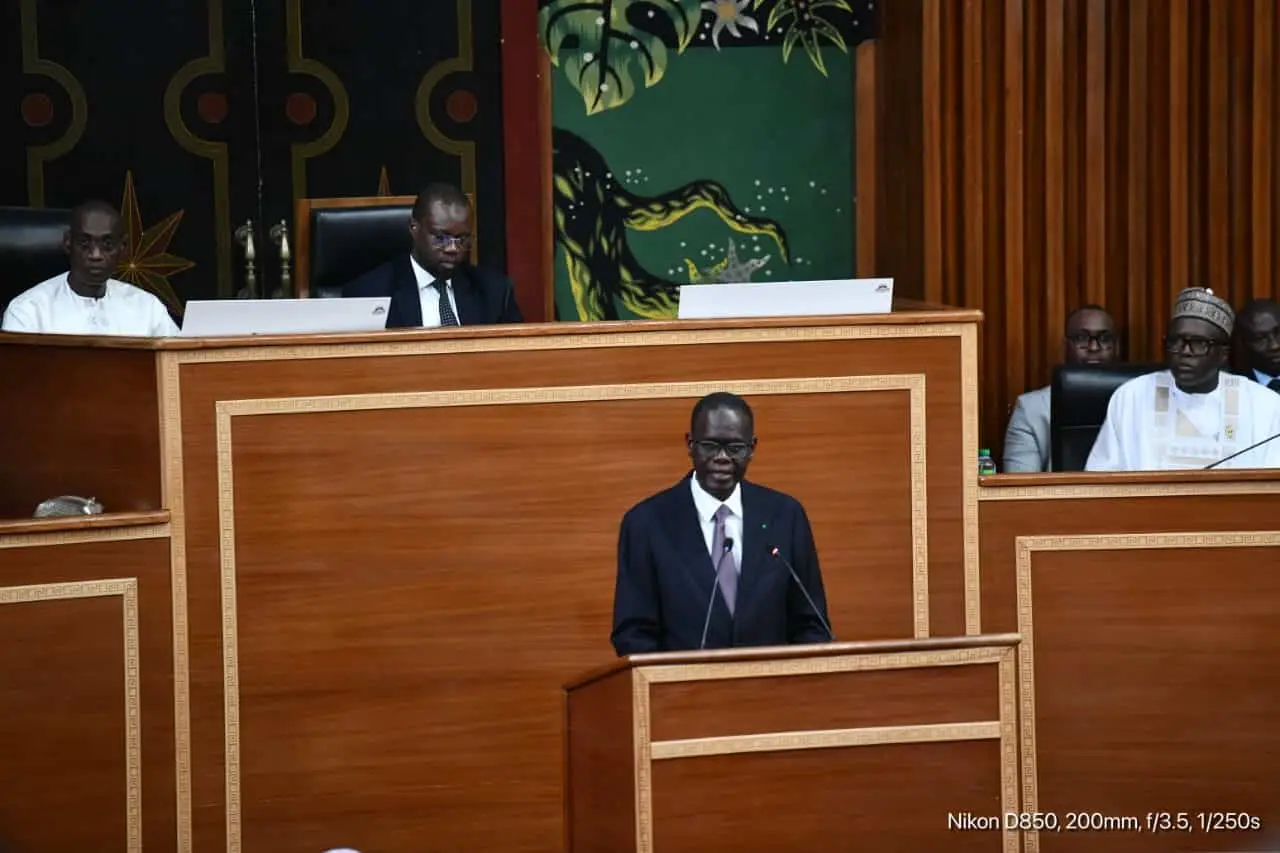
DPG: The 5 milestones set by Prime Minister Ahmadou Al Aminou Lô before the National Assembly
It is a constitutional exercise that has become a major political event. This Tuesday, Prime Minister Ahmadou Al Aminou Lô delivered, in accordance with article 55 of the Constitution, his General Policy Declaration (DPG) to the deputies. A powerful speech delivered in a particular context: that of the technical agreement just sealed, on September 1, between Senegal and the International Monetary Fund (IMF). The Head of Government took the opportunity to roll out five structuring commitments, a series of so-called “catalytic” projects, and a working method intended to avoid the pitfalls of the past.
1. Tell the truth about the accounts before straightening out the country
First commitment, and not the least: to consolidate public finances, the extent of the slippage of which has been revealed by the audits carried out since 2024. The Prime Minister recalled that the debt of the consolidated public sector reached, at the end of 2024, around 132% of GDP, more than 23,500 billion CFA francs, for a deficit reassessed at 13.7% of GDP. An observation that he summed up bluntly: a government that wants to be judged on its results must first say where it is starting from.
Faced with this situation, the “Jubbanti Koom” Economic and Social Recovery Plan (2025-2028), endowed with 6,166 billion CFA francs, is struggling to keep its promises: at the end of August 2026, only 172.5 billion had been mobilized in domestic resources, out of a target of 303.3 billion, i.e. an achievement rate of 56.9%.
It is in this context that the rapprochement with the IMF takes place. The Prime Minister insisted on the need for clarity with the Senegalese regarding this relationship, recalling that the institution remains the only one authorized to pronounce on the macroeconomic trajectory of a country and the sustainability of its debt. The technical agreement concluded at the beginning of September provides for four axes: restoring macroeconomic stability, reducing budgetary vulnerabilities, increasing social spending and supporting growth driven by the private sector.
In the sensitive area of fuel subsidies, around 800 billion CFA francs per year, 65% of which would benefit the 20% wealthiest households according to the Government, a progressive reform is announced, with better protection targeted towards the National Family Security Exchange. Stated objective: to reduce the cost of energy subsidies below 1% of GDP by 2029, while preserving domestic butane gas.
Another project: a Senegal Debt Treatment Plan (PTDS), presented as almost finalized, as well as the clearance of payment arrears owed to the private sector, estimated at 1,956 billion CFA francs at the end of March 2025, a file considered central to unlocking the cash flow of thousands of SMEs.
2. Put the State back in order and consolidate the rule of law
Second commitment: recovery is not limited to macroeconomic aggregates, it concerns the State itself. The Prime Minister mentioned the audit of public finances covering the period 2019 to March 2024, submitted to the Financial Judicial Unit in April 2025, and the six investigations opened by the Criminal Investigation Division for suspicion of misappropriation of public funds.
He also took stock of the review of strategic contracts (hydrocarbons, mines, energy, water, major infrastructures) initiated since July 2024, with around thirty mining conventions currently being renegotiated, on the basis of three claimed principles: legal security for investors in good faith, firmness where the national interest has been harmed, and refusal of brutality or naivety.
On the institutional side, several measures have been announced: effective generalization of asset declarations, implementation of the 2025 law on access to information with the installation of a National Commission before the end of September 2026, justice reform (digitization, penitentiary system, judicial protection of children), and reform of the electoral calendar with a view to the territorial deadlines of 2027 then the presidential and legislative elections of 2029.
3. Make oil, gas and mining sovereignty a lever for development
Third axis: transform rather than consume extractive rent. The Prime Minister recalled that the Sangomar and Grand Tortue Ahmeyim fields, in production for approximately two years, represent proven reserves estimated at 960 million barrels of oil and 560 billion cubic meters of gas. PETROSEN SA must now exercise strategic leadership of national oil-gas policy.
The issue of the Yakaar-Teranga gas field was the subject of particular development, with the Head of Government pointing out “shortcomings to be corrected” in its management, in particular concerning the recovery of compensation due to the State at the expiration of the contract in July 2026, valued at $55 million.
On the mining side, the ambition stated for 2029 is to increase the State’s annual revenues to around 600 billion CFA francs (compared to 370 billion in 2019), with a local processing rate of 50% and traceability of 90% of gold production. The agricultural sector is not left out, with objectives to cover food needs through local production: 64% for rice, 114% for potatoes, 100% for onions, in particular.
4. Solve the daily difficulties of the Senegalese
Fourth commitment, undoubtedly the most awaited by public opinion: concretely improve purchasing power and living conditions. The Prime Minister has set a series of indicators supposed to measure government action – cost of the consumer basket, weight of essential expenses in household income, access to water and healthcare.
On the social level, the Government relies on ANSD figures: more than a million vulnerable households identified, of which only 355,013 are actually covered by social safety nets, leaving a deficit of 645,636 households, or nearly five million people exposed to poverty. The envelope for family security grants, increased to 70 billion CFA francs in September 2026, must be doubled from 2027.
In terms of energy, the objective is a 30% reduction in the price of kWh of electricity by 2030. On housing, the deficit is estimated at 500,000 units, with an ambition to deliver at least 30,000 occupied homes per year. The Masterplan of the Senegal 2050 Agenda, for its part, evokes a potential of 1.52 million jobs by 2029, distributed in particular between agricultural cooperatives, artisanal fishing, agropoles and renewable energies. On education, the Government announces the construction of 15,000 connected classrooms and the recruitment of 2,527 additional teachers by the end of 2026.
5. Guarantee territorial equity in all public policies
Fifth and final commitment: break with the concentration of investments in Dakar. The Prime Minister presented a framework organizing the national territory into eight development poles (Dakar, Thiès, Center, North, North-East, South-East, South, Diourbel-Louga), with priority deployment on the South, Center and North poles, accompanied by an “Act IV” of decentralization.
Concretely, the Government announces more than 3,000 kilometers of road opening, the rehabilitation of several national corridors, the relaunch of the railway between Dakar and Tambacounda, as well as the finalization of the ports of Ndayane and Bargny-Sendou. In terms of health, the observation is severe: 80% of resources in the health sector remain concentrated in Dakar. Four new level 3 regional hospitals are announced in Saint-Louis, Ziguinchor, Mbour and Kaolack, as part of the first public-private partnerships in the sector.
A method to stay the course
Beyond the five commitments, Ahmadou Al Aminou Lô detailed the method intended to avoid the pitfalls observed during the first years of mandate: prioritize high-impact projects via a “project bank”, finance without borrowing “without demonstrated impact”, link each minister to a public mission letter accompanied by measurable objectives, measure the results by their real effects rather than solely by the means employed, maintain a permanent dialogue with the driving forces of the Nation, and publish quarterly the indicators for monitoring the action government.
A speech which, between assumed budgetary rigor and social promises, draws the road map for a Government which says it is ready to be “judged on the evidence”, and which will now have to convince with facts.
OBN
