
Casamance: In the returning villages, women finally want to come out of the shadows
After fleeing the war and leaving everything behind them, women from returning villages of Casamance are now trying to rebuild their lives in deeply isolated areas. Gathered at the initiative of the Women’s Platform for Peace in Casamance (PFPC), they exposed their difficulties and formulated the same cry: access to training, financing and markets to regain their autonomy.
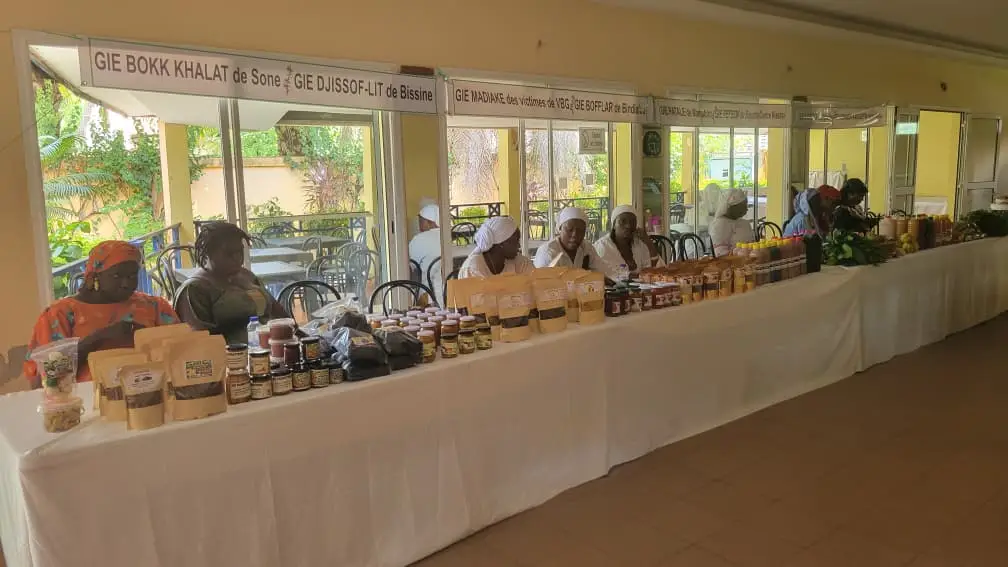
ZIGUINCHOR – Newfound peace is not always enough to erase the scars of armed conflict. In the returning villages of Casamance, women still have to deal with isolation, the absence of infrastructure, the lack of financing and economic activities which are struggling to take off. On the occasion of the International Day of Peace, celebrated this year with a delay in the south of the country, the PFPC, in collaboration with its partners, organized a forum dedicated to “Rediscovered autonomy and dignity: successful return for the displaced from Casamance”. The meeting, marked by a strong mobilization of women from Tambouille, Djigoudière, Kandiadiou and other villages affected by the conflict, was also punctuated by a mini-market dedicated to their products. Regarding women, several State structures, including the Priority Investment Guarantee Fund (Fongip), the National Agency for the Revival of Economic and Social Activities in Casamance (Anrac) and the Upgrading Office (Bmn), took part in the discussions. For Léonie Gomis, vice-president of the PFPC, the urgency now is to transform the return to the villages into a real opportunity for economic reconstruction.
“These women live in great precariousness and in extremely isolated areas. They had fled their villages, leaving everything behind them. Today, their return must be accompanied by a real empowerment policy in their favor. The PFPC, with its partners, remains determined to support them,” she assures.
Isolation, lack of resources and inaccessible market
In Kadiadiou, on the edge of the Gambia, the difficulties take on another dimension. Sokhna Jammeh, member of the “Ussoforal” GIE, is active in the “soap factory”, but says he lacks technical skills and financial resources.
“We need training because we do not master production techniques. Financing is also essential, but access remains very difficult. We are much closer to Gambia than to Senegal,” she explains.
This proximity to the Gambia constitutes both a constraint and an opportunity.
“We sell our products in Gambia, but we want to be able to access the Senegalese market. This is the wish of many women from returning villages. The State must support us, because the isolation of our localities constitutes a real obstacle,” she pleads.
In Djicoudière, in the department of Bignona, commune of Djibidionne, the finding is just as worrying. Safiétou Diémé, member of the “Kassofor” GIE, deplores the lack of recognition of their organization and the glaring infrastructure deficit.
“We recently returned to our village, where almost everything is missing. We hear about funding from the DER-FJ, but we do not yet really benefit from these mechanisms. We have no schools or roads. Our children are Senegalese, but some don’t even understand French,” she laments.
The same goes for Djirack, in the Oussouye department, where economic potential nevertheless exists. The women have a market garden and are involved in the production of oysters. But due to lack of equipment, these resources remain largely underexploited.
“We have very fertile land, but since our return, we have the feeling of being left to our own devices. Our market gardening area is not functional because we are missing the essentials: fencing, a well and financial support,” emphasizes Mariama Badji.
Her GIE also produces oysters, an activity which, according to her, could generate more income if resources were available.
“Oyster production brings us a lot of money, but we need a canoe to access the bolongs. At the moment, we have to walk to get the product, which makes the work extremely difficult,” she says.
However, there is no shortage of ambitions.
“We want to get into fruit and vegetable processing. We have a lot of potential in our village, but above all we suffer from a serious lack of support,” concludes Mariama Badji.
Behind these testimonies, the same observation is essential. In the returning villages, peace must now translate into roads, equipment, training, financing and real access to markets. For these women, rebuilding no longer just means returning home. It is now a question of being able to live there with dignity and build their future there sustainably.
