
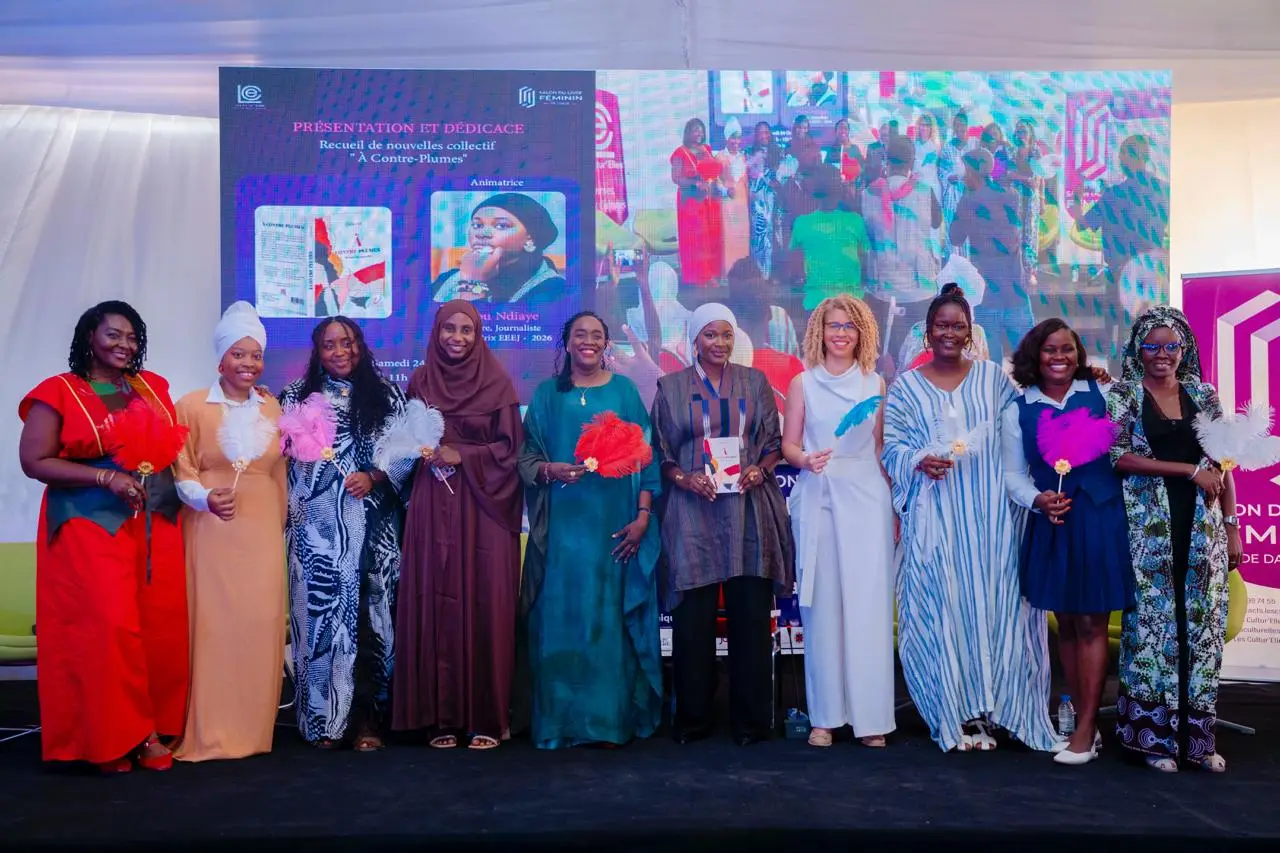
“À Contre-Plumes”: Ten authors shatter silences
The Dakar Women’s Book Fair lowered its curtains last Saturday. But this last day was an opportunity for ten authors to present À Contre-Plumes (published by the publishing house Le Fil d’Ariane), the fifth collection of short stories born from the creation and writing residency organized as a prelude to the Salon. From a dressing room where shoes speak to the streets of Saint-Louis, from a village in the Sahel to a Dakar projected in 2056, these stories move from “the intimate to the imaginary, from the serious to the funny, from the familiar to the unexpected”.
The atmosphere is good-natured and joyful during this presentation session. Between bursts of laughter and affectionate hugs, the presentation of the collective collection, which was also a moment of reunion, took place in joy and good humor. But the themes addressed by these ten feathers remain no less serious.
Read also: “À Contre-Plumes”, ten female voices brought together in the same collection
Reflecting their multiple nationalities, the authors cast a wide net. They sign texts with very different universes and tones. Some shake up the form, others the expectations, but all give a place to characters who go beyond the framework, refuse ready-made roles or end up deviating from them.
The collection opens with an allegory. In Between soles and laces, Marie Paul Weecar Tine Basse depicts shoes subject to their owner’s “annual sorting”. In a humorous vein, the short story speaks of impermanence, the end of a cycle and the illusion of status. Escarpina believes that her prestigious origins protect her, while Derbie, the most loyal, ends up in the garbage bag. Fidelity and loyalty guarantee nothing, and the final question suggests the idea of a more definitive sorting, which recalls the condition of women themselves.
The condition of women at the heart of the stories
This feminine condition is at the heart of several texts. In The Sky Closed, Fatoumata Dicko recounts, through the eyes of a Fulani teenager, polygamy and the silent violence it inflicts on the first wife. The model couple formed by her parents collapses under the weight of tradition, Pulaaku, gossip and the injunction for women to be patient and docile. Maïra remains silent before passing away in the middle of the ceremony.
In Mbaa, the gentle dissident, Maimouna Diallo tackles domestic violence head-on. It describes the influence of a husband who controls his wife’s studies, dating and body, as well as his inferiority complex in the face of a more educated wife. Tobacco, a refuge inherited from an adolescence deprived of maternal affection, ultimately becomes the symbol of liberation. Mbaa files a complaint, obtains his medical certificate and smokes openly, enjoying “dissidence”.
The mother, between transmission and mourning
The maternal bond and mourning also run through a large part of the collection. For Christina N’da, her text is not just made up of words written on paper. “My goal was to make eternal a person who is no longer there and who connected me to reading,” she confides about her new Allô Maman. Through this story, she explores the transmission between three generations, motherhood seen from both sides and the regrets linked to distance. The fall, open, lets us hear a breath at the end of the line.
With To You Who Loved Me So Much, Anne-Marie Diédhiou pays tribute to a loving mother, her aunt, Maman Anna, who gave up marriage to raise her brothers before raising her in turn. “I pay tribute to an extraordinary soul who occupied an essential place in my childhood and my development,” she says. The news affirms that motherhood is also a question of choice, while evoking Diola traditions, the rural exodus, the educational requirement and a mourning which is not over.
In Amul Yaakaar, Awa Thiongane Gaye extends this maternal figure with Ken Bugul, a courageous mother who mobilizes her entire network to enable her son to obtain a scholarship. But the friendship is undermined by jealousy: Ousmane, from a wealthy background, betrays his friend with a simple silence. Poverty, university strikes, the weight of a first name that means “hopeless” and the guilt linked to a mistake of omission compose a story of resilience and secrecy.
Between science fiction, censorship and freedom
Other news turns the gaze towards the future or elsewhere. With Rougui, Aminata Bocar Ba imagines a Dakar of 2056, half swallowed by rising waters, where the virtual world keeps families apart and where a service allows you to send messages after your death. It is through one of these posthumous messages that Rougui learns of the double life of her husband, Malick. The short story combines science fiction, criticism of digital abuses, climate crisis and the illusion of a perfect marriage, where one is “loved correctly, but not exactly”.
In Beasts of Ink, Hadassa creates a poetic story about writing as a space of freedom. From childhood, where scribbling resists coloring, to hiding under an authoritarian regime, Rana and Charbel experience a lifelong love, nourished by calligraphy and multiple languages — Arabic, Latin, Amharic and Greek. Political satire, faith, transmission from father to son and censorship lead to a revolution carried by the written word.
When words break the silence
Finally, two texts question the power of silence and voice. Soulful, by Fatoumata Koita, follows a young woman who becomes attached to a man considered crazy, whose diary serves as her mirror. The short story questions the social outlook on mental illness, exclusion and loneliness, and asks this disturbing question: are we all crazy? Its dreamlike ending remains ambiguous.
In Silence radio, Gaël Hottmongo features Aïcha, anonymous host of a radio show aimed at women. An orphan walled in silence after an attempted infanticide committed by her own mother, who became a minister, she discovers her origins and chooses to show herself openly. The text contrasts the force imposed on women with their right to vulnerability and celebrates the word that heals, leading to rebirth and rediscovered love.
In the end, three common threads connect these stories. The first is that of the female condition, with its violence, its social injunctions, polygamy, influence and imposed sacrifices. The second is that of the bond with the mother and mourning, with its regrets and its transmission. The third is that of speech against silence: writing, speaking, singing or smoking in public become so many gestures of freedom.
Added to this are betrayal, secrets and double lives, which remind us that behind appearances, each and especially each carries a weight that the collection finally chooses to put into words.
Arame NDIAYE
