
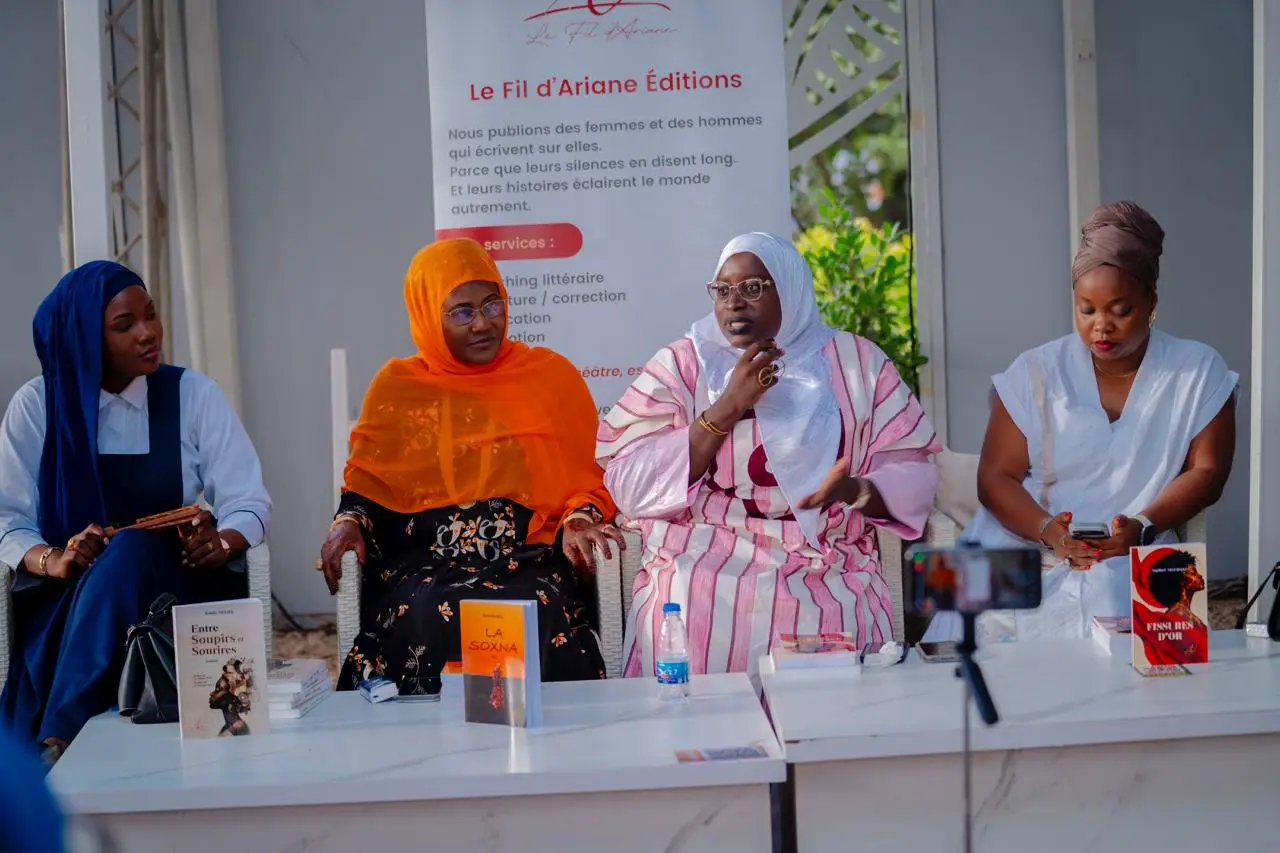
Literature: Matrimoine at the heart of a dialogue between three authors from Le Fil d’Ariane Éditions
On the occasion of the Dakar Women’s Book Fair, the publishing house Le Fil d’Ariane brought together three authors around matrimony, transmission and the place of women in family relationships. Through their works, Rokhy Ndiaye, Mame Anta Mbacké and Angelina Uloma Nwachukwu question marital responsibilities, freedom to choose and the sometimes unsuspected realities of intimate life.
Heritage is not limited to material heritage or the memory of women who have left their mark on history. It is also transmitted through stories, family experiences and lessons passed down from one generation to the next. It is around this concept that the literary meeting organized by Le Fil d’Ariane Éditions was structured, on the sidelines of the Dakar Women’s Book Fair, placed this year under the theme of matrimony.
At the initiative of Mame Ngoné Faye, founder of this publishing house, three authors shared their views on questions that cross the lives of women: responsibilities in the couple, the choice of a spouse, the place of love in marriage and the secrets that can remain within a family. An approach which made it possible to put into perspective the worlds of their works and the reflections they provoke.
“I said to myself, as we are part of the Dakar Women’s Book Fair and this year, the theme is on heritage, I looked in my catalog and I said to myself: hey, there are three works that overlap,” begins Mame Ngoné Faye.
The meeting thus gave rise to a dialogue between Rokhy Ndiaye, author of Between Sighs and Smiles, Mame Anta Mbacké, who signed La Soxna, and Angelina Uloma Nwachukwu, whose work Fissures d’or was also presented during the discussions. Beyond their narrative differences, these texts give a central place to women and their experiences, while questioning human relationships.
Marital responsibility beyond material obligations
In La Soxna, Mame Anta Mbacké portrays Bassirou, a man torn between his professional obligations and his family responsibilities. While his first wife, Soxna, who is seriously ill, needs him, he considers just sending her money, hesitating to go to her bedside.
This attitude reveals the limits of a conception of marital duty which favors material means to the detriment of presence and support. For the author, the character’s situation makes it possible to question the responsibility of the husband and the role of the mother in the transmission of family values.
“A sick person doesn’t just need equipment or money. His mother made him understand that his wife needed his physical presence,” explains Mame Anta Mbacké during the discussions.
In the story, Bassirou’s mother refuses to let him evade his obligations. She encourages him to join his wife and realize what his absence can cost him. The maternal figure thus appears as a vector of transmission, capable of reminding the next generation of the moral requirements of family life.
The novel also addresses the difficulty of communicating within a couple. Through Sorna, who ends up expressing the suffering kept within her for a long time, Mame Anta Mbacké highlights the need for true listening between spouses. Feminine speech, long contained, then becomes a means of bringing out truths essential to understanding others.
The right to choose their life
With Between Sighs and Smiles, Rokhy Ndiaye focuses on the criteria that guide the choice of a spouse. Its story features a young woman who hesitates to commit to marriage with a man who is described as kind, pious and attentive.
Through this hesitation, the author questions the criteria for marital success often imposed by those around us or by society. Are the qualities traditionally associated with a good spouse enough to guarantee a fulfilling relationship? The question opens up a reflection on the freedom of women to define their own expectations and choices.
“It’s not enough for a man to tick all the boxes, as they say, to be a good husband. It is not enough to be pious, caring, kind, or have money for him to be a good husband,” emphasizes Rokhy Ndiaye.
For the author, young women must be able to determine their own criteria for living together, without letting their decisions be dictated by social norms or family expectations. Marriage cannot be reduced to a list of qualities appreciated by those around you: it also presupposes a personal choice and adherence to the relationship.
Maternal transmission occupies, here again, an important place. By telling her own story to her daughter, the mother seeks to make her understand that she must take responsibility for her decisions. The legacy of previous generations therefore does not necessarily consist of reproducing the same paths, but also of transmitting the ability to decide for oneself.
The gray areas behind appearances
The third literary universe presented during the meeting focuses on trust and the hidden realities of family life. The story mentioned features a woman who thought she knew her husband perfectly, before discovering a facet of his marital past of which she was unaware. Their daughter, Iris, is also confronted with a new reading of her parents’ history.
This discovery upsets the certainties built over the years. She reminds us that human relationships are not always limited to appearances and that even the closest people can retain experiences or parts of their history that those around them are unaware of.
“So no, you can’t fully know a person,” says Angelina Uloma Nwachukwu during the exchange.
Beyond the romantic relationship, this reflection extends to family and friendly ties. It invites us to consider the complexity of individuals, whose attitudes and decisions can sometimes surprise those who think they know them. The story thus underlines the difficulty of reducing a person to a fixed image, constructed over the years.
Through these stories, heritage emerges as a living heritage: that of words, experiences and lessons passed on between mothers and daughters, but also that of the questions that allow new generations to build their own path. Literature then becomes a space where individual stories nourish collective reflection on women, family and society.
Arame NDIAYE
