
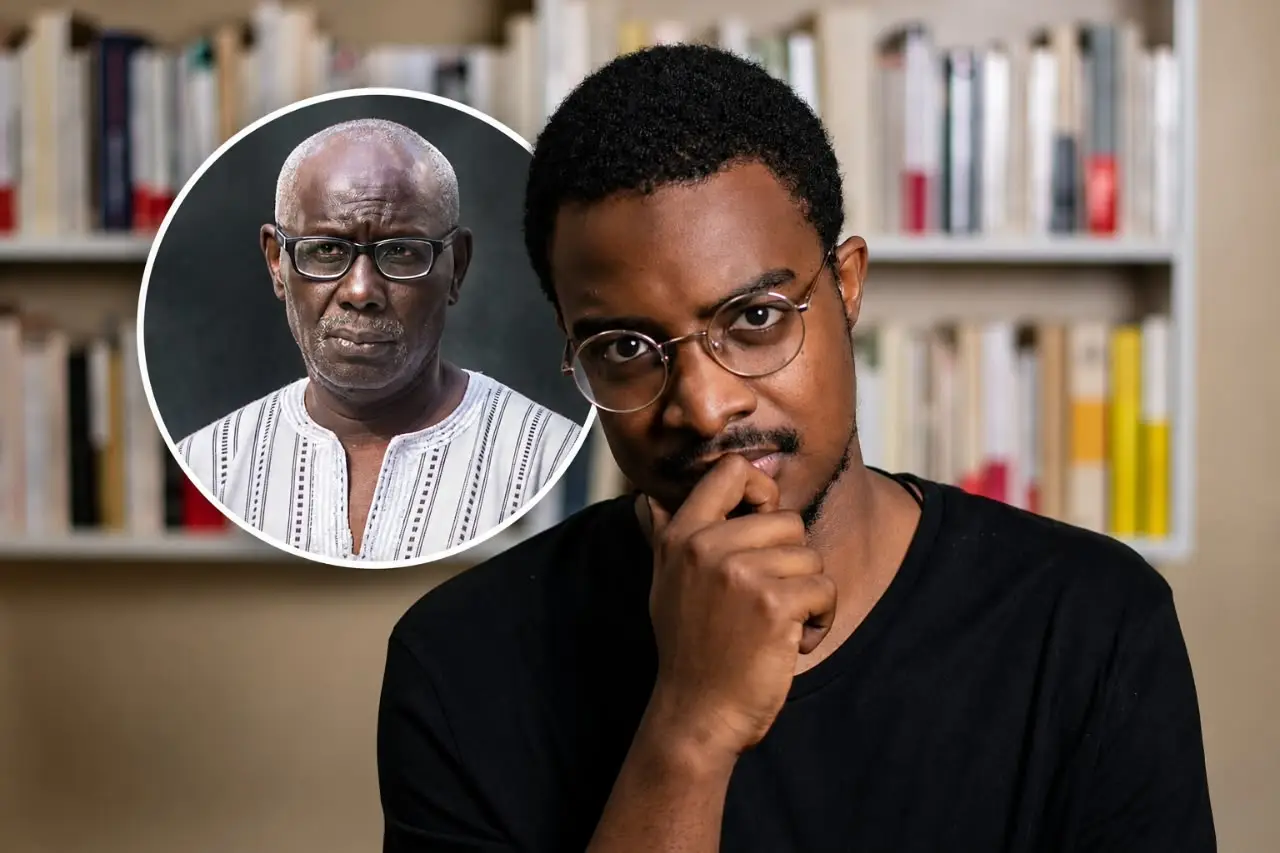
Boris is Senegal (By Khalil DIALLO)
What do we call Senegal today? The country with the second star, acquired hard on the ground by Sadio Mané’s gang and still disputed in court. A country with growing insecurity, marked by homicides against a backdrop of theft and increasingly numerous feminicides. The land of eternal Teranga where debate is made difficult by political disagreements. All of these meanings can be true at the same time, and they are, but the one that particularly interests us is quite different. To this question, I answer, not without provocation: Senegal is Boubacar Boris Diop. On the occasion of its eightieth anniversary, the country breathes literature and takes a break from socio-economic constraints to study its work through the words of academics, writers, critics, editors and other personalities of the Republic of Letters, among whom I myself should have been included, had it not been for illness.
This is not a question of paying homage in the simple and dull sense of the term, but of an attempt to objectify the complexity of the work which is the pride of a country. By bringing Senegal to a new international audience through Murambi, the Book of Bones, he allowed the emergence of a new generation of writers and showed us that another Senegalese literature was possible; an unclassifiable, polymorphous, indomitable literature and a double of Leviathan. It is this work that I propose to talk about, because Boris is nothing other than that, that which pushed young people of my generation to seek more, higher, stronger, harder, that which I call the infinite labyrinth from which blood and tears flow, in which every writer must live and create.
There are works that are impossible to exhaust. They are irreducible to what they tell: the human condition, which they dig so deeply that they continue to trace furrows in our minds to reveal to us the other side of fiction, the ruthless examination of reality through the mechanisms and tools of the art of the novel and leading to what I like to call obstinate literature.
From Le Temps de Tamango, Boris established a poetic and literary geography that he has continued to deepen since then, through the exploration of memory carried out to the height of justice. With this first novel, distinguished by the Senegalese Copyright Office Prize, Boris established himself as one of the pioneers of African political fiction and initiated the postcolonial reflection which would push him, years later, to write essays like Africa Beyond the Mirror and to begin writing in Wolof. Through a mise en abyme carried out by intradiegetic and extradiegetic narration mechanisms, this novel goes beyond the question of protest and the novel of post-independence disillusionment.
The Drums of Memory extends this gesture and is part of the quest for the national hero, to deconstruct preconceived ideas and stories adopted or told by the former colonist. This second novel, through Fadel Sarr, haunted by events that he himself did not experience, makes memory an obsession that precedes the individual and goes beyond him. In 1990 he won the Grand Prix de la République du Senegal for letters and, dare we say it, because the prizes are only as good as their winners, gave this distinction the prestige which makes it the dream of many Senegalese writers.
If everyone knows Murambi and what he brought to light, what he said about evil, its metamorphoses and its modes of appearance, it is in two other texts that we must look for the answers to the questions raised by this novel: Kaveena and The Rider and His Shadow.
The Horseman and His Shadow, where Kadidja tells stories to someone she never sees, explains how the fable can approach horror where testimony alone fails, as well as the condition of the contemporary African writer speaking to a people who are not his own, whom he does not see and whom he does not know. Kaveena, immersed in the twists and turns of neocoloniality, questions evil as a system, with its perpetrators, its sponsors and its silences.
Through the writing of these two texts, he proves, if necessary, that the postcolonial African novel does not have to choose between political commitment and formal requirements, that collective memory and narrative architecture can mutually reinforce each other rather than contradict each other. Thus, Boris does not give in in his texts to either the temptation of bare reporting or that of aestheticizing metaphor; he digs another path between fiction and historical archive, in which literature and reality contaminate and distort each other. In short, they are each the mirror in which the other is seen. Without going into other technical or genetic considerations of Diopian work, and to return to my basic postulate, it is worth noting Boris’s most important work: mythologizing Senegal, making it a land of literature, and making its history and its wounds the history of literature. Indeed, without citing all of Boris’s novels in full, we can easily see how, in The Rider and His Shadow, The Time of Tamango, The Little Monkey and A Tomb for Kinne Gaajo, the Senegalese territory is not a setting but a living, complex organism, and the most impactful character. The alleys of Dakar, the neighborhood rumors (of the Medina, for example), the flavors and smells of the markets, the falling dusk or the rising sun on the tales constitute an affective geography which refuses exoticism as much as folklore and mythologizes the place in its banality, making it universal through an excess of local precision.
His labyrinthine novels, where the stories are linked without ever being resolved, where the traditional tale serves as a matrix for a reflection on madness, murder, power and fabrication as resistance to trauma and the birth of another possibility of reality, of another glorious postcolonial Africa, can be read in the same way as his political commitment and allow us to say unequivocally that Boris is Senegal, because each of the sufferings of his country becomes an obsession that we find in his work and which he denounces in his articles and political columns.
If we can easily believe that it is the tutelary shadow of Sheikh Anta who is at the origin of the reappropriation of the language started by Boris twenty years ago through the writing of his texts in Wolof, it is above all another lesson that must be drawn from this fact: the call of sovereignty. Because a people who do not know their own language, who do not teach it, who do not teach their children their history in their language, are a people without roots.
This infinite labyrinth of the name of the novelistic practice, which I have tried to summarily define here and of which Les Petits de la guenon represents perhaps the most accomplished accomplishment to date, is the material proof of the reason why Boris is Senegal, and says why Senegal celebrates its son. In this novel, first written in Wolof under the title Doomi Golo, old Nguirane Faye entrusts to notebooks intended for his grandson Badou, who has gone far away, the memory of a country and a neighborhood: all of Boris’s work can be found there, transmission as a duty, language as an anchor, the story as a bulwark against oblivion. This literature which refuses amnesia, the ease of the consoling story, and which keeps open, in the precise and implacable beauty of the prose, the question of what we owe to the dead and to the living whom the violence of the world has made invisible, is the symbol of the vigil started by Boubacar Boris Diop more than forty years ago, a vigil which forbids us, as a nation, to sleep with a clear conscience as long as even a moment of injustice remains at our doors.
If there is one wish to make to this Sartre enthusiast – from the work from which he took his author’s name and who transmitted his passion for it – for his birthday, even if he does not need one, it would be that the Swedish Academy demonstrates its modernity and resolutely places itself in world literature by recognizing, in the wake of the Neustadt Prize, this son who has become a metaphor for Senegal, who is, for many, including myself, the most important pen of contemporary literature.
By Khalil DIALLO
