
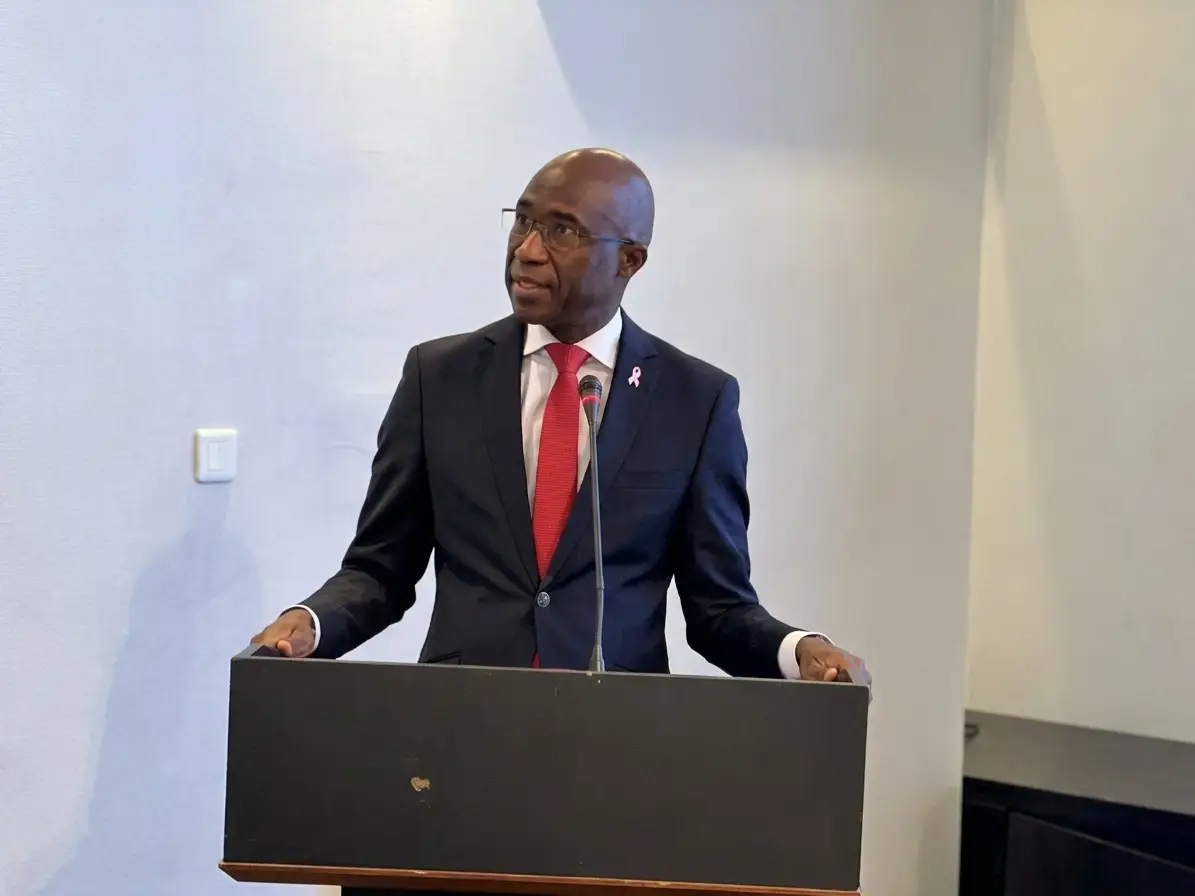
Use of evidence collected on the battlefield: Me Moussa Sarr pleads for mutual legal assistance in West Africa
The procedures for collecting evidence collected on the battlefield are not harmonized in West African countries and coordination between soldiers, investigators and magistrates remains insufficient. This is the observation made by the Minister of Justice, Keeper of the Seals, Me Moussa Sarr, during the opening of a workshop on Tuesday on the subject on Tuesday October 6, 2026, in Dakar.
Senegal welcomes, for three days, magistrates, investigators, experts and officers from fourteen West African and neighboring countries. The latter will discuss the use of evidence collected on the battlefield in legal proceedings.
In reality, in the most remote areas, underlines the Minister of Justice, Me Moussa Sarr, these forces are often the first on the ground. Sometimes they are the only ones there. They are the ones who apprehend suspects, who seize phones, computers, documents and weapons, who collect biometric data.
“This is what we call battlefield evidence. They serve military action. They can also serve justice, provided they reach the judge. However, very often, they do not succeed, or they arrive there in a state which no longer allows them to be used. Collection procedures are not harmonized. Coordination between the military, investigators and magistrates remains insufficient,” underlined the minister.
The region’s security system recomposed
In fact, according to him, the texts of the different states in the sub-region do not always say how information collected by the army can enter into a criminal file. Added to this is a more recent difficulty. This is the region’s security system which has been profoundly restructured in recent years, and the circuits through which these elements were collected and shared have been disrupted.
“The whole point is there. (…) The first is to fight against impunity. A suspect detained without being tried gives the feeling of being a victim of arbitrariness. An accused acquitted for lack of usable evidence leaves one with impunity. In both cases, public confidence declines, and terrorist groups know how to take advantage of this. A fair trial, based on solid evidence, has the opposite effect. It shows victims and public opinion that the State responds to crime with the law,” he noted.
Thus, according to the Minister in charge of Justice, the link between the forces engaged on the ground and the judicial authority must therefore be “organized” well before the trial. It must be done within a clear framework, where everyone remains in their role and where everyone’s action can be controlled.
“The second requirement relates to the admissibility of the evidence. Before the judge, proof is valid if we can establish where it came from, who collected it, who kept it and under what conditions. In a theater of operations, this traceability comes up against urgency and danger. I measure what is asked of a soldier when we expect from him, under fire, the reflexes of an investigator,” he added.
However, he emphasizes, it is at this moment that it all begins. The seizure report, the seal, the delivery to investigators, the extraction of digital data and their authentication form a chain. It only takes one link to give way, and the entire procedure is weakened.
Protect sources and methods
In this regard, he noted that Senegalese law, like that of many countries represented here, is not closed to these elements. Criminal evidence is free. But it must have been collected fairly and be able to be discussed adversarially at the hearing. The judge only forms his conviction on what has been debated before him.
“Classified information poses a particular difficulty here. Sources and methods must be protected. We must also respect the rights of the defense. Other countries have found balances. I hope that these three days will allow us to examine them in the light of our own legal systems. You have recognized references for this,” pointed out the minister.
In this regard, Me Moussa Sarr cited the Abuja Recommendations, adopted by the Global Forum to Combat Terrorism. But also, the United Nations guidelines on the use, before national courts, of information collected by the military.
The third requirement, according to the Minister of Justice, is respect for human rights. On this subject, he maintained that: “Senegal does not intend to compromise on this point. Evidence obtained with disregard for human dignity has no place in a courtroom, regardless of the seriousness of the facts.”
Also read: ECOWAS Court of Justice: Senegal reaffirms its commitment to strong community justice
In reality, the United Nations Convention against Torture, to which Senegal is a party, rules out any declaration obtained by such acts. The International Covenant on Civil and Political Rights and the African Charter on Human and Peoples’ Rights guarantee everyone the right to a fair trial.
“Cooperating with defense and security forces is necessary. This does not amount to delegating the function of judging to them. The magistrate freely assesses the elements submitted to him, wherever they come from. These three demands would remain a dead letter without cooperation between our States,” he said.
Because, he says, terrorist groups ignore borders. However, their procedures still stop there too often. A phone seized in one country may contain evidence that a judge in another misses. While the Security Council, through its resolution 2396 of 2017, invited States to share these elements for the purposes of prosecution.
“Mutual legal assistance offers formal channels for this, which we need to make faster. But everyone knows here that nothing replaces trust between practitioners who know each other,” argued Me Moussa Sarr.
Mariama DIEME
