
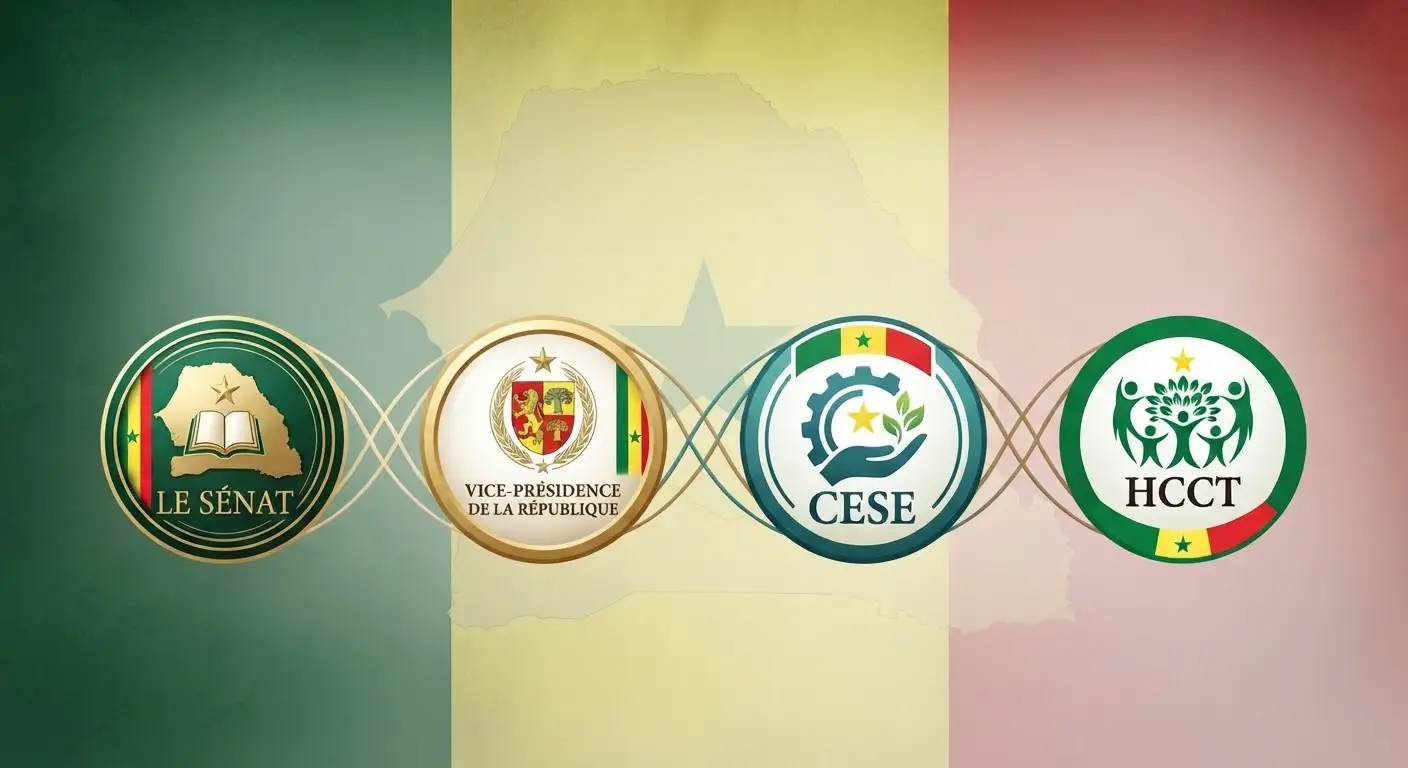
Constitutional reform of September 28, 2012: Senate, Vice-Presidency, CESE, return to an institutional turning point September 28, 2026
On September 28, 2012, Senegal initiated a major reorganization of its institutional architecture. A few months after his accession to the supreme office, at the end of the second democratic alternation, Macky Sall adopted constitutional law no. 2012-16, which notably abolishes the Senate and the Vice-Presidency and transforms the Economic and Social Council into the Economic, Social and Environmental Council (CESE).
A reform then presented as a response to the imperatives of rationalizing public spending and social emergencies. Nearly fourteen years later, the Senegalese institutional landscape has further evolved, notably with the disappearance of the CESE and the High Council of Territorial Communities (HCCT).
2012, the institutional act of the second alternation
The year 2012 constitutes a pivotal moment in the recent political history of Senegal. Elected on March 25, Macky Sall succeeds Abdoulaye Wade in a context marked by high expectations in terms of governance, transparency and reduction of the state’s lifestyle.
The floods which hit several localities in the country during this year also increased the pressure on public authorities. The new administration then highlights the need to mobilize more resources in favor of populations and social emergencies.
It is in this context that the abolition of the Senate occurs among the first institutional decisions of the new regime. Macky Sall justifies this measure in particular by the desire to devote the resources allocated to this institution to the fight against floods. The Senate, reestablished in 2007 under Abdoulaye Wade, thus disappeared in favor of a new unicameral Parliament, structured around the National Assembly.
Senate and Vice-Presidency abolished
The constitutional reform of September 28, 2012 profoundly modifies the organization of public authorities. With the disappearance of the Senate, Senegal abandons its experience of a bicameral Parliament and returns to a single legislative chamber.
The same reform puts an end to the office of Vice-President of the Republic, created under the regime of Abdoulaye Wade. The top of the executive is thus refocused around the President of the Republic and the Government.
The abolition of the Senate had raised questions about the usefulness and cost of a second chamber, but also about the representation of territories and the diversity of interests in the legislative process. For the new power, it was part of a logic of rationalization of public spending.
From the Economic and Social Council to the EESC
The 2012 reform is not limited to the abolition of institutions. It also transforms the Economic and Social Council into the Economic, Social and Environmental Council. Created by the constitutional law of September 28, 2012, the CESE becomes a consultative assembly responsible for enlightening public authorities on economic, social and environmental issues. Its organization and operation are specified by organic law no. 2012-28 of December 28, 2012.
The integration of the environmental dimension then constitutes a notable development in the institutional system. The CESE may in particular be consulted by the President of the Republic, the Government and the National Assembly on questions falling within its areas of competence.
2016: the HCCT completes the new institutional building
Four years after the 2012 reform, the institutional architecture is undergoing a new evolution. Constitutional law No. 2016-10 of April 5, 2016 establishes the High Council of Territorial Authorities (HCCT), as part of the reform of Act III of decentralization. It is a consultative institution intended in particular to support decentralization, planning and territorial development policies.
The HCCT was therefore not created by decree. Its creation falls under the Constitution. Its organization and operation are then set by organic law no. 2016-24 of July 14, 2016. Decree no. 2016-1005 of July 25, 2016 also set the date of the poll and convened the electoral college for the election of High Councilors.
The institution then has 150 members, including 80 indirectly elected and 70 appointed by the President of the Republic, for a five-year term.
2024, the third alternation and a new reform
The institutional landscape is experiencing a new rupture twelve years after the 2012 reform. After the election of Bassirou Diomaye Faye as President of the Republic in March 2024, Senegal organizes early legislative elections on November 17 of the same year, following the dissolution of the National Assembly by Decree No. 2024-1980 of September 12, 2024.
The vote gives a large parliamentary majority to PASTEF, which obtains 130 of the 165 seats in the National Assembly, with 1,991,770 votes, or 54.96% of the valid votes cast. This new political configuration gives the power resulting from the third alternation a sufficient majority to initiate a new sequence of institutional reforms.
Among these is the abolition of two consultative institutions: the CESE and the HCCT. On December 14, 2024, the National Assembly adopted the bill repealing the organic laws which governed these two institutions, by 134 votes for, 8 against and 2 abstentions. Organic law No. 2025-01 of January 6, 2025 legally establishes their suppression.
Thus, an institution born from the constitutional reform of 2012, the CESE, and another created four years later, the HCCT, disappeared from the Senegalese institutional landscape at the start of the third alternation.
From 2012 to 2025, a changing institutional landscape
The retrospective view thus makes it possible to measure the evolution of the Senegalese institutional architecture over nearly fifteen years. In 2012, the second alternation resulted in the abolition of the Senate and the Vice-Presidency and the transformation of the Economic and Social Council into the CESE.
In 2016, the HCCT completed this building as part of Act III of decentralization. In 2024-2025, under the third alternation, the CESE and the HCCT are in turn abolished.
Beyond the succession of texts, these different stages refer to the same question: how to organize institutions to meet the requirements of representation, effectiveness of public action and control of state spending? The response has evolved according to the alternations and political orientations.
The reform of September 28, 2012 thus appears, with hindsight, as one of the first major institutional acts of the second alternation. Its legacy, however, is not limited to the institutions that it abolished or transformed: it can also be read in the reforms that followed it and in the choices made, twelve years later, by the authorities resulting from the third alternation.
By Cheikh Gora DIOP
