
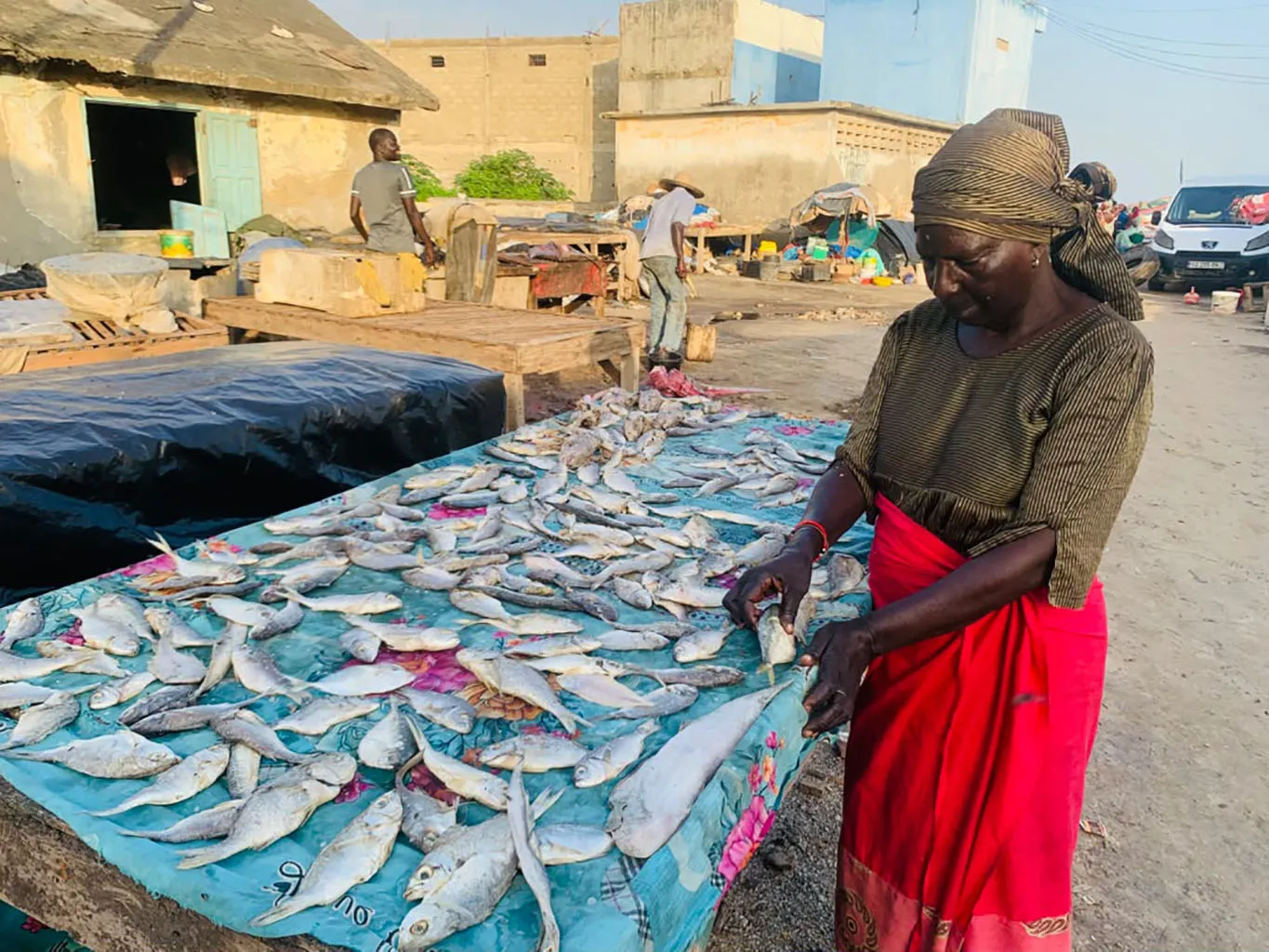
Rufisque: the women of Ndeppé faced with the scarcity of fish
Behind the actions repeated daily, there is a concern: the scarcity of fishing resources and the surge in prices are weakening an activity that supports entire families. Women processors are therefore looking for sustainable solutions to preserve their profession.
The daytime temperature, hot and unbearable, softens as the sun goes down. It’s the time chosen by brave ladies, bucket in hand, to calmly walk the closed Rufisque-Ouest canal to get to Ndeppé, the site housing the fishing quay and the women processors.
Adjoining the Departmental Center for Popular and Sports Education (Cdeps) of Rufisque, the local women transformers are revealed. A wide doorless opening serves as an access point to the space where the drying tables are displayed. Some expose the finished product to the “bana-bana”, the resellers. A few meters further away, Aby Sy Diané, resident of the Léona Valda district located opposite the site, with 20 years of experience in this field, is working on preparations. Delicately, while applying the salt, she repeats an age-old gesture to obtain “guedj tambadiang” (small dried fish).
“After acquiring the goods (the blue-spotted porgy, the gilthead sea bream and several other species), we clean the fish, then we salt them and let them dry for two to three days. This process is done away from ultraviolet rays,” she explains. At the other end of the site, given the energy required by this physical and tedious work, the ladies call on the men to help them. Spread out on the ground, the well-seasoned fish are ready to be smoked.
Difficult to obtain raw materials
Despite their bravery and hard work, these women face a major problem: finding enough fish at a reasonable price. “During this winter period, fish, the basis of our activity, are becoming scarce. We buy a box of sardinella (yaaboy) for 20,000 FCFA, and the speckled sea bass for 30,000 FCFA. It’s extremely difficult, because these prices are very high,” says Ms. Diane.
She is not the only one to deplore this situation. Mame Déguène Mbengue, former resident of Diokoul Wague, is now leaving Diamniadio to come work on the site. She recalls that business used to be good: “We rubbed our hands, but today, that is no longer the case. Fish is becoming increasingly rare and expensive; Sometimes we buy a box of sardinella for 22,000 FCfa,” she adds.
To better understand this problem linked to the scarcity of the resource, a detour via the Rufisque fishing quay allows you to go up the entire chain. Faced with the strong waves created by the swell during this winter period, some cautious fishermen preferred to moor their canoes on the crowded beach. Discussions are going well.
Sales price of finished product
“Look, the sea is very rough. It’s been two to three days since we went offshore because of this swell,” says Mamadou Niang, known as Niangata, canoe captain, with a wave of his hand. As a fisherman, he notes and confirms that basic products for women processors (sardinellas and others) are in short supply. “Even we fishermen don’t see any,” he says. According to him, their current releases focus on tuna which they sell at 60,000 FCFA per box.
The scarcity of the resource does not only affect sardinella; it extends to other species (grouper, sea bream, etc.). Ousseynou Mbaye, a fish merchant for more than 25 years, emphasizes that in its current state, the sea no longer brings in much. “Activities are slowing down. Before, we had fish in abundance, but the sea has been attacked from all sides, especially by overfishing. We manage as best we can,” he says bitterly. He, who supplies fish to export factories, says he is struggling to satisfy demand 10 times higher than supply: “It is very difficult for us to obtain 50 kg despite the high demand,” he says.
On the quay, the same concerns can be seen on the faces of the resellers from the central market who have come to stock up on supplies. Looking desperate, Fatou claims to have paid 20,000 FCFA for the box of sardinella, adding that sometimes she has to buy it at 35,000 FCFA.
On the processing site, there is endless heated bargaining between sellers and resellers, most of whom come from Bambilor. “The prices of salted fish vary from 1,000 to 4,000 FCfa. It is outside the winter period that the goods are much more accessible on the market,” declares Aby Sy Diané. As for the “yéet” (marine gastropod mollusk), she adds, half a kilo costs 2,250 FCfa and a quarter costs 1,000 or 1,200 FCfa.
Prices far from enthusing loyal customers who are trying to do well. “We pay 1,250 FCfa for a kilo of “keccax” (salted and smoked fish), not including transport costs. We retail from 200 FCfa. The profit is insignificant compared to the very high cost price,” explains Amy Wade, saleswoman from Bambilor.
However, she perfectly understands the situation, the result of an increasing chain going from capture to processing. This reality often makes Mame Déguène Mbengue uncomfortable in front of her regular customers. “We sometimes engage in lengthy bargaining. Sometimes, the prices they offer per kilo are lower than our purchase price. For example, they want to buy at 1,000 FCfa while our floor price is set at 1,200 FCfa,” she relates.
For these hardworking women, who provide for the needs of their household thanks to this work – particularly for their children’s education – institutional support is strongly hoped for in order to perpetuate their activities, particularly in terms of the availability and financial accessibility of the raw material: fish.
