
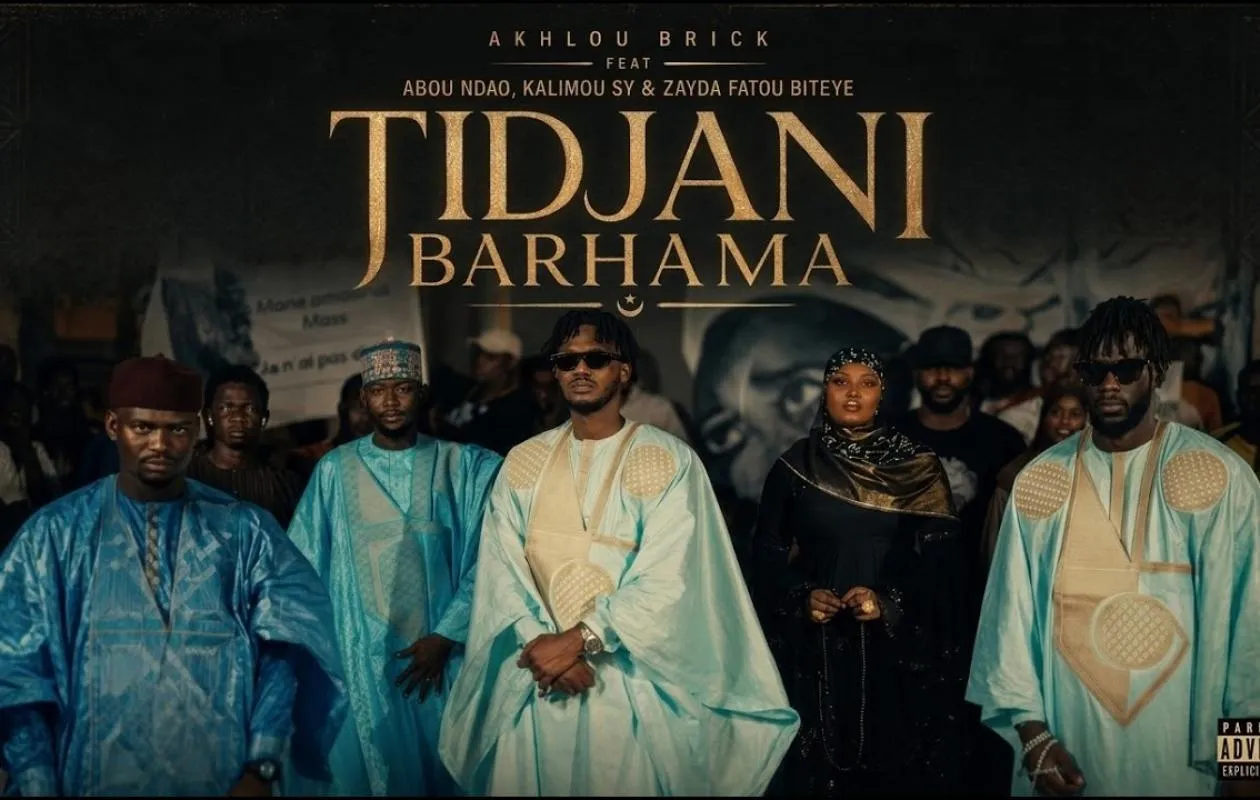
Akhlou Brick at the heart of a musical dialogue around Baye Niass September 1, 2026
As Gamou and Gamou-waat approach (one week after Mawlid) celebrated in Medina Baye, Akhlou Brick pays tribute to Baye Niass with “Tidjani Barhama”. It is a piece at the crossroads of several musical traditions. Rhythms of “faydou saani”, Hausa tunes of Kalimou and Abou Ndao, zikr of Fatou Bitèye, choirs with the accents of a church choir: the group composes with voices and sounds from several horizons.
In the context of the Gamou of Medina Baye, and mainly with the celebration of the Gamou-waat (which occurs a week after the birth of the Prophet) specific to the stronghold of the Niassene disciples, tributes to Sheikh Al Islam El Hadji Ibrahim Baay Niass are multiplying in the religious, cultural and artistic fields. Music plays an important place in this expression. Akhlou Brick joins in with “Tidjani Barhama”, a title dedicated to Baye Niass and which takes the side of the musical encounter.
The group does not stick to rap production accompanied by religious references. It brings together several voices and several traditions, with the rhythm of “Faydou Saani”, the Hausa tune of Kalimou, the choruses with the accents of a Christian choir and the zikr carried by Zeyda Fatou Bitèye. This co-construction gives the piece a particular identity. The different interventions do not play the same role, but each brings a specific color and allows Akhlou Brick to work on the tribute to Baye Niass through music as much as through words.
The rhythm of “Faydou Saani” occupies an important place in this architecture. He immediately connects the piece to a musical tradition linked to “Fayda”. Its presence gives the title a recognizable base on which Akhlou Brick places his writing. The choice is relevant because it avoids reducing the reference to “Fayda” to a few words or a simple theme. The tradition is directly present in the sound.
The piece takes another direction with Kalimou Sy and Abou Ndao. Their intervention is based on a Hausa tune which modifies the musical color of the title. This dye brings a different sound, with a way of putting the voice which contrasts with that of the rap and with the other passages. This sequence recalls the West African dimension of “Fayda” and the linguistic spaces in which it developed.
The choice of Hausa tone is therefore not insignificant in a tribute to Baye Niass. It allows the piece to go beyond a strictly Senegalese framework and to bring to light another cultural component of the world of “Fayda”.
Tastes and colors
Kalimou gives it another musical depth. Thus, the choirs constitute another particularity of “Tidjani Barhama”. Their color at times recalls that of a Christian choir, particularly in the harmonies and in the way in which the voices group together. This sound contrasts with the vocal forms usually associated with “zikr” and Senegalese religious rap.
This choice deserves to be noted because it shows a desire to work on music beyond the immediately expected references. The backing vocals give the piece a different vocal texture and create a contrast with the solo passages.
Fatou Bitèye brings another dimension. His intervention belongs to the register of zikr. His voice does not seek perfectly regular diction. Certain syllables catch, are repeated or prolonged. This way of conveying the text is reminiscent of “ngoyaan”, particularly in this way of letting the voice follow the intensity of the expression rather than a strict regularity.
This particularity gives its passage a force which has a lot to do with the voice itself. Fatou Bitèye gives a vocal form that belongs to a specific tradition.
The contrast with the choirs is interesting. On one side, several voices united in collective harmony. On the other, a voice which carries the “zikr” with its repetitions, its hitches and its variations.
These elements allow us to understand what works in “Tidjani Barhama”. The rhythm of “Faydou Saani” remains identifiable. The Hausa air of Kalimou retains its particularity. The choirs keep their color. Fatou Bitèye brings the specific character of zikr. Rap serves as a framework for this whole. The success of the piece is also due to this distribution.
However, Deyza’s intervention can be debated. His rapping passage seems less necessary than the others. This is not about judging the artist or their ability to rap. The question is that of the construction of the piece.
After the rhythm of “Faydou Saani”, the Hausa tune of Kalimou and Abou, the choirs and the zikr of Fatou Bitèye, the title already has a sufficiently strong identity. Deyza’s verse then brings the song back to a more expected register.
However, the interest of “Tidjani Barhama” lies precisely in the moments where Akhlou Brick moves away from the habits of rap to make other musical traditions heard.
This reservation is all the more important as the other participations seem to respond to a real artistic logic.
This does not take away the interest of “Tidjani Barhama”. On the contrary, this reserve allows us to measure what the piece achieves when it trusts its most singular choices.
Akhlou Brick shows that a musical tribute to Baye Niass can be written with several colors, several vocal traditions and several rhythms. It is this diversity that gives the title its personality. It would have deserved to be highlighted even more.
By removing the passage from Deyza, Akhlou Brick would have left more space for what makes “Tidjani Barhama” different. The song already had a lot to say. Above all, he had a lot to say.
Amadou KÉBÉ
