
The village where knowledge took root September 2, 2026
Founded by Cheikh Sidy Khouya Kounta, the village of Nder Naar, small in area, maintains close ramifications with Ndiassane.
You have to leave the main road to understand Nder Naar. Behind Mékhé, on the axis which leads towards Pékesse, the tar ends up disappearing. The road becomes clayey, narrow, sometimes difficult to pass. The wintering this year seems to have been generous. The grass has spread to the edges of the track and forms a long green border around this reddish earth.
Here you have to slow down. The puddles impose their law. Sometimes deep, sometimes spread over several meters, they force the driver to look for the best passage. At times, you have to leave the main track and take a secondary path, less wet, which winds between the fields.
Some workers are already at work. The rainy season has awakened the earth. The movements are precise and regular. The countryside lives to the rhythm of farm work.
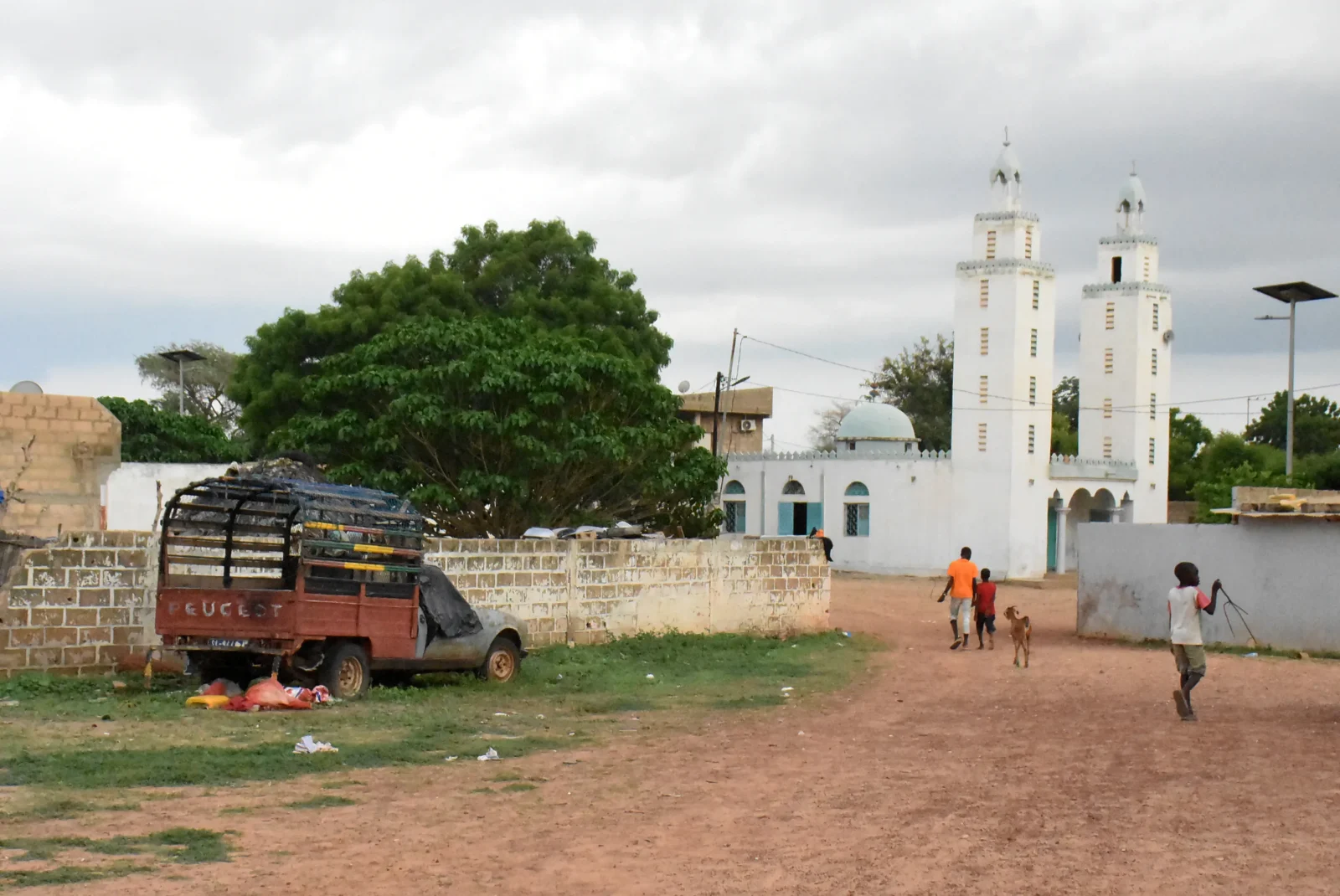
Then, at the end of this track, Nder Naar appears. At first glance, nothing particularly distinguishes this village from other rural towns in Cayor. However, behind this apparent tranquility lies a history dating back more than a century and a half, intimately linked to Islamic teaching and to some of the great religious figures of Senegal.
At the entrance to the village, a cemetery. The visitor is immediately taken back to history. This is where Cheikh Sidy Khouya Kounta rests, born in 1823 and died in 1895. To understand Nder Naar, you have to start with him.
His father Mame Abdou Latif Kounta from the Kunti fraction of the woulad wafi came to visit his cousin Cheikh Bounama Kounta, the latter gave him in marriage his eldest daughter Sokhna Fatma Kounta
Mouhamed Dioulite Kounta, great-grandson of Cheikh Sidy Khouya Kounta, is one of the custodians of this family memory. When he talks about the history of the village, he goes back to the origins, long before the name Nder Naar took hold.
“Nder Naar’s real name was Darou Salam. This is the name given to it by its founder, Cheikh Sidy Khouya,” he says.
The name Nder Naar would have come later. It would be linked to a baobab which was in the locality and around which birds called “Nder” lived. Over time, the name of these birds would have come to designate the village.
But the name is only a gateway to a much larger story.
“Her real name is Sidy Lamine. But “Khouya as his sister called him” was a sign of affection,” explains Mouhamed Dioulite Kounta.
Behind this name lies the journey of a man whose life was devoted to knowledge and transmission.
The return from Mauritania
Before becoming the master of Darou Salam, Sheikh Sidy Khouya had been a student of the Koran. Family tradition reports that he was sent to Mauritania to complete his religious learning. There he studied the Koran and Islamic sciences.
But far from his family, his absence continued. His mother Sokhna Fatma Bounama asked for him. His uncle, Sheikh Al-Bakaye, then asked him to come back. He returned to Senegal with knowledge that he would now pass on.
“Khouya was sent to Mauritania where he learned the Koran. Returning home, he settled down and began teaching.
Local tradition also relates the role played by one of his uncles, Pothie Fall, in its establishment. Lat-Dior would have outlined the perimeter on which his establishment would take shape.
The place gradually becomes a place of teaching. Children come to learn the Koran. Disciples settle down. Men of knowledge pass by there. Nder Naar is beginning to move beyond its strictly local framework.
The creation of the village is located in 1864. From this period, Darou Salam gradually becomes a religious center whose influence extends beyond the limits of the village.
When the village becomes a school
In Nder Naar, knowledge was not limited to reciting the Koran. Cheikh Sidy Khouya taught different dimensions of religious knowledge.
According to the story passed down by his descendants, he highlighted two notions in particular: sharia and haqiqa.
Around the teacher, an organization of teaching is put in place. People are responsible for learning the Koran. Students come to receive the basics of religious knowledge.
But Nder Naar also welcomes scholars. Cheikh Sidy Khouya is not just a teacher. He is also a man of the pen.
“He wrote a lot,” emphasizes his great-grandson.
Part of his heritage is thus found in his writings, but also in the oral memory preserved by his descendants.
Before becoming a center of knowledge, Nder Naar is also a story of land. A land obtained in circumstances that family memory continues to tell.
Cheikh Becaye Kounta, son of Mouhamed Dioulite Kounta and direct descendant of Cheikh Sidy Khouya, looks back on this episode which would have determined, for a long time, the agricultural vocation of the village.
“The space was occupied by an uncle of Lat Dior. But Houya had prayed for Lat Dior and his wishes were granted,” he says.
Grateful to the master, Lat Dior would have liked to show him his gratitude. He asked him what he could do for him, what he wanted in gratitude.
“He asked her: what do you want to please yourself? As a token of recognition. Houya told him, “I just want land to farm.” »
Lat Dior then decides to give him the space occupied by his uncle.
“So, Lat Dior gave him ten square kilometers that his uncle occupied,” continues Cheikh Becaye Kounta.
Ten square kilometers of land which would gradually become the material base of Nder Naar. Cheikh Sidy Khouya made it an area devoted to agriculture and livestock.
The village would thus develop around a dual vocation: feeding people and training minds.
This agricultural dimension is still visible today. Arriving at Nder Naar, the fields appear even before the first houses. The land remains at the heart of village life.
The population, too, has grown over time.
“Today there are forty households in the village. But most of them grew up and gave other homes,” explains Cheikh Kounta.
The first homes grew larger. The children grew up, started their own families and in turn built new homes.
The village thus expanded without really breaking with its original organization. The land given to Cheikh Sidy Khouya became, over time, a living space.
The meeting with Mame Mor Anta Saly
The history of Nder Naar is marked by the relationship between Cheikh Sidy Khouya and Mame Mor Anta Saly.
Following a dream considered to be a harbinger, the latter took the young Ahmadou Bamba to the master.
According to oral tradition, Cheikh Sidy Khouya recognized Ahmadou Bamba’s exceptional spiritual vocation very early on. He announced his future greatness. He honored him by having the largest ox in his herd sacrificed, a highly symbolic gesture.
By Oumar FEDIOR
