
In the laboratory plots, the future of Casamance rice It is barely past 9 o’clock and the feet are already sinking into the damp earth. In the valleys of the Agricultural Research Center (Cra) of Djibélor (Ziguinchor department), women are bent over young rice plants. A few meters away, the technicians…
It’s barely after 9 o’clock and already our feet are sinking into the damp earth. In the valleys of the Agricultural Research Center (Cra) of Djibélor (Ziguinchor department), women are bent over young rice plants. A few meters away, technicians inspect the plots, monitor the water and track signs of salinity. Here, nothing is left to chance. In these spaces, each variety is tested, selected and multiplied before heading to agricultural cooperatives.
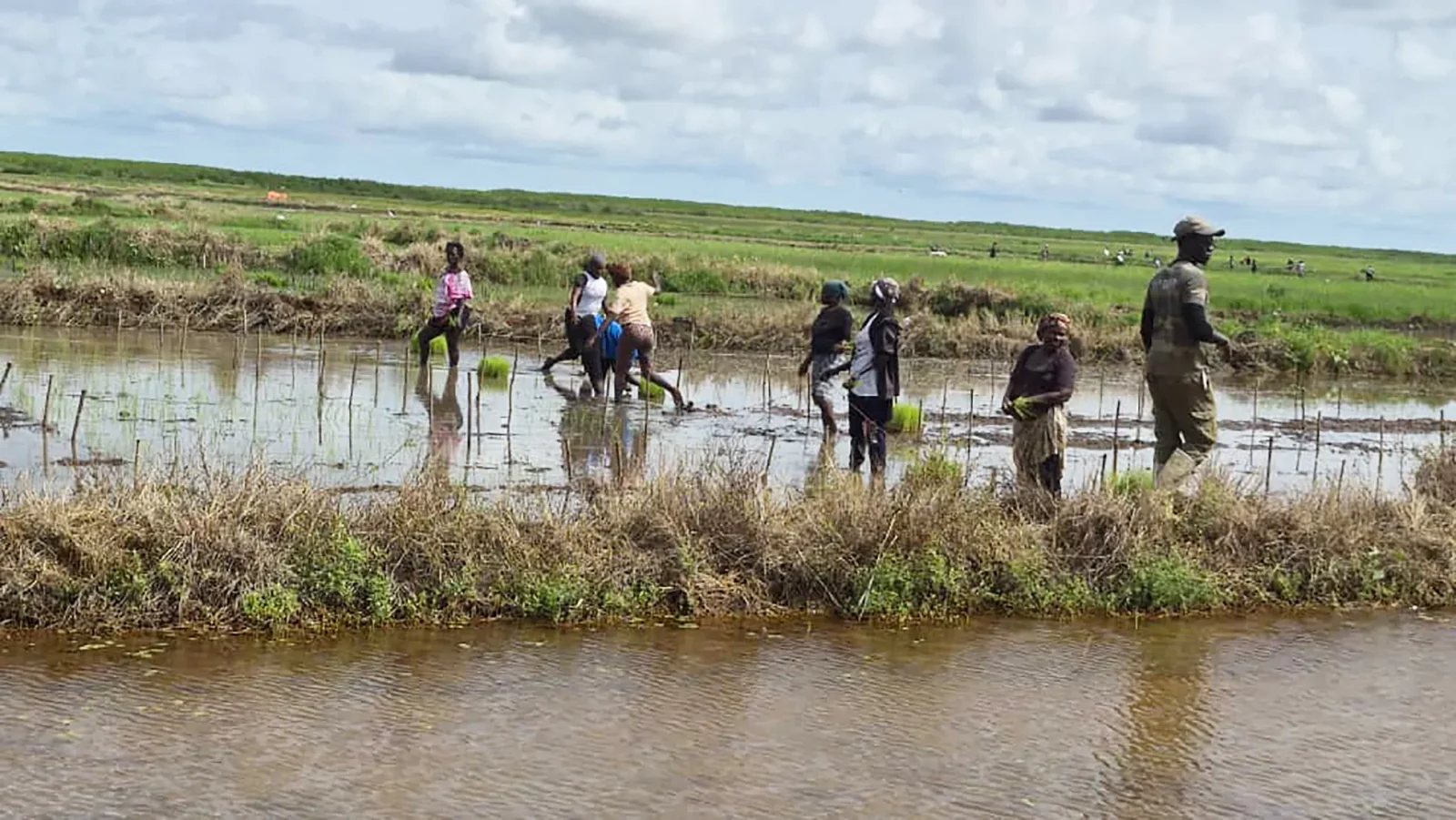
ZIGUINCHOR ‒ Tuesday September 1, 2026. The sun begins to shine above the valleys of Djibélor (Ziguinchor department). The air is still heavy with the humidity characteristic of Casamance mornings. As you move away from the road, the noises of the urban center disappear. Before us, the landscape opens up. Green. Everywhere ! Carefully drawn plots of rice, bunds, channels, puddles and, in the middle of it all, silhouettes leaning on the earth. These are the women. They move slowly, almost at the same pace. One hand holds the young plants, the other pushes them into the earth. Then they move a few centimeters and start again.
A gesture. Then another. The same gesture, hundreds of times. To succeed in seed experimentation, the Cra de Djibélor received financial support as part of the Competitiveness Program for Agriculture and Livestock in Senegal (Pcae), implemented by the Ministry of Agriculture. At first glance, nothing really distinguishes these plots from a traditional rice field. However, behind this apparent simplicity lies particularly meticulous scientific work. “What you see here corresponds to the first link in the seed chain. We are working on generations G1, G2 and G3. The G stands for generation. G1 is the first level, where we ensure conservative selection, maintenance of the characteristics of the varieties and the production of pre-basic seeds,” explains Jeannot Diatta, expert in varietal selection at the Djibélor Agricultural Research Center in Ziguinchor. He speaks standing at the edge of the plots. Behind him, the young plants seem tiny.
However, it all starts here. Before the producers’ fields. Before the seed bags. Before the harvest, everything starts here, in these small plots where each variety is observed, controlled and multiplied. “In G1, we work on plots of 100 square meters, or 10 by 10 meters. These are small areas because we are still at the first level. Then, in G2, the areas increase to around 1,250 square meters. And in G3, we can go up to 5 hectares,” explains the technician.
In Djibelor, the particularity is elsewhere. No large irrigation facilities like in the Senegal River valley. Here, the sky is an actor in its own right. The rain commands. “Our particularity is that we work in a strict rain-fed system. So we mainly depend on precipitation. This is different from Saint-Louis, where our colleagues work more in the irrigated system. Here, we produce seeds adapted to the rainfed rice growing conditions of Casamance,” explains Jeannot Diatta. This year, for the moment, the sky is not against the researchers. “For the moment, the rainfall is normal. We are not in a deficit situation. The meteorological data available to us indicates that we are within the norms,” he assures. But in these valleys, every day counts. The campaign started about two weeks ago. We must now complete the installation of the plots.
Here, it’s the rain that sets the tempo
“We should normally complete the implementation this week, before September 10 at the latest. We need to respect this schedule to allow the different varieties to complete their cycle, because some have a short cycle and others a long cycle,” explains the expert in varietal selection. A few meters further on, the work continues. The tractor has already made its way. The machine has prepared the ground. But the last word still goes to women. Adèle Diatta is among them. She has known these plots for several years. “I’ve been working here for about six years. When I arrived, other women were already there. We do direct seeding first, then we come back to spread the organic matter, remove weeds and transplant the rice. Then, during growth, we come back regularly to weed,” she says. Immediately afterwards, she plunges her hands into the earth again. “We started working in these fields in March, particularly with the bringing of mango leaves into the valleys. This helps improve soil fertility. For transplanting, we start at 8 a.m. and we can work until 2 p.m.,” continues Adèle Diatta.
A few plots away, Siméon Bassène is waiting for us. Responsible for seed production at Cra de Djibélor, he knows every corner of the station. He points to the plots. “This station is 25 hectares. We carry out both experiments and production of pre-basic seeds there. For the G2 and G3 generations, we have the BG 90, the War 77 and the Roc 5, with one hectare for each, as well as around three quarters of a hectare for the War 1,” he explains. The transplanting is complete. But some plants have disappeared. We have to start again. “We have completed the transplanting. Currently, we are re-seeding to replace the plants that did not survive,” he says. “For the moment, tillering has not yet started. If you come back in a fortnight, you will see a big difference. The plants will have grown again and the plot will be much denser,” promises Siméon Bassène.
Faced with salt, researchers bring out the “artillery”
But something is worrying. Salt! In certain parts of the valley, traces of saline intrusion are visible. Some plants died. “We have recorded some mortalities linked to saline intrusions. We had already used TerraCalco. Now we need to let the plants grow before flooding the plot further. The water blade will exert pressure and push the salt beyond the area occupied by the roots,” explains Siméon Bassène. The fight against salinization is being waged on several fronts. Dams. Amendments. Organic materials. Careful water management. And above all, the choice of varieties.
“To combat salinization, we first have physical means, notably anti-salt hydro-agricultural dams. We also use calcium amendments such as TerraCalco, but also phosphogypsum. Organic amendments, including mango leaves, also play an important role,” he explains. He adds: “You also have to master the water blade and choose the varieties correctly. In salty areas, you cannot put just any rice. Some varieties are very sensitive to salinity. We therefore favor tolerant varieties like Roc 5, War 1 and War 77.” In these plots, the fight against salt is therefore not only a question of chemistry or water. It also plays out in the genetic heritage of rice to the extent that variety becomes a weapon.
