
The Western Corniche of Dakar breathes again August 28, 2026
A few weeks before the Dakar 2026 Youth Olympic Games, scheduled from October 31 to November 13, the West Corniche of Dakar is changing. The release of certain spaces formerly occupied by commercial activities gives space to walkers and athletes, with an underlying question: how can we sustainably preserve this public space by the ocean?
Between the strides of joggers, the steps of walkers and the movements of athletes, the Western Corniche of Dakar has regained a little of its breath.
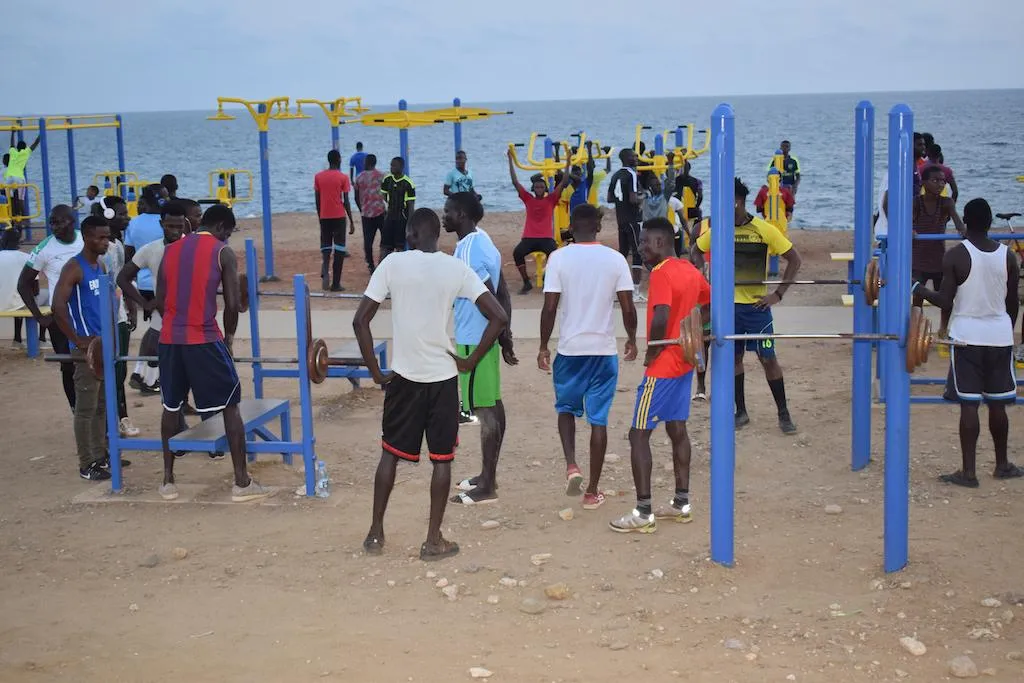
Along this space gained on the Dakar coastline, residents move around with greater ease. Some come to run, others to train on the sports equipment or simply to enjoy the breath offered by the seafront.
Wednesday August 26, a little after 6 p.m. After a day of intense heat, the last rays of the sun begin to fade. A light breeze from the ocean accompanies the first athletes. Joggers, walkers, young people in sportswear and families pass each other on the axis connecting the Place du Souvenir africain to the roundabout of the Rectorate of the Cheikh Anta Diop University of Dakar.
Amsatou Ndiaye is one of those who have adopted this new rhythm. A teacher established at Fann Hock, she has just finished her work day. With her cap tied, she sits on sports equipment and goes through the exercises. The arms work and the legs follow. She breathes, recovers for a few seconds and continues again.
“We have rediscovered the beauty of our Corniche. We breathe clean air and we train in a healthy environment,” rejoices the fifty-year-old.
A few meters away, Seynabou Sall picks up his pace. This thirty-year-old has made walking her regular appointment. She stops in front of a piece of equipment, works her legs, then resumes her route.
Absa Gomis prefers a more relaxed pace. Beside him, two teenagers finish their run by stretching. “I come here regularly to walk. It’s nice because we’re outside, with the sea nearby,” confides Ms. Gomis, her face sweating.
These scenes tell another life on the Corniche. The waterfront is no longer just an axis of circulation along the ocean. It also becomes a space for gentle mobility, physical activity and relaxation.
In a dense capital, where open public spaces are precious, the Corniche constitutes a real breathing zone.
The transformation can be seen above all in the uses. Residents come to run before returning home, walk after work or maintain their physical condition without having to pay for a gym.
“We now see a lot of people coming to play sports. The space seems more open,” notes Abdou Seck, a young sportsman used to the place.
Thiaba Sambe belongs to this new generation of users. With headphones in her ears, she takes advantage of the facilities to do a few exercises before returning.
“I can come after work, do a few exercises and come back. It’s practical and it doesn’t cost anything,” she explains.
Beyond the facilities, it is therefore a public space which seems to regain its function. La Corniche offers Dakar residents a place to move, get some fresh air, meet up and enjoy the coastline.
A dynamic which occurs in the particular context of the preparation of the “Dakar 2026” Youth Olympic Games scheduled from October 31 to November 13, 2026, but which users above all want it to survive the competition.
Explanations from the mayor of Mermoz-Sacré-Cœur
Reached by telephone, the mayor of Mermoz-Sacré-Cœur, Alioune Tall, explains that the decluttering operations are the result of reflection and consultations carried out upstream.
“After reflections and meetings, we felt that it was necessary to release the right of way,” he says.
For the councilor, the issue goes beyond just preparing for the “Dakar 2026” Youth Olympic Games. “It is practically the only space that populations have to enjoy the sea and the sea air,” he emphasizes.
The municipality has therefore initiated actions to free certain sectors occupied by installations.
The operation mobilizes the town hall of Mermoz Sacré-Cœur, the town hall of Fann-Amitié-Point E, the Ministry of Urban Planning and the City of Dakar, within the framework of intermunicipality, with the support of the police.
If the Joj gives particular visibility to the transformation of this part of the Dakar coastline, the mayor presents it as an action in favor of the living environment and the environment.
“The objective is to improve our living environment and preserve our environment in a sustainable way,” he says.
Babacar Gueye DIOP
