
Professor Youssoupha Ndiaye offers his life as an educator as an example August 24, 2026
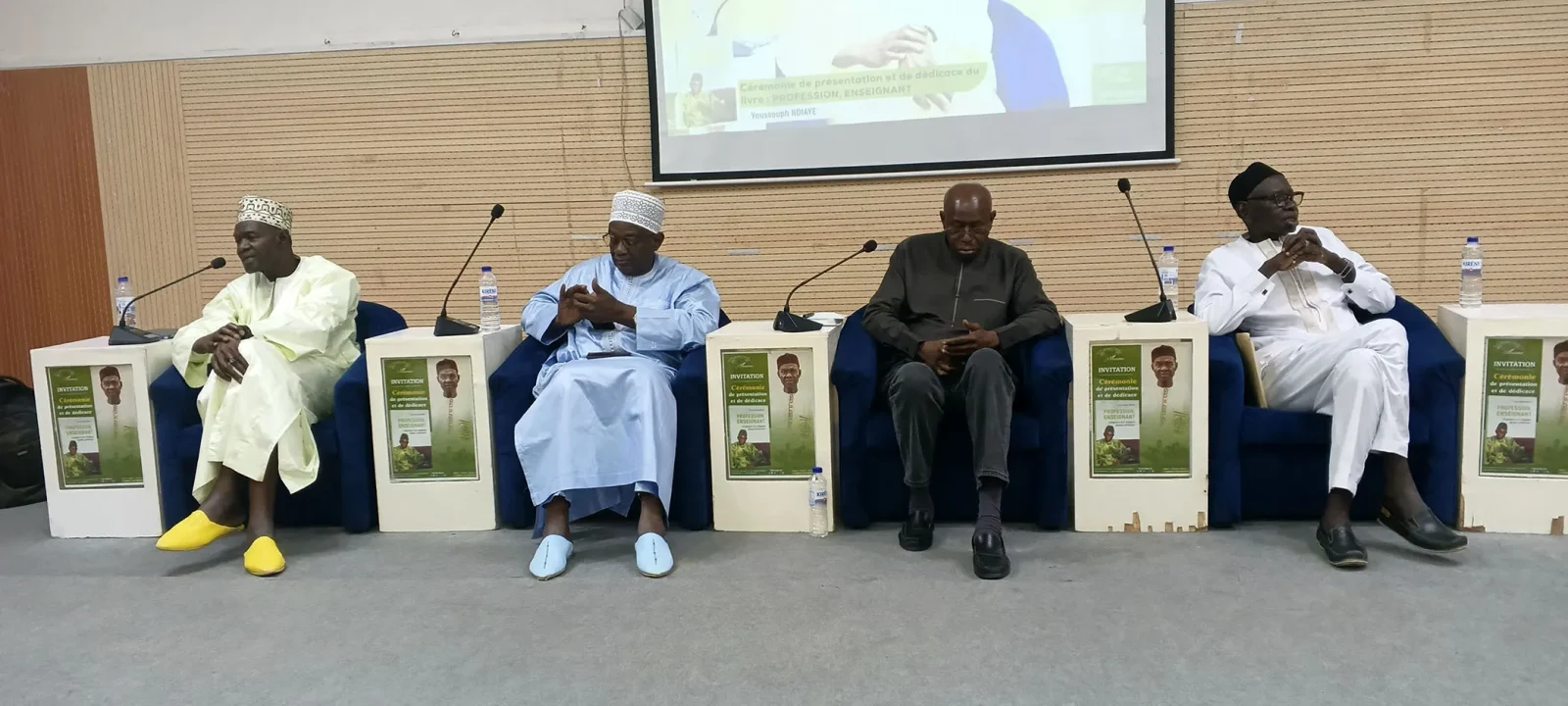
In his book “Teaching profession, the journey of a villager who became a teacher”, Youssoupha Ndiaye, who climbed all the ranks before becoming a principal, retraces a journey made of trials, perseverance and loyalty to the school. Presented last Saturday in Dakar, the 229-page work is intended to be both a life story, testimonies about the profession and transmission to younger generations.
He could have stayed in the village and become a farmer. But the destiny of Youssoupha Ndiaye took another direction. Born in Thiaré Langhem, in Saloum, in the Kaolack region, the former principal of high school Seydou Nourou Tall, history-geography teacher and sociologist, made school the path of personal and social transformation. The spark for writing came from his students. Some found it hard to imagine that their well-groomed teacher could have grown up in a village. A 6th grade student even asked him, after a lesson devoted to the rural world, if he had ever seen a village. Others, hearing him speak Wolof, were surprised at his mastery of this language, convinced that he had lived in Europe for a long time. These perceptions pushed him to write to “distinguish between appearance and reality”. Behind the teacher is a village child who has experienced effort and deprivation. “Teaching profession” thus becomes a living memory. The author recounts his childhood, his attachment to Thiaré, his years of apprenticeship, his stays in Kaolack and moments when abandonment could have prevailed.
In particular, he talks about a difficult period spent in a family that was not his and where he “saw all the colors”. He held on, then returned to his loved ones and found a framework allowing him to continue his studies. The university years are also tough. Youssoupha Ndiaye remembers those days when he did not have a ticket to eat at the university restaurant. A comrade, Matar Dramé, then kept his bread for him, which he swallowed with a few peanut seeds. His mother knew nothing about it. “If she had known, she would have come to get me,” he confides. These scenes call for neither complaint nor pity. They illustrate a central value of his journey, resilience. The author returns to his academic orientation. Admitted to a course that did not correspond to his project, he fought to join the history and geography department. A good student in Arabic, he believes he does not have the oral fluency necessary to continue on this path. His admission to history and geography will be experienced as a deliverance and will shape his entire career. The book, presented last Saturday at Éditions L’Harmatan Sénégal, also bears the trace of a time when the French school still aroused mistrust. Youssoupha Ndiaye recounts the surprise of a parent discovering that he could read and translate a letter in Arabic as well as passages from the Koran. The episode becomes the symbol of a possible dialogue between the modern school and cultural heritages. But the work is not limited to the story of an ascent. It is also a reflection on the teaching profession.
Another conception of the teaching profession
For Youssoupha Ndiaye, transmitting knowledge first requires creating the conditions for its reception. “You cannot communicate knowledge in a gloomy atmosphere,” he says. In his classes, he therefore regularly uses games, dramatization, imitation and humor to awaken attention. He mimes, plays characters, transforms certain sequences of the course into small scenes, convinced that a concept retained with a smile can become permanently anchored in the memory. This conception of the profession is accompanied by an ethical requirement. The former principal deplores teachers who neglect their obligations in the public sector to favor private lessons. He does not condemn accumulation, but calls for it to be practiced “with ethics and with dignity”. In his eyes, entering a class is not enough to make a teacher. Some discover their vocation and become true educators. Others, he regrets, remain in the “camouflage”, to the detriment of the students. Preface to the work, Dr El Hadj Habib Camara sees in this story much more than an autobiography. According to him, it is “a lesson in sociology, success and active pedagogy”. The work, he emphasizes, is mainly aimed at the author’s former students and young teachers. The former find there an invitation to succeed without denying their origins, to remain attached to the family and the values of their environment. The latter can draw from it a rigorous, ethical and living conception of the profession.
Mr. Camara places particular emphasis on humor which gives the book its particular tone. The anecdotes allow the author to revisit happy moments as well as difficult passages. Dr Habib Camara sees it, in turn, as an educational tool, a form of self-deprecation, a cement of bonds and a means of resisting adversity. The “pink donuts”, the jam mistaken for sugar at the university restaurant or the class memories give the story its lightness without weakening its depth. Humor also serves to denounce the flaws of the profession. Through the story of a teacher who abandons his class at public school to go teach in the private sector or that of a teacher surprised by an inspector, Youssoupha Ndiaye exercises satire without excessive anger. “Through each anecdote, whether tragic, funny or educational, he shows that life itself is the greatest school,” summarizes the preface. Beyond the career, “Teaching profession, the journey of a villager who became a teacher” is finally a book of loyalty. Loyalty to a village, to a family, to fellow travelers and to those who made the climb possible.
The author does not hide his attachment to Thiaré Langhem, to the point of wishing to rest there one day. “This land remains the matrix of its identity,” he wrote. From the child not inclined to the fields to the teacher, from the young student who knows hunger to the educator, his journey carries a conviction: origin does not condemn destiny, on the condition of working, resisting and keeping the memory of the path traveled.
Daouda DIOUF
