
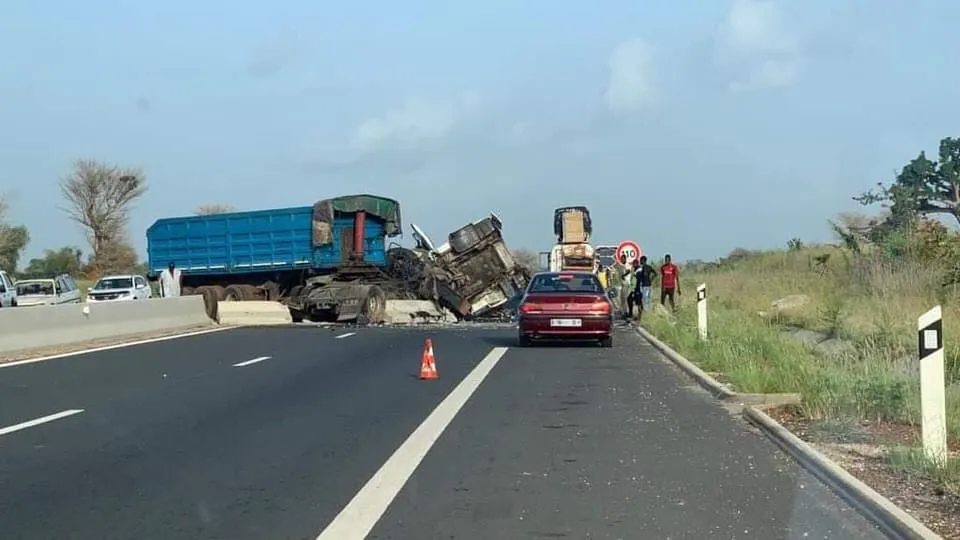
(Data journalism) 868 deaths, 15,407 accidents: the chilling toll on Senegalese roads in 2025
Senegalese roads caused 868 deaths in 2025, according to figures from the National Road Safety Agency (ANASER). Here is what the overall figures reveal, as well as the causes and the regions most affected.
Road accidents remain one of the most worrying public health problems in Senegal. This observation is consistent with that of the World Health Organization (WHO), which recalls that nearly 90% of deaths linked to road accidents worldwide occur in low- or middle-income countries. Despite the public policies implemented by the Senegalese authorities to stem this phenomenon, the trend remains alarming: the number of road deaths continues to increase from year to year.
The 2025 report from the National Road Safety Agency (ANASER), published in February 2026, provides an edifying inventory. Over the whole year, 15,407 accidents were recorded across the country, causing 868 deaths, 5,592 serious injuries and 9,536 minor injuries. These figures reflect a daily reality: on average, more than 42 accidents occur every day on Senegalese roads, causing an average of 2 to 3 deaths daily.
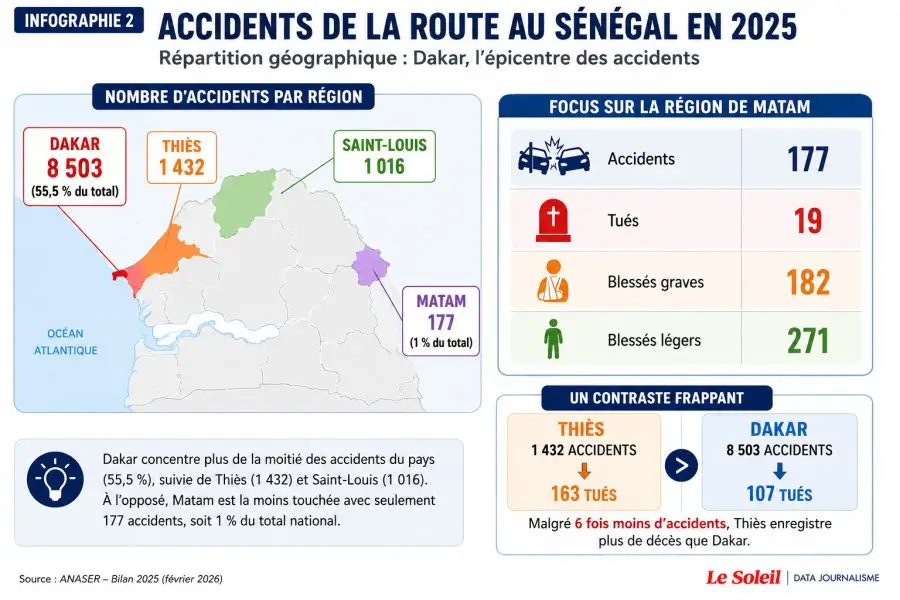
Dakar, the epicenter
The geographical distribution of accidents reveals an extreme concentration around the capital. The Dakar region alone accounts for 8,503 accidents, or 55.5% of the national total, more than half of the country’s losses in a small territory. It also records more than 19% of serious injuries, and more than 25% of minor injuries nationally.
Thiès and Saint-Louis complete the top three with respectively 1,432 and 1,016 accidents. In contrast, the Matam region appears to be the least affected with 177 accidents (1% of the total), 19 killed, 182 seriously injured and 271 lightly injured.
However, one lesson deserves to be raised: the number of accidents is not always correlated to their seriousness. The Thiès region illustrates this paradox in a striking way. While it records a number of accidents six times lower than that of Dakar, it totals 163 deaths compared to 107 for the capital. In other words, the accidents occurring in Thiès are in proportion significantly more deadly than those in Dakar, a probable signal of higher speeds and less dense traffic but more dangerous by impact. Overall, it is the regions concentrating the majority of economic activities and mobility flows (Dakar, Thiès and Saint-Louis) which pay the heaviest price for road insecurity.
December and the summer holidays, a high-risk period
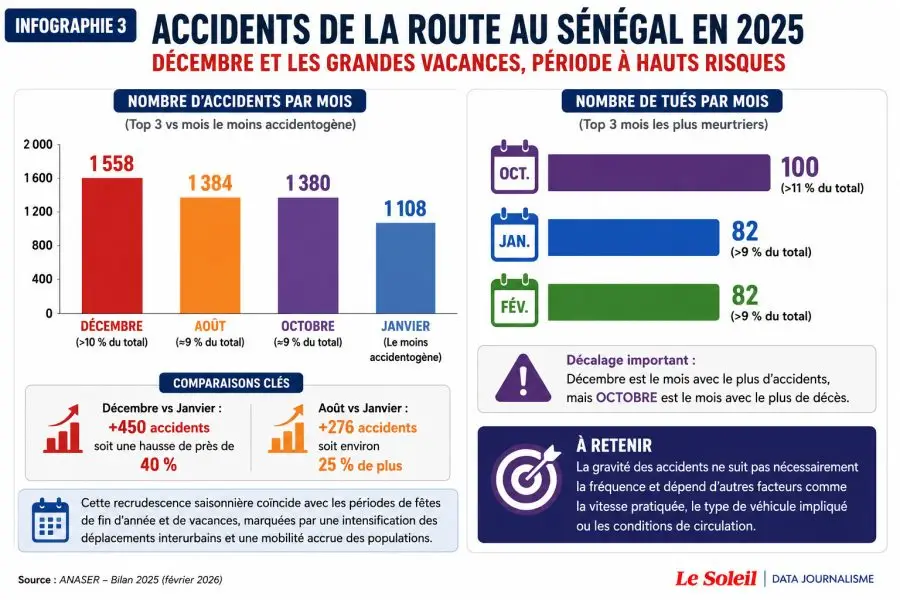
Monthly data analysis highlights a marked seasonality. The month of December is the deadliest in terms of number of accidents with 1,558 cases, or more than 10% of the annual total. It is followed by the month of August (1,384 accidents) and October (1,380 accidents), each representing nearly 9% of the year’s cases.
In comparison, the month of January recorded “only” 1,108 accidents. The difference is significant: December has 450 more accidents than January, an increase of almost 40%, while August has 276 additional accidents (around 25% more). This seasonal upsurge coincides with the end-of-year and holiday periods marked by an intensification of interurban travel and increased mobility of populations throughout the territory.
When it comes to victims, an “interesting” discrepancy appears. It is the month of October which concentrates the greatest number of deaths with 102 deaths (or more than 11% of the annual total). It is closely followed by January and February with 82 deaths each (more than 9%). This gap between the most accident-prone month (December) and the deadliest (October) suggests that the severity of accidents does not necessarily follow the frequency and that it probably depends on other factors such as the speed used, the type of vehicles involved or the traffic conditions specific to each period.
Major roads, death row
National roads and motorways alone account for 6,431 accidents, or more than 41% of the national total. The dangerousness classification of these axes is final.
The national road number one (RN1) which connects Dakar to the Malian border over 646 km comes well ahead with 1,458 accidents, or 23% of accidents occurring on the main roads. This corresponds to a density of 2.25 accidents per kilometer. On a human level, this axis is also the deadliest with 141 deaths and more than 2,200 cumulative injuries.
The A1 highway linking Dakar to Mbour over a little over 90 km ranks in 2nd position with 21% of accidents on major roads. Its accident density is in reality much higher than that of the RN1 compared to its length: 15.1 accidents per kilometer compared to 2.25 for the RN1, a figure which calls into question the safety of this infrastructure, which is more recent and supposed to be better secure.
National roads number 2 and number 3 concentrate respectively 10% and 15% of accidents on major roads, sections characterized by dense traffic and a strong presence of heavy goods vehicles transporting goods.
In terms of mortality, RN2 recorded 92 deaths, just behind RN1. Conversely, the least accident-prone sections of the national network are the RN8 (Rufisque-Saint-Louis section), the RN7, the RN4, the RN 6 and the Voie de Dégagement Nord (VDN) which recorded only one death over the year. Finally, it is appropriate to underline the weight of urban roads which alone recorded 131 deaths and 789 serious injuries, revealing that the danger is not limited to the main interurban roads but massively affects daily traffic in urban areas.
The human factor, the overwhelming cause of accidents
The analysis of the causes of accidents confirms a reality already well documented in the literature on road safety: human error largely dominates technical or environmental causes. Non-compliance with driving rules, which include distracted driving, non-compliance with priority at intersections, drunk driving and non-compliance with signs, constitutes the leading cause of accidents with 30% of cases recorded. Even more serious, this category of cause is responsible for nearly 40% of deaths recorded in 2025.
Lack of vehicle control comes in 2nd position with 25% of accidents, followed by excessive speed (20%) and recklessness (16%). Mechanical failure, often singled out in public opinion, actually represents only 4% of accident causes, a figure significantly lower than the individual behavior of road users. Miscellaneous causes not classified in the previous categories total 5%. This hierarchy of causes confirms that the fight against road insecurity in Senegal is based above all on a change in driving behavior rather than on the state of the vehicle fleet or infrastructure.
Evening and afternoon most critical time slots
On major roads, the distribution of accidents according to time of day draws a clear profile. The 6 p.m. to midnight time slot alone accounts for 37% of accidents, followed by the 12 p.m. to 6 p.m. time slot with 33%. Together these two slots in the afternoon and evening therefore represent 70% of accidents occurring outside urban areas, a proportion which can be explained by intense vehicle mobility at these times, combined with smoother traffic, therefore more conducive to speed, outside urban areas.
The 6 a.m. to 12 p.m. time slot represents 25% of accidents. On the other hand, the night period 00:00-06:00, which corresponds to the time of traffic ban imposed on public transport vehicles, only records 5% of accidents, confirming the effectiveness of this regulatory measure in reducing risky night-time traffic.
Vulnerable users, first victims of urban collisions
Examining the types of collisions in urban areas highlights a very unequal exposure of road users to road risks.
Collisions between mopeds constitute the most frequent type of accident in the city with 30% of recorded cases. They are also responsible for a disproportionate share of mortality and injuries: 34% of deaths and 63% of injuries in urban areas are linked to this type of collision. This observation reflects the predominant place taken by motorized two-wheelers in Senegalese urban mobility as well as the intrinsic vulnerability of their drivers, who are poorly protected in the event of an impact.
Collisions between motor vehicles, although busy (25% of urban accidents), paradoxically present a much more modest contribution to mortality with only 4% of deaths, the bodywork and safety equipment of cars offering significantly greater protection than that of bays.
Pedestrians and cyclists appear to be the biggest victims of the road. Pedestrians hit by a vehicle represent only 4% of urban accidents but account for 17% of deaths and 17% of serious injuries. An extremely high severity ratio for this category of users. Likewise, cyclists hit by a vehicle represent only 9% of accidents but 19% of deaths, confirming their extreme exposure in the absence of suitable cycling infrastructure.
Finally, the report highlights an emerging phenomenon to be monitored: accidents involving horse-drawn vehicles which are still marginal (9% of accidents, 3% of deaths, 6% of serious injuries) but whose progressive presence in urban and peri-urban traffic constitutes a new challenge for road safety/
The 2025 report from ANASER paints a portrait of Senegalese road accidents that are both massive and concentrated: concentrated geographically around Dakar and the main structuring routes (RN1, A1 motorway), concentrated in time around periods of high mobility (end-of-year celebrations, vacations), and concentrated in terms of causes since human behavior (non-compliance with driving rules, excess speed, recklessness) explains the overwhelming majority of accidents. disasters, far ahead of mechanical failures or road conditions.
This reading of the data calls for targeted action: strengthening of controls on the deadliest routes, increased awareness during busy periods, reinforced protection of vulnerable users (pedestrians, cyclists, two-wheeler drivers), and above all, in-depth work on respecting driving rules, identified as the most determining factor in the occurrence of fatal accidents in Senegal.
Oumar Boubacar NDONGO and Cheikh Tidiane NDIAYE
