
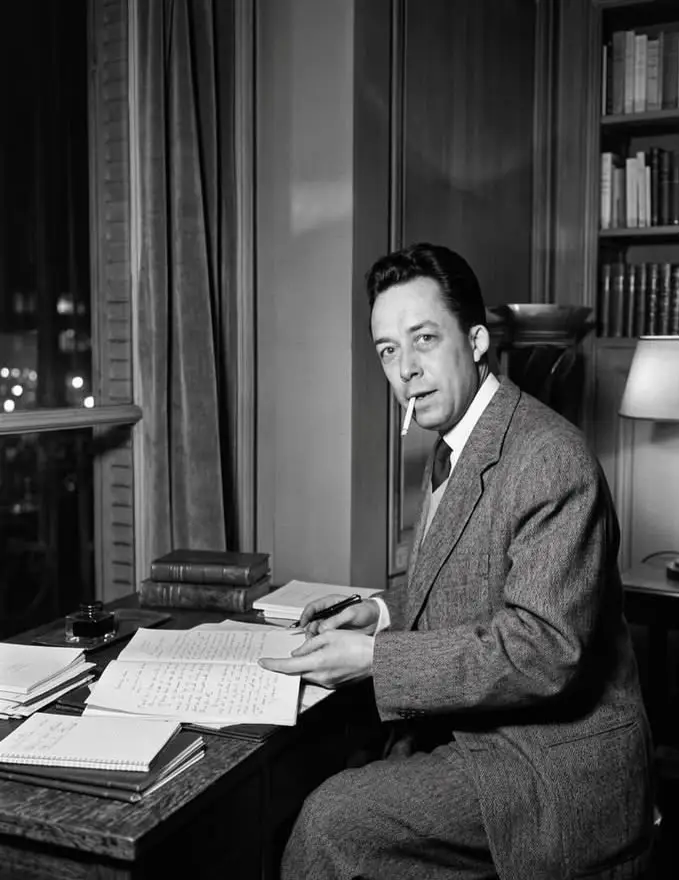
Literary space: Camus, elegy on the edge of “meaning”
Today, Albert Camus is dead. The sentence would be worthy of Meursault, except that Camus would undoubtedly have found the situation a little ironic. The man who had spent his life writing about the absurd, death, freedom and revolt ended up receiving the Nobel Prize in Literature in a rented tuxedo in Stockholm, while his wife wore a dress that their daughter Catherine would remember. Chance definitely had a sense of staging. Under the gilding of the Swedish Academy, Camus nevertheless spoke of something much less ceremonious, the responsibility of the writer towards men and their time. From the poor Algeria of his childhood to the streets of Oran struck by the plague, from Sisyphus condemned to push his stone to the rebellious man refusing to sacrifice his fellow man to an idea, Camus will have spent his life searching for how to live in a world which provides no answers, with the only certainty that death never misses an appointment.
On December 10, 1957, Stockholm was white with cold when Albert Camus came to receive the Nobel Prize for Literature. He is forty-four years old and, on this day full of ceremonies, there is a man wearing a tuxedo that he had rented, while Francine, his wife, is wearing a dress for the occasion. Years later, their daughter Catherine would remember these details with the loving precision of family memories, giving the ceremony a humanity that official photographs cannot contain. Camus arrives in Stockholm with the glory that the Swedish Academy has just given him, but also with everything that preceded this consecration. When he speaks before the Swedish Academy, Camus speaks with the heart of a man who knows that literature does not constitute a private territory and that a work also belongs to those whose wounds, hopes and silences it bears. He thinks of his masters, his fellow resistance fighters, the writers who preceded him and those who worked in the shadows without knowing honors. “Art is not a solitary pleasure,” he asserts, and this sentence summarizes an entire conception of the writer, called to enter the community of men, to take part in their destiny without renouncing the freedom of his conscience. The ceremony ends, the applause disperses, the tuxedo will return to its owner, the photographs will enter the archives and the speech will reach the libraries. But Camus’ thought immediately brings us back to an older question, the one that has accompanied his work since “The Myth of Sisyphus”, how to live when the world gives no response to our need for meaning? To understand this question, we must return to Algiers. Camus was born in 1913 in Mondovi, into a poor family, and lost his father during the First World War before really having time to know him. Her mother, Catherine Sintès, raises her children alone in a modest apartment in Algiers, almost deaf, illiterate, silent and hardworking. In this house where money is lacking, young Camus nevertheless discovers a wealth that his thoughts will never cease to celebrate, light, the sea, the body, football, summer afternoons and this immediate beauty which needs no justification to exist. All its singularity is already found in this coexistence of poverty and splendor, death and joy, injustice and beauty. In “The Myth of Sisyphus”, published in 1942, Camus places the absurd at the center of his thinking. Man asks the world for an answer that the world does not have, seeks a reason for his existence, justice for his suffering and a promise capable of giving death meaning.
The reverse and the right side
Man knows his end and it is precisely this knowledge that gives each moment a particular value. Sisyphus pushes his rock, the stone comes back down and his work begins again, without definitive accomplishment or promised rest at the top. However, Camus asks us to imagine Sisyphus happy, not because he is resigned to his misfortune, but because he is aware of his destiny. He knows what awaits him and resumes his walk, master of this existence which offers him no external consolation. Mediterranean light belongs to this philosophy. Agnès Spiquel, one of the great specialists of Camus, notably worked on this alliance between the absurd and the affirmation of life. In Camus, the awareness of death accompanies an intense desire to live, and beauty does not erase tragedy, it gives it new depth. The absurd opens up another question, that of action. What to do when the world guarantees neither justice nor meaning? In “L’Homme revolté”, Camus responds with revolt, this refusal of humiliation, oppression and violence which claims to control man. Those who say no for themselves recognize the same dignity in others and transform their individual refusal into a collective demand. “I revolt, therefore we are,” he wrote, giving the revolt a fraternal dimension. Jean-Yves Guérin underlined the importance of this political dimension in Camus’s journey, from the Resistance to journalism, from Combat to the debates on communism and the clashes around Algeria. This is where one of Camus’s great conflicts with his time and with Sartre lies. Their disagreement concerns violence, revolution, communism and the rights that History can claim to exercise over individuals. Camus refuses that a supposedly better future serves as justification for the deaths of the present, that a just cause can give the right to sacrifice men in the name of a superior truth. Michel Onfray insists on this dimension in “The Libertarian Order, the philosophical life of Albert Camus”, where he defends the figure of a libertarian Camus, attached to freedom, to measure and to concrete life, deeply hostile to systems which subject the individual to a collective truth. “The Plague” gives this thought its most human face. In Oran, a disease locks down a city, separates families and transforms the dead into numbers, while Doctor Rieux works among the sick without knowing the meaning of the epidemic or knowing if he will defeat it. He heals because a man suffers before him, without waiting for a metaphysical justification for his work and without asking for an explanation of the suffering before attempting to relieve it. This conviction takes on a painful dimension when it comes to Algeria.
Camusian elegy
Camus belongs to this land by birth, memory and body, he knows the light, the poverty and the injustices of the colonial system, but the war of independence places him in a position which satisfies neither. His attachment to his mother, his positions on violence and his hesitation in the face of independence fuel the criticism he will receive. On January 4, 1960, Albert Camus died in a car accident in Villeblevin. He is forty-six years old. In the wreckage is the manuscript of “The First Man”, the book in which he returns to his childhood, his mother, his deceased father, his school and the poverty which had marked his early years. Death interrupts him at the moment when he returns to his beginnings, as if the writer, after having traveled the world, wars, ideologies and honors, had returned to look for the child he had been. This image has a singular power. The writer celebrated three years earlier in Stockholm, covered with honors, now works on the poor child of Algiers, returns to the mother who did not read his books, to the father of whom he has almost no memory, to the streets and the silences of his childhood. Literary glory fades in the face of this intimate quest and the manuscript will survive the man, while the novel will remain unfinished. Camus offers a way to stand up. When the stone comes back down and everything starts again from the beginning, there is still the possibility of pushing it. This is where Camus’s elegy resides, in fidelity to a life whose end he knew, in love of the world without illusions about the world, in the desire to serve men without ever subjecting them to an idea.
By Amadou KÉBÉ
