
Bathing which purifies the circumcised August 23, 2026
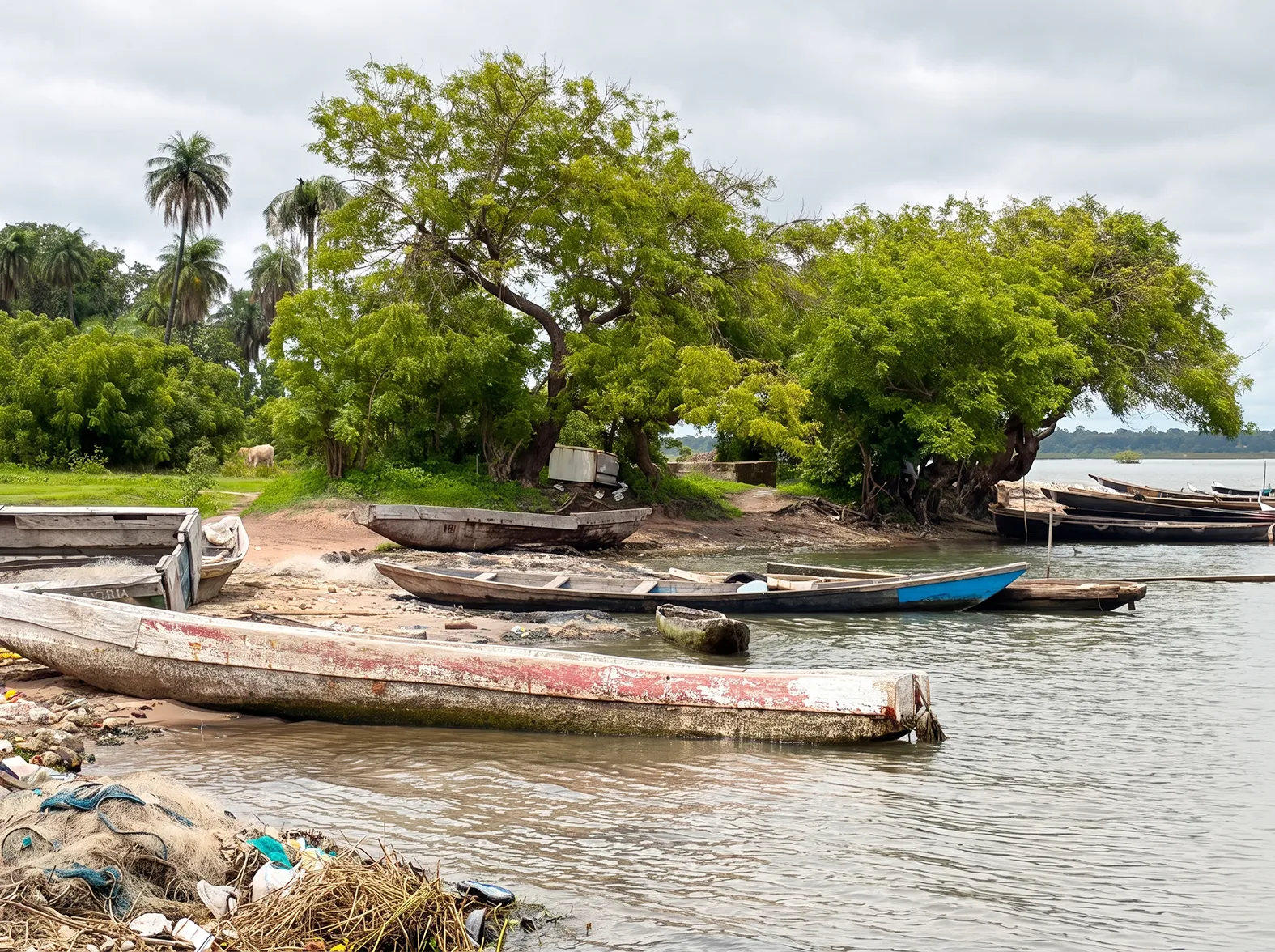
In Marsassoum, the communities still have an ancestral link with the Soungrougrou, a tributary of the Casamance River. There they purify the bodies of widows and those of the circumcised who have been healed. Unfortunately, the river transport and trade which punctuate economic activity day and night on the shore have almost disappeared, leaving some still nostalgic natives to fend for themselves.
MARSASSOUM – Three years after the closure of the sanctuary for the circumcised in the Toronkocounda district, in Marsassoum, the bank of Soungrougrou is still far from rediscovering the atmosphere of the leaf dance, the “Diambadong”.
The Bélal Ly district which was to take over this year, still leaves uncertainty over the holding of this event marked by the bathing of the circumcised in this part of Soungrougrou, very close to Toronkocounda, the district formerly occupied by the Fulani.
According to the stories of the natives, they carried out trade and fishing on this shore, which was once a colonial trading post.
Today, fishing is almost dead on one bank of the Soungrougrou, but traditional rites such as the purification of soiled bodies and the bathing of the circumcised remain the activities that animate this tributary of the Casamance River.
Sitting on a piece of wooden canoe buried half in the sand, Yaya Dramé watches the waves die at his feet.
Anchored in tradition, it is at the heart of circumcision ceremonies organized throughout almost all of Boudié.
“On this specific point, our grandparents prayed there. In the 1980s, they brought the circumcised there, as they left the “Joujou” (Sanctuary of the circumcised) for swimming. Sea water is said to purify. So, if we wash the circumcised with this water, we remove the bad things,” interprets this connoisseur of Mandingo tradition, holding in his hand a nest of millet eaters which he plans to put in his place of business to attract good fortune.
A well-known actor in the world of protective masks for the circumcised, the “Kankourang”, Yaya explains that the Soungrougrou bolong which crosses Marsassoum is an opportunity for local communities.
Place of body purification
Elsewhere, he says, the circumcised are taken to the oldest well in the village to perform the exit swim.
But, among us, our ancestors chose the sea, this arm of the Soungrougrou, for washing the circumcised.
“A choice that contains secrets that I won’t be able to display all of here,” slips the forty-year-old.
In Marsassoum, neighborhoods of the commune such as Sourouacounda, Sorancounda, Kancaba and even hamlets located far from the inlet come to wash the circumcised here.
“It’s a kind of purification. Because even those released from prison come here. We see them washing here before returning home. It’s a way of removing impurities and bad language,” comments Yaya Dramé.
The communities’ attachment to the sea is also mystical.
In many localities in Casamance, to ward off bad luck, the natives open up to the sea.
And this practice is also anchored among the traditional women of Marsassoum.
“In the neighborhoods of the commune, they go out beating gourds on the streets, chanting prayers.
In Marsassoum, these guardians of tradition, according to Yaya Dramé, always end their demonstration by heading towards this bank of the Soungrougrou.
It is also on this same place that they offer purification baths to women at the end of widowhood, Yaya Dramé tells us.
“We made money there”
The Soungrougrou bolong which winds along the commune of Marsassoum was a real economic hub.
In the past, Marsassoum played an important role in the peanut economy.
Peanut shelling factories were installed in the capital of Diassing, encouraging the human rush and the development of trade.
The economic boom has also boosted river transport.
“We found the ferry. It was a real economic era. He commuted every hour. We take advantage of the long waits to get busy travelers across. We made money here,” Yaya Dramé still remembers at the time as a canoeist on the tributary.
“It was a golden period. Traffic was booming. The ferry ceased operations at 9 p.m. Late passengers were obliged to request our services, we canoeists.
And so, the late hours were an opportunity for me to pocket 15,000 FCFA in one trip,” recalls Yaya Dramé, looking wild at times.
Since the crossing was modernized, with the construction of the bridge, open to traffic in 2024, the economy has been at half mast.
The ferry is docked.
On the banks next to the fish sellers’ shelters, the monster stands the test of time.
Attacked by rust, it receives visits from a few curious people on rare occasions.
That was the economic engine.
But since it stopped flying the flag, the local economy has been in decline.
We didn’t expect that,” Yaya seems to regret.
“I benefit from it,” admits Ramata Ndiaye
His stall located like so many others, along the laterite which leads to the bank of Soungrougrou, Ramata Ndiaye accelerates the lever of his machine while grinding the minced fish fillet.
Mother of five children, it is in this small factory that she earns her living, profiting from fish products caught in the Soungrougrou bolong.
“I am not alone, there are other women who work here on the bank. They are not here today,” she assures, repeating the movement of her crank.
In artisanal fish processing for almost 4 years, Ramata confirms that fish resources have become rare.
“Today there are no fish. It’s a problem for households, but I benefit from it because all the women come to my house,” she says alongside the hubbub caused by the rush of a few men and women towards the artisanal canoe of Malian fishermen.
“Personally, I come home with 4,000 FCfa per day if things go well, sometimes less. It’s quite the opposite with men, they want to earn more,” she says, referring to the absence of men on the shore.
For her, the Soungrougrou of today is far from that of yesterday.
The fishery is dead due to overexploitation of the bolong.
The transport formerly provided by the ferry and wooden canoes has ceased since the erection of the bridge.
“It is certainly a huge step for the modernization of our city, but it has left many indigenous people behind,” she admits.
To increase their earnings, Ramata and his friends hold a tontine of 1,000 FCfa per person.
She shoots after every weekend.
In Marsassoum, the Soungrougrou continues to play its part in the purification of the bodies…
