
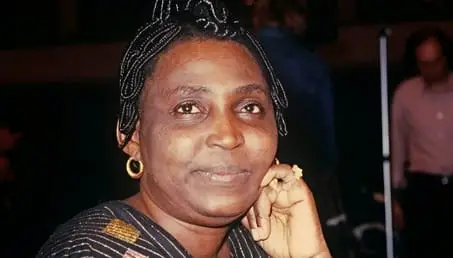
Died on August 17, 1981: Mariama Bâ, the pen that has long carried the voice of African women
She only had two novels to have a lasting impact on African literature. That will have been enough. Forty-five years after her death, Mariama Bâ remains one of the most significant voices in Senegalese and African literature.
Born on April 17, 1929 in Dakar, into a Muslim Lebou family, Mariama Bâ grew up in an environment where education still occupies a rare place for a young girl of her time. Daughter of Amadou Bâ, who became Minister of Health in the first Senegalese government in 1957, she was raised by her grandfather after the death of her mother. Despite the reluctance of those around her, she continued her studies, encouraged in particular by her father.
She joined the Rufisque Normal School for Young Girls, a veritable nursery for the French-speaking African female elite, where she obtained her teaching diploma in 1947.
A teacher for several years, she married the MP Obèye Diop, with whom she had nine children before divorcing. This personal experience confronted her with the realities of the female condition, to which she devoted a large part of her commitment. Mariama Bâ then multiplies speeches and press articles in favor of women’s rights, gets involved in several women’s associations and defends education which she considers to be the primary condition of all emancipation.
She denounces in particular the marginalization of women in decision-making bodies, the inadequacies linked to the protection of maternity and polygamy, all questions which will later nourish her literary work.
In 1979, she published Such a Long Letter, her first novel. In this epistolary work, Ramatoulaye Fall tells her friend Aïssatou about her widowhood, her life as a woman and mother, but also the wounds linked to polygamy. Mariama Bâ will deny this, her heroine not being, according to her, her double. However, the novel was an immediate success and earned her, in 1980, the first Noma prize for publication in Africa, awarded at the Frankfurt Book Fair, a distinction then unprecedented for an African woman.
Since translated into around twenty languages and included in Senegalese school curricula, Une si longue lettre has established itself as a classic of French-speaking African literature. The novel will even experience a new life in the summer of 2025 with its film adaptation by Senegalese director Angèle Diabang.
But Mariama Bâ will not have time to measure the full extent of her legacy. She died in Dakar on August 17, 1981, at the age of 52, following a long illness. On this 45th anniversary of her death, the memory of the writer remains particularly alive, as her work continues to nourish reflections on the place of women, education, marriage and traditions.
A few months after his death, his second novel, A Scarlet Song, appeared. Published posthumously, the book continues its exploration of the tensions between African traditions and the upheavals of the modern world, through the story of a mixed couple confronted with family and social misunderstandings. The work earned him, in 1982, the Grand Literary Prize for Black Africa.
Forty-five years after her death, Mariama Bâ’s legacy remains intact. Senegal paid tribute to him by giving his name to several establishments, notably to the Mariama Bâ House of Education, located on the island of Gorée.
Sheikh Gora DIOP
