
When non-execution of judgments undermines integration October 29, 2026
Human rights defenders and jurists consider the ECOWAS Court of Justice to be a godsend and a real tool for integration, because any citizen of a member state can seize it without exhausting domestic remedies. However, although its judgments are mandatory and enforceable, execution remains the weak link, with a rate of only 18.5% according to the Court’s figures from March 2026.
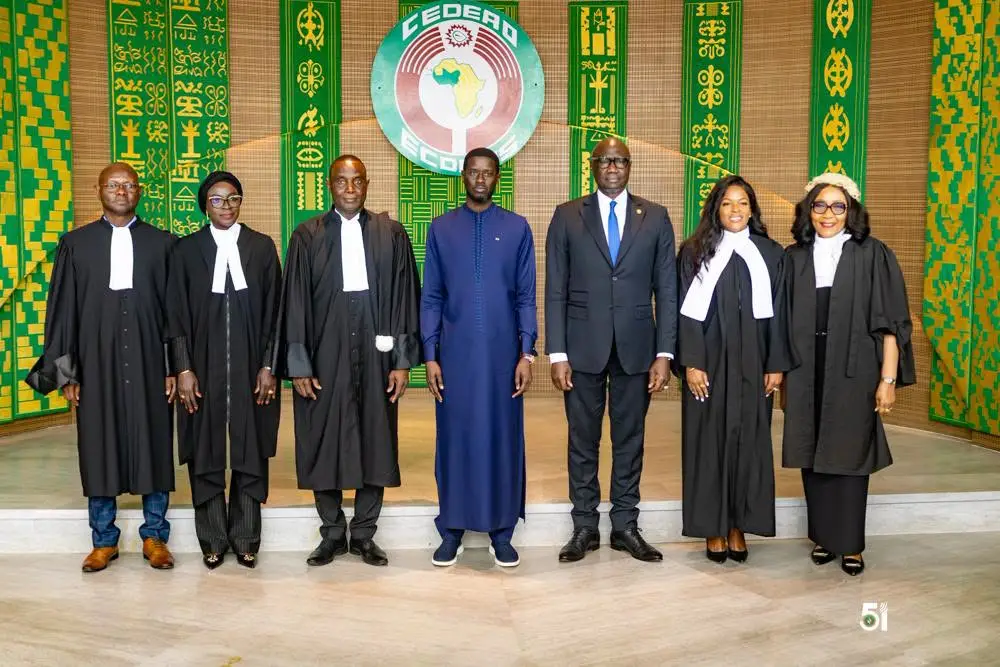
On October 6, 2026, in Abuja, Nigeria, the Head of State, Bassirou Diomaye Faye, also the current President of the Economic Community of West African States (ECOWAS), presided over the installation and swearing-in of the new judges of the Court of Justice of the community organization. This event marks the starting point of a non-renewable four-year mandate for the five magistrates of this jurisdiction.
These five judges, Désiré Henri Aïhou (Benin), Awa Bah (Gambia), Charlyne M. Brumskine (Liberia), Henrietta Uzoamaka Didigu (Nigeria) and Yaouza Ouro-Sama (Togo), are now responsible for operating this fundamental organ of ECOWAS.
Since January 2005, any natural or legal person who is the victim of a violation of their human rights in an ECOWAS member state can directly appeal to the Court of Justice established by the organization in 1991. “Provided that the request is not anonymous and that it is not pending before another international jurisdiction,” specifies Dr. Moustapha Fall, professor-researcher in public law at the Faculty of Legal and Political Sciences (Fsjp) of Cheikh Anta University. Diop from Dakar (Ucad).
This accessibility pushes Me Assane Dioma Ndiaye, lawyer, and Seydi Gassama, executive director of Amnesty International Senegal, to describe this jurisdiction as a real “godsend” and an integration tool. Another great advantage lies in the fact that the referral can be made without prior exhaustion of domestic remedies.
“This is a godsend because we do not generally have, at the level of our countries, such specialized institutions in matters of human rights violations,” adds Me Ndiaye. Extolling the merits of the Court, the human rights activist emphasizes that the procedure “is very flexible and democratic”, the applicant not needing to be wealthy. “Simply send your application to the Court Registry in Abuja. The latter communicates it to the respondent State which articulates its defenses, then the Court rules to verify whether the violation is proven and, if so, grant the requests for damages,” he explains.
The ease of referral in the face of the execution barrier
Unlike the African Court on Human and Peoples’ Rights, the ECOWAS Court can be seized without going through the national courts. Once the judgment is rendered by the judges, the chief registrar notifies it to the member states. The texts governing the Court provide that States are required to ensure its execution, the judgment having a binding and enforceable nature. Hence the obligation for each country to designate a competent national authority responsible for monitoring.
However, on this point, Dr Moustapha Fall indicates that of the 12 Member States concerned, only 10 have established this mechanism. Senegal is one of them. Since 2023, the Ministry of Justice has been working on this in collaboration with the State Judicial Agency (Aje), authorized to receive and execute judgments.
Despite these measures and the binding nature of the decisions, very few convictions are actually enforced. According to figures provided by the former Chief Registrar of the Court Anthony Anene-Maidoh, as of March 16, 2026, the overall execution rate stood at only 18.5% (i.e. 37 judgments fully or partially executed out of 162 executed).
Six countries — Benin, Cabo Verde, Ivory Coast, Ghana, Guinea-Bissau and Togo — have an execution rate of 0%. The Gambia is a good student with a rate of 44.4% (4 saves executed out of 9). Senegal follows with 18.2% (2 stops out of 11), ahead of Nigeria at 16.6% (10 out of 60).
A real obstacle course for the victims
Getting a victory in Abuja is one thing, enforcing it is another. “For many victims of human rights violations in West Africa, the real challenge begins after the verdict,” testifies Me Demba Ciré Bathily.
Me Assane Dioma Ndiaye, however, qualifies by specifying that the reluctance is less for financial reparations. “The State of Senegal quite systematically executes monetary sentences,” he admits.
On the other hand, Seydi Gassama notes significant delays, when decisions affect the administration or national legislation. The cases of Karim Wade, in 2016, and Khalifa Sall, in 2018, are telling illustrations: the Court’s judgments have never been transposed into the domestic legal order.
Likewise, the judgment of March 31, 2022 relating to the “Ousmane Ngom” order — by which the Court asked Senegal to repeal the ministerial text of July 20, 2011 prohibiting political demonstrations in the city center of Dakar, in the space between avenue El Hadj Malick Sy and Cap Manuel — remains unapplied. “Until now, we have not obtained the formal repeal,” deplores Me Ndiaye, who is also awaiting concrete actions concerning the reform of the compensation commission for victims of prolonged pre-trial detention.
Seydi Gassama attributes this inertia to “bad political will”. Me Bathily points out, for his part, an “institutional barrier”, in particular the absence of formal designation of executing authorities in several States, as well as the political context of crisis. The recent withdrawal of Mali, Burkina Faso and Niger from ECOWAS, now grouped within the Confederation of the Alliance of Sahel States (Aes), has led to the removal of dozens of ongoing cases, weakening the community legal space.
Finally, Me Bathily mentions the brakes on “judicial sovereignty”, with national supreme courts often perceiving community injunctions as interference. Dr Moustapha Fall recalls that certain decisions impose complex reforms, which “require legislative or even constitutional modifications”. He cites the April 2021 ruling ordering Senegal to eliminate the electoral sponsorship system.
The risk of “paper justice”
However, the lawyer considers that these constraints do not exempt States from their obligations. According to Mr. Fall, “even if the 2012 protocol provides for sanctions which may go as far as freezing assets”, individuals who do not obtain satisfaction cannot apply to the Court to have their State condemned for non-compliance. In fact, to enforce a decision of the Court, the ECOWAS protocol only gives the possibility to the Member States themselves to make the complaint or to the President of the Commission. This is why Dr Moustapha Fall thinks it is important to see how to invite the President of the Commission to monitor the execution of judgments by the States. Me Assane Dioma Ndiaye and Seydi Gassama campaign for pressure from human rights organizations. As for the media, they are invited “to work to popularize the judgments in order to force the national executives to comply”. For Me Demba Ciré Bathily, “as long as States refuse to bow to the binding force of its decisions, the ECOWAS Court of Justice will remain a paper justice”.
37 decisions executed in 25 years: the contrast with Europe
Despite its democratic character, and therefore its accessibility for citizens, the ECOWAS Court of Justice lags considerably behind courts such as the European Court of Human Rights (ECHR).
According to data from March 2026, the execution rate of judgments of the ECOWAS Court stagnates at around 18.5% (37 judgments executed out of 199 enforceable decisions identified), while in Europe, this rate oscillates between 80% and 96%. At the end of 2024, 3,916 cases were pending, while in Abuja around ten judgments are handed down per year, Strasbourg saw nearly 1,000 cases closed in 2025 alone. A gap which illustrates the difficulty of African community justice in asserting itself in the face of national sovereignties.
By Fatou SY
