
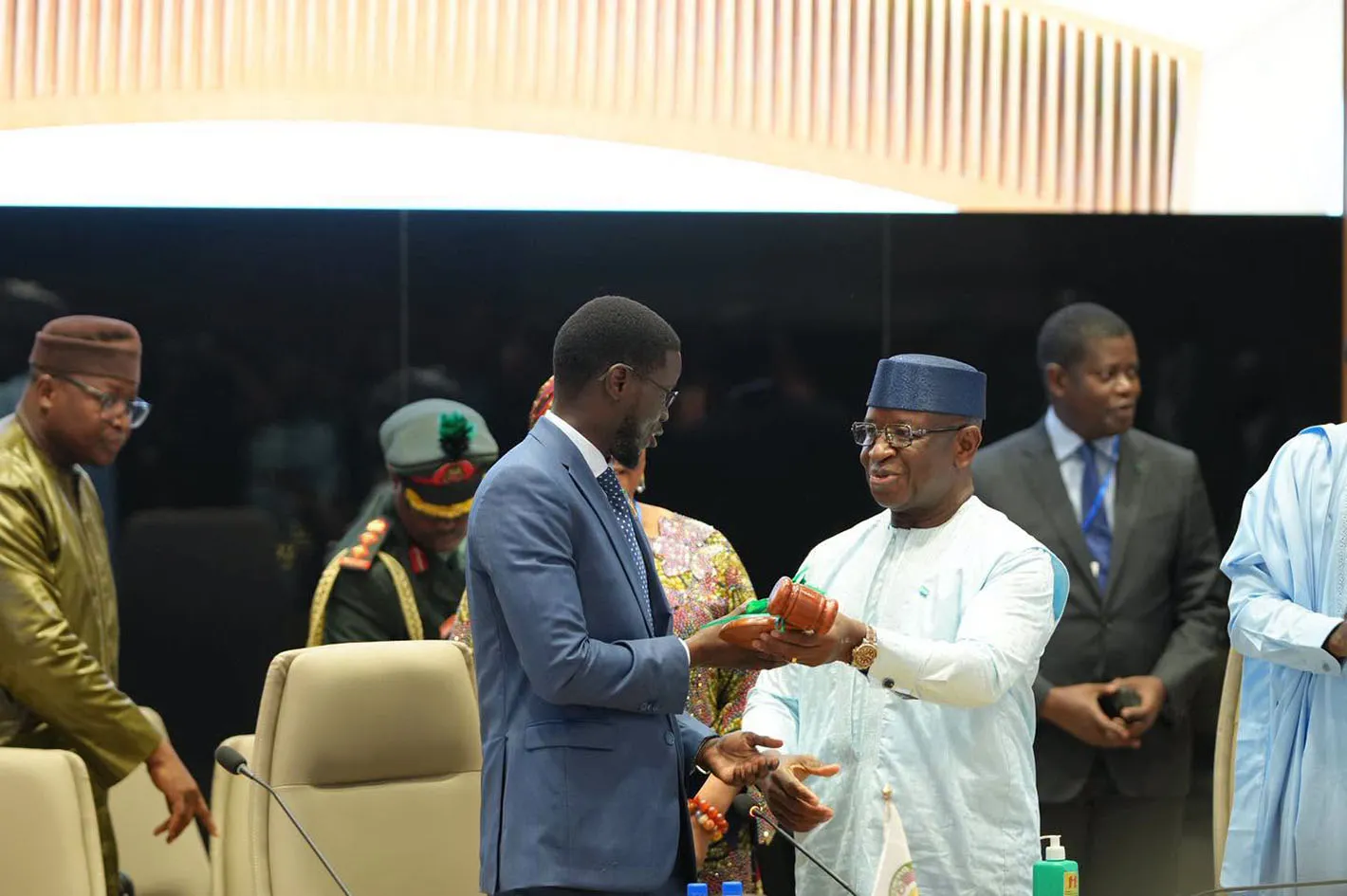
Freetown consecrates Senegal’s leadership at the head of ECOWAS
The stay of President of the Republic Bassirou Diomaye Faye in Freetown will remain one of the highlights of Senegalese diplomacy this year.
Having come to take part in the Summit on the Future of Regional Integration and the 69th Ordinary Session of the Conference of Heads of State and Government of ECOWAS, the Senegalese Head of State leaves with a double consecration: the current presidency of the Organization for one year, and the attribution to Senegal of the presidency of the Community Commission for the 2026-2030 mandate.
A word of truth in the face of regional fragilities
Faithful to his method, the Head of State chose frankness rather than diplomatic rhetoric. Before the Conference, he provided a straightforward diagnosis of the region’s vulnerabilities: the spread of terrorism from the central Sahel to coastal countries, the persistent weakness of intra-regional trade, and exposure to climatic and food shocks. However, he did not fail to underline, as a counterpoint, the resilience of the West African economies and growth prospects higher than the African and world averages.
With each observation, a demand for action was formulated: immediately activate the regional counter-terrorism force, intensify joint operations, pool resources and protect affected populations. “We will have to act quickly to activate the regional counter-terrorism force,” he insisted, also pleading for greater financial autonomy for the Community.
The President also recalled that this commitment went beyond the sole framework of the summit: the meeting held on July 10 in Dakar of the UEMOA High Level Committee on Peace and Security is, according to him, concrete proof of this, a commitment which precedes and extends the regional forums.
A long-term vision for a renovated ECOWAS
Making his remarks long-term, the Head of State spoke of fifty years of achievements for the Organization, but also of challenges likely, in the long term, to threaten its survival. His conviction remains that regional unity and solidarity condition common prosperity. “We must give hope to our populations, in particular the youth who constitute the future of our Community,” he said, calling for profound institutional reforms: a more stable architecture, scrupulous respect for community texts, the implementation of programs in agriculture, industry, energy and infrastructure, as well as a firmer anchoring in the principles of democracy and good governance.
Senegal at the helm of ECOWAS
The trust placed in the country materialized at two levels, both at the top of the community architecture. The Conference elected Bassirou Diomaye Faye as current president of ECOWAS, thus placing Senegal at the head of the Organization for the coming year. At the same time, he was given the presidency of the Commission, the executive body of the Community, for a four-year term.
To lead this mission, the Conference endorsed the candidacy of General (2S) Birame Diop, presented by the Head of State. Former Minister of the Armed Forces and former Military Advisor to the Secretary General of the United Nations, General Diop is recognized for his leadership, his integrity and his expertise in matters of peace, security, governance and regional integration. “He will come to ECOWAS with all my support and the legacy of Senegal’s historic commitment, to carry out his mission,” assured the President of the Republic.
A dual responsibility which now places Dakar at the heart of West African governance, with Senegal responsible for transforming this regional confidence into concrete results for the people of the Community.
By Cheikh Gora DIOP
