
Complete formula for elegance July 21, 2026
My grandfather said that “the dead are not dead”. Birago Diop wrote it, Alioune Diagne Coumba Aïta embodies it. “Sama maam daan na ne: the dead are not under the earth”. They cling somewhere in the memory of those who knew and loved them. And it is possible to resurrect them. Through a documentary, for example. Like the one produced by Maniang Lam on the former Minister of Urban Planning, “Alioune Diagne Coumba Aïta: Itinerary of a humanist servant of the Republic”.
There is his hand, among those which dug up the Assainies plots of Dakar and Liberté 6, Hamo and Ngor-Virage. There is his intelligence in the development of the Chemical Industries of Senegal (Ics) and the National Oilseed Marketing Company of Senegal (Sonacos). There is thus its mark in the construction of post-independence Senegal.
Current Senegal does not forget Alioune Diagne Coumba Aïta (1934-2024), his family deciding to immortalize him through a film. Even if he himself, during his lifetime, began the process of self-immortalization.
The Minister of Urban Planning and Housing under Abdou Diouf was a poet. And that means what it means. His stanzas are worth all those that raise awareness. With the added bonus that they are written in a Wolof language that will speak to Senegalese youth. To young people who can recognize themselves in his “sama maam daan na ne”. In this motif which punctuates his poem “Ndawalbiiramréw”, composed in Paris in 1962. Composing in Wolof, in Paris, in 62… if that is not being patriotic!
After studies, Mr. Diagne preferred, in his own words, to serve the flag. Patriotism. Among the structures visited, and which allowed him to acquire the tools necessary to serve the flag, are the Bank of France and the International Monetary Fund. When we talk about ADCA, we naturally think of economy, currency, urban planning.
And yet, he first wanted to be a doctor. Then an illness… destiny.
Maam Alioune, alab lebu!
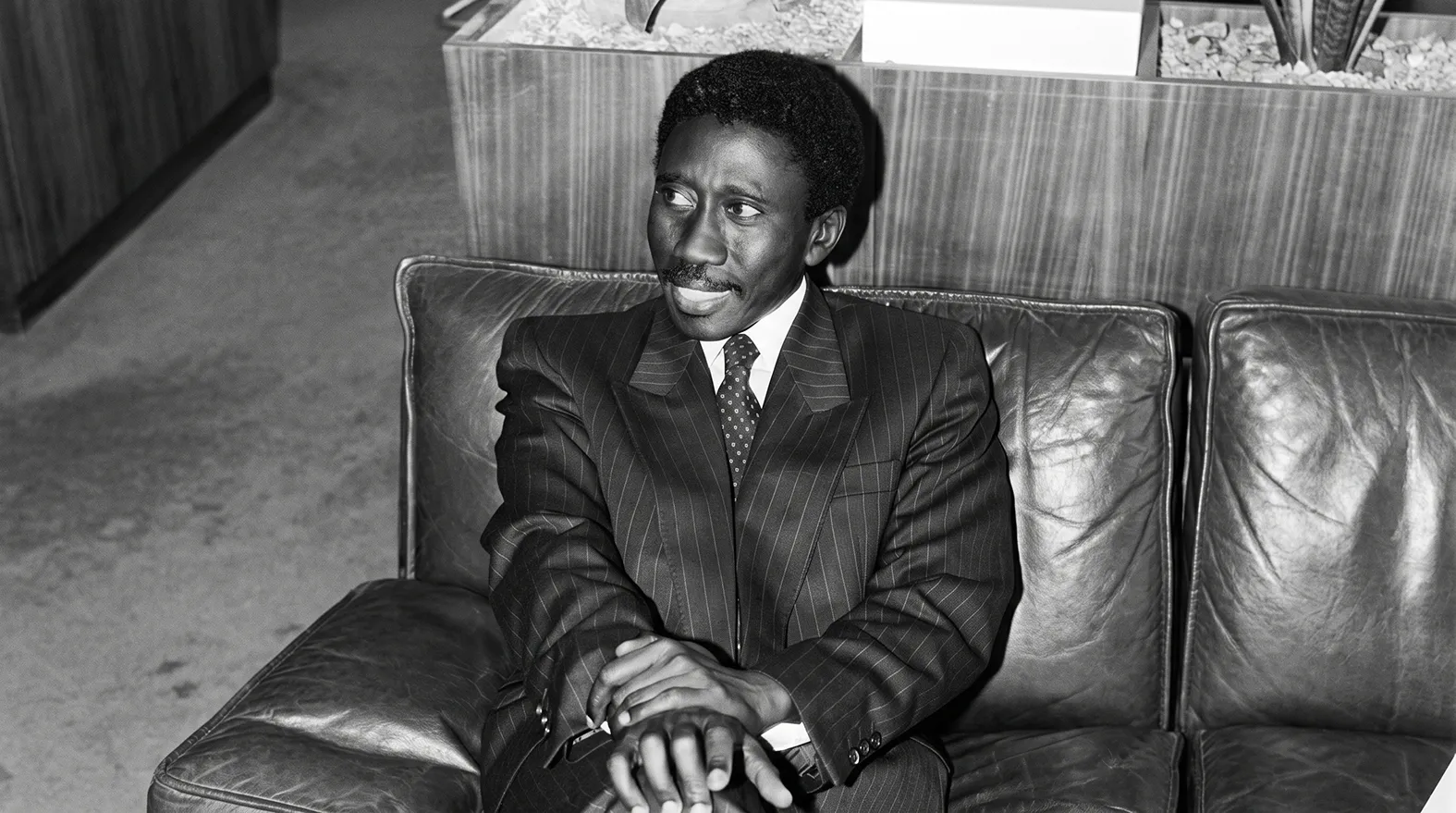
Mermoz, July 16, 2026. On the giant screen of one of the Pathé rooms, a man monitors the entrances and exits while the voice of Youssou Ndour sings about Africa. He watches, frozen in the black and white poster of a documentary which sought to retrace “the journey of a humanist servant of the Republic”. The eyes, the eyes, the eyes… it’s almost, almost, almost Ibrahima Nour Eddine Diagne.
A walk, near the sea, of the person to whom the tribute is paid, inaugurates the documentary film. Alioune Diagne Coumba Aïta, alab lébu! Thus the artistic direction, through the inaugural image alone, anchors the character in his kingdom of water.
Water, furthermore says a liquid identity. Who is fundamentally Lebou. Which is resolutely universal. The testimonies, in particular that of General Ibrahima Gabar Diop, illustrate this fact. Paris, Sorbonne, Latin Quarter, French gastronomy, Mr. Diop remembers…
Without doubt, the immensity of the sea can also take the place of a metaphor, to express the extent of his erudition evoked throughout the film by different voices. Different voices which, gradually, sculpt in the memories the bust of a (fairly) unknown to the Nation.
These voices tell us that he wanted to perfect his Arabic. Not out of simple intellectual curiosity, and even less out of secular fascination with a foreign language. Arabic responded to a deeper aspiration. The search for more intimacy with the Quran.
Behind the costume of the minister and the Director General, there is in fact the mantle of the religious. He was Tidiane. Holder of an ijjâza, moreover. Koran, rosary, devotion and prayers: here is a man whose life is crossed by the spiritual quest…
And the testimony of his friend Moustapha Niasse proves decisive: “At the university campus, we did not have a mosque, but we had set up the basement of Pavilion A. And the students, like him, like me, like others, who were fond of prayer and wird, went down there at fixed times, prayer times, and it was he who was the imam,” reveals the former president of the National Assembly Moustapha Niasse.
This designated imam, recognized as a man of faith, was also a man of duty. Towards his country, accomplished. Towards his community, accomplished. When we add to the picture rigor, discretion, intelligence, among other values given to it by the voices in the film, we border on perfection. Alioune Diagne Coumba Aïta was “almost perfect,” said a voice. A waliyu, says another.
“And it was he who was the imam”
In any case, the grandsons keep the memory of him as the perfect grandpa, the light of perfect Sundays. Like him, former president Abdou Diouf remembers him as a precious collaborator.
“Mr. Alioune Diagne was for me a contemporary of the same generation. We maintained close personal relationships that I always appreciated. Which earned, upon my accession to the highest office of the country, the choice that I made in his person by designating him among others to the following functions: Secretary of State for Employment in 1984, Minister of Urban Planning and Housing in 1986. Of all these functions, Mr. Diagne Alioune knew how to fulfill himself with haughtiness and efficiency, giving me complete satisfaction.
Thus the former head of state speaks of the one who was at the head of the Reflection Group for Competitiveness and Growth (Grcc), which accompanied the economic reforms resulting from the devaluation of the Cfa franc.
The costume, the administration and the offices. The mantle, the spiritual quest and the family. What, again? Martial arts!
And ? And the National School of Administration and Magistracy, where he otherwise served the country for seven years, participating in the training of future executives such as Mamadou Lamine Loum, Ousmane Tanor Dieng.
Presence, yes. Culture of permanent presence, no.
And ? And the legislative fight for a law to oblige multinationals to recruit in executive positions. And of course, there are many initiatives that he has taken for and within the Lebou community from which he comes.
But, Alioune Diagne Coumba Aïta is one of those men who do not have “the culture of permanent presence”, as his son Nour Eddine will point out. He knew how to step aside, like a true man of transmission, as described by Moustapha Niasse.
And he was certainly not one of those who silence their thoughts, who fade into conformism. His comrades in the Communist Party called him a “deviationist.” The other was certainly not wrong to say that ADCA was a man of refusal.
And what a life, that of a man who was Sheikh and Sensei, administrator and life coach, poet and teacher, imam and minister. Alioune Diagne Coumba Aïta undoubtedly deserves to be classified in the pantheon of Men who have a full life.
Despite all this, “he was just a person who came to tell his life and his achievements”, we learn from his son Ibrahima Nour Eddin Diagne. “Fortunately we had this idea of having those who lived with him testify”, so that the different facets of the character, scattered in their memories, are assembled on screen by the Majestik studio.
It is then a model, “elegant in everything”, who is brought to the screen in the documentary film directed by Maniang Lam.
Moussa SECK
