
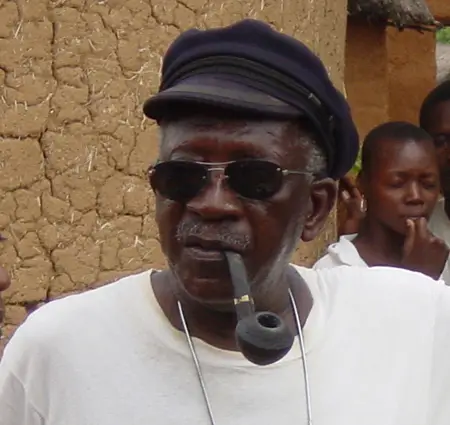
19 years after breaking his pipe, the memory of Ousmane Sembène remains June 9, 2026
Born on January 1, 1923 in Ziguinchor and died on June 9, 2007 in Dakar, Ousmane Sembène remains one of the most influential intellectual figures. Writer, filmmaker, screenwriter and activist, he is widely considered the “father of African cinema” for having contributed to the emergence of independent, committed film production anchored in the realities of the continent.
Coming from a modest background of fishermen in Casamance, Ousmane Sembène knew the realities of manual work very early on. After having worked in several professions in Dakar, notably as a mason and mechanic, he was mobilized in the French army during the Second World War. Demobilized, he moved to Marseille where he worked as a dockworker and became involved in trade unionism. This working experience will deeply nourish his literary and cinematographic work.
It is through literature that he enters the world of creation. His first novel, Le Docker noir (1956), was directly inspired by his life in France. He then continued with several major works, including O Country, My Beautiful People! (1957) and especially Les Bouts de bois de Dieu (1960), considered a classic of French-speaking African literature. Through his novels, he denounces colonial injustices, social inequalities and the mechanisms of oppression that affect African populations.
Aware, however, that books reach a limited audience in an Africa still strongly marked by illiteracy, Sembène turned to cinema at the beginning of the 1960s. Trained in Moscow, in 1963 he directed Borom Sarret, often presented as one of the first postcolonial African films. Three years later, La Noire de… (1966) brought him international recognition. This feature film, which tells the tragic story of a young Senegalese woman employed by a French family, is considered the first major film directed by a sub-Saharan African.
Lover of the seventh art
Throughout his career, he used cinema as a tool of popular education and social criticism. With Mandabi (1968), shot in Wolof, he broke with the domination of French on the screen and affirmed the importance of African languages in cultural creation. His films Xala (1975), Ceddo (1977), Camp de Thiaroye (1988) and Guelwaar (1993) question the excesses of post-independence elites, power relations, religion, colonial memory and the contradictions of African societies. Several of his works have also been censored in Senegal because of their critical impact.
Among her most notable fights is also the defense of women’s rights. Her last great success, Moolaadé (2004), awarded at the Cannes Film Festival, denounces female genital mutilation and highlights women’s resistance to oppressive traditions.
Beyond his work, Ousmane Sembène has profoundly influenced several generations of African directors. Its ambition was to allow Africans to tell their story themselves, far from outside eyes and representations inherited from colonization. Even today, his legacy continues to inspire contemporary African cinema and debates on culture, memory and social justice.
YEAR
