
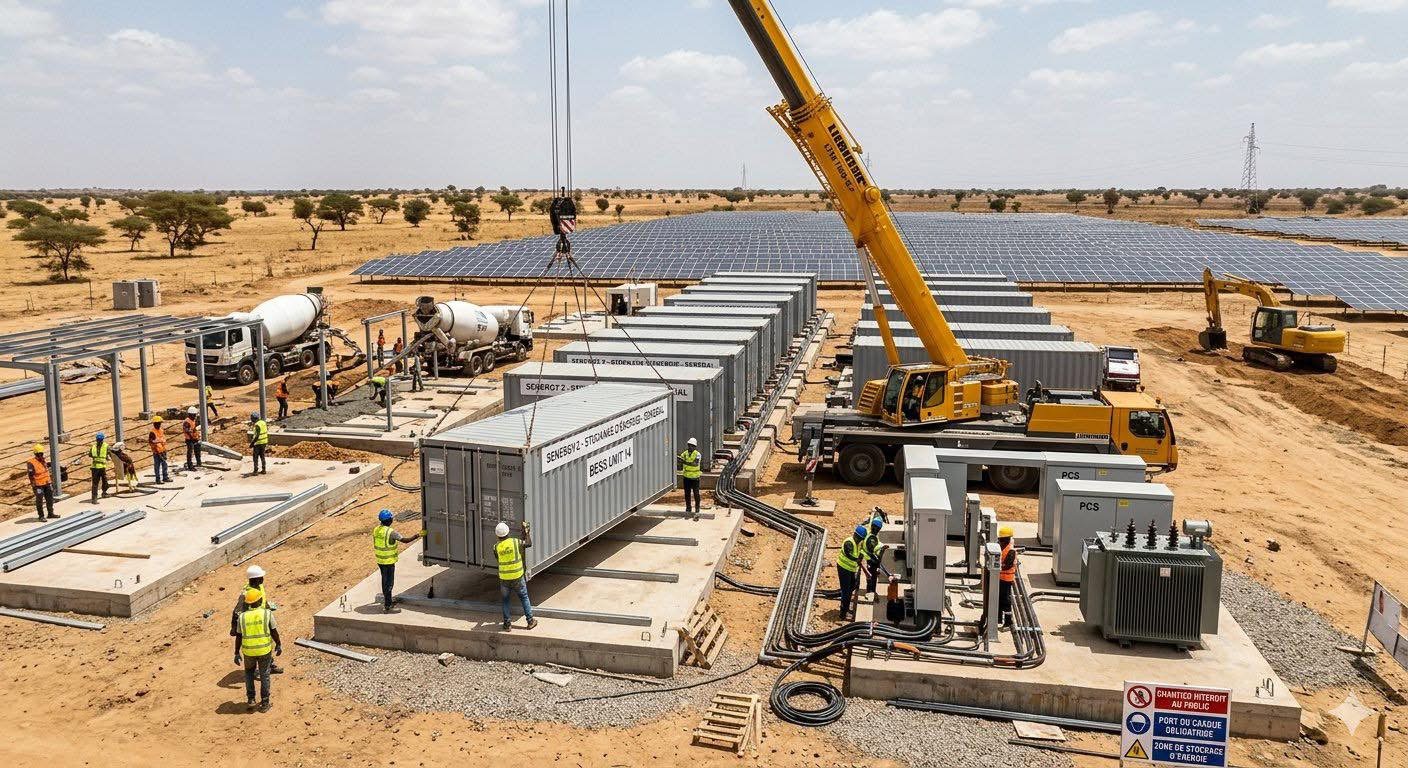
Energy transition: work on the first electricity storage plant launched in Diass
Work on Senegal’s first battery electricity storage plant was launched on April 20 in Diass (Thiès region), an infrastructure intended to stabilize the national electricity network and promote the integration of renewable energies.
Located near Blaise Diagne international airport and backed by an existing solar power plant, this installation, supported by Senelec with the support of the French Development Agency (AFD), is based on a battery energy storage system (BESS). It will make it possible to conserve the electricity produced during the day to restore it during periods of low sunshine, reports RTS.
With a capacity of 56 MW / 56 MWh, the plant will be able to absorb network fluctuations in less than 250 milliseconds, thus helping to reduce the risk of load shedding and improve quality of service.
This project is part of the Partnership for a Just Energy Transition, concluded between Senegal and its international partners, with a view to accelerating the decarbonization of the energy mix. The authorities aim in particular to increase the share of renewable energies to 40% by 2030, compared to around 30% currently.
The launching ceremony was held in the presence of Mamané Djitté, chief of staff of the Minister of Energy, Oil and Mines, as well as several technical and financial partners. The project benefits from overall funding of 36 million euros, including 28 million in the form of a donation from Germany via the KfW and 8 million in a sovereign loan granted by France through the AFD, under the aegis of the European Union.
Beyond its technical contribution, this infrastructure is presented as a lever to strengthen the country’s energy sovereignty, by optimizing the exploitation of local resources and reducing dependence on imported hydrocarbons. It should also contribute to the objective of universal access to reliable and competitive electricity by 2029.
Integrated into the Smartgrid program launched in 2018 to modernize electricity transmission and distribution networks, the project will be carried out over a period of 12 months. Its commissioning is scheduled for March 2027.
