
(Video) Quai de Podor: Lamine Sarr, 71 years old, sculptor of the mysteries of the river
Nothing predestined him to become an artist. His return to Senegal in 1989, after several years spent in Mauritania, discreetly changed the course of his life. The upheavals of the time, then the difficulties of returning, brought him back to an artistic passion. Now aged 71, Lamine Sarr has made the Quai de Podor his open-air workshop.
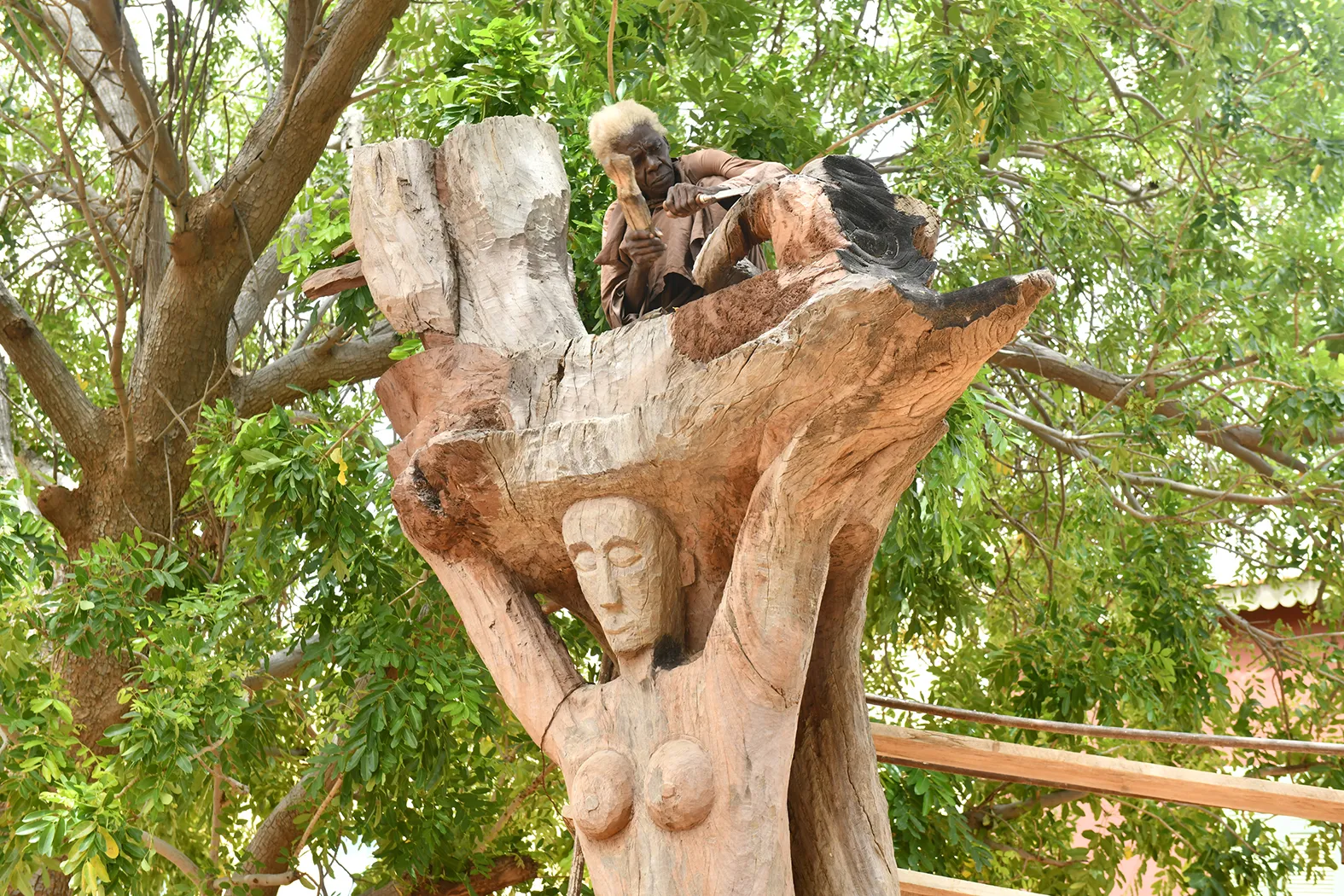
Between the river, the canoes and the passers-by, he has been working for years on a work which alone sums up his attachment to the territory: “Kemaan gui” (the mystery). A monumental sculpture, carved from a historic caïlcedrat, that the municipality gave him in 1997. Started the same year, the work stopped for more than two decades before Lamine Sarr resumed work in December 2023. Since then, the native of Podor has set about finishing it despite age and a body that makes the task tougher every day.
A mermaid. Arms that spread out like hair. A hair that is not hair: it is the river, which flows to the mouth. A canoe, a paddler and a harpooner. This is all of Lamine Sarr’s work, contained in one image. He called it “Kemaan gui” (the mystery). A name that says it all: water, fishing, the canoe, the man of the river, and this imagination that we never really sculpt, that we only touch on. The Podor quay became his workshop.
But above all it became his bet: that his name and his vision of the river would last, long after him, in the annals of the city. No stone, no metal. A tree. A monumental caïlcedrat, which the municipality gave him in 1997. He attacked the wood that year. Then nothing, for years. The construction site is sleeping. He wakes up in December 2023.
To express his ambition, Lamine Sarr summons giants: Bartholdi and his Statue of Liberty, Eiffel and his tower, Carl Jacobsen and his Little Mermaid of Copenhagen. What he remembers about them is not the size of their works, but their longevity. They have surpassed their time, their function, their own death, to become landmarks.
“If they can do it, we can too,” assures Lamine Sarr. He doesn’t copy anyone. He steals their audacity, not their forms to build something that remains, that belongs to a place, that crosses generations without asking permission. Podor doesn’t have any rocks for that. Never mind.
“If we had rocks, I would have done it. But we have a caïlcedrat,” he assures. Then the tree becomes material, monument and memory all at once. But to understand how a man comes to defy time with a tree, we have to go back up the river to another bank.
At 71 years old, Lamine Sarr carries the river into his history even before sculpting it. After primary school and the Koranic school in Podor, he headed to Mauritania. A country of adoption, not an exile. His mother is from Mbagne, on the other side of the water. He remained there for many years.
In Podor, in his neighborhood of Mbodiène, he never felt like he was leaving home when he went there. “Same people, families are divided by the river,” he said. A natural border, not just a border. “We are citizens of the Valley,” he recalls. Boghé fully embraces it.
Then 1989 arrives, and everything changes. The events fracture the links between Senegalese and Mauritanians in the valley. His adopted family stays, he returns. In Podor, he tries to take over the once-thriving family bakery. Today, out of breath, without certification, unable to keep up with the competition.
Before the tree, there were the canoes
He changes course. The building, then. Two years, and his father’s illness closes that door too. His brothers are there, but he is the one who comes back and stays at the bedside. A “vagrant,” he says of himself. The one who goes looking elsewhere, who comes back when necessary. The bakery is closed, the building is saturated. There’s only one thing left for him to try. Something he has known since childhood, without ever having taken it seriously: art.
None of this happened all at once. In 1992, a meeting changed everything. Hamady Sy, carpenter and sculptor, puts a wood chisel in his hands. Lamine Sarr already had the eye, he had never had the gesture. He has it now. A childhood passion becomes a profession. He sculpts small canoes, first. Then everything related to fishing. He gave his first pieces: small wooden boats, gifts for those around him. Nobody really believes it.
We look at him as a man who got lost in a fad with no future. Then a mayor of Sézanne, in Nord-Pas-de-Calais, bought a piece for thirty thousand CFA francs. At the time, it was a fortune. But for him, money matters less than what this sale changes. Suddenly, what we took for a whim becomes an activity that has a name, a price, a future. A seminar in Thiès confirms it in another direction. There he meets Dominique Barbe.
Also read: Siouré Thiambé: a jujube tree, symbol of collective memory
He is told, bluntly, that he is not a sculptor, but just a fisherman who tinkers. He takes it and continues. He changes material. He collects aluminum, iron, broken tiles, everything that others throw away. From these remains, he takes pieces which he keeps like treasures. And little by little, an idea grew, too big to fit on a shelf: get out of the object and make a monument. “I didn’t want to be like everyone else,” he says.
Not pieces that we move, that we put away, that we forget in a corner, but works planted in public space, anchored in everyone’s memory. He had started a sculpture for the sinking of the Joola. An accident, a convalescence, and the work disappeared. Like others, lost along the way, over the years. But the idea of the monument never let go. And it is she who, years later, will take the form of a caïlcedrat on the quay of Podor.
Since the construction site resumed, the quay is no longer quite the same. People stop. Some observe in silence, others give him nicknames. Lamine Sarr knows it: the undertaking is long, and his body does not always agree with his projects. But it’s no longer just about finishing a sculpture. He wants the thing to stay.
Complete “Kemaan gui”, then start again somewhere else, something else. A dream contained in one line, but which weighs heavily: may history remember that he succeeded. “Knowing your ambition is the first act of courage,” he admits. Recognition, for him, comes later. What matters is that the work stands in the landscape of Podor, in the memory of those who will come after. “As it will go down in the annals of history, that’s enough for me,” he rejoices.
On the quay, an old tree slowly becomes a work of art. And in this wood, Lamine Sarr tries to retain what the river never retains: the memory of a people, but also the gestures of the fishermen, the movement of the water, and a certain idea of the Valley.
By Samba Oumar FALL (texts), Assane SOW (photos), Oumar B. NDONGO (Video)
