
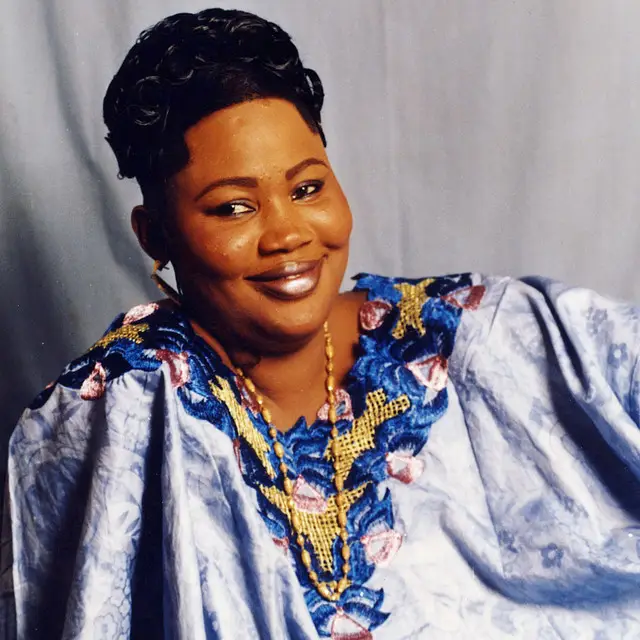
The voice that crossed generations September 15, 2026
As the Magal approaches, an old song by Fatou Guéwel, “Serigne Modou Moustapha”, has found new circulation on social networks, bringing up in the news feeds a voice that many Senegalese had known in the era of cassettes and the heyday of mbalax, but that new generations are now discovering on their phones. This digital resurgence offers above all the opportunity to find Fatou Guéwel herself, an artist who has spanned more than three decades of Senegalese music.
Social networks have this particular way of creating a dialogue between eras, by putting on the same thread a song released several decades previously and the productions of artists who belong to a generation born with the Internet, so that an old song can suddenly find a considerable audience among young listeners who were not aware of the circumstances of its creation. It is in this movement that “Serigne Modou Moustapha”, a song by Fatou Guéwel dedicated to Serigne Modou Moustapha Mbacké, first caliph of Cheikh Ahmadou Bamba, found new visibility thanks to the Magal, reminding us in passing that certain works do not truly disappear when they remain attached to a religious and cultural memory strong enough to be regularly reactivated.
But behind this returning song, it is above all a woman that we find. Fatou Guéwel is one of those artists whose career allows us to understand a profound transformation of Senegalese music, from an era when singers built their reputation through cassettes, ceremonies, appearances on television and tours, to one where a piece can be reborn years after its recording through a video published on a social network.
Ceremonial debut
Born Fatou Binetou Diouf in Dakar in June 1964, she grew up in a family of griots, in an environment where music accompanies the main events of social life and where the sung word constitutes as much a form of entertainment as a means of transmitting a story, celebrating a person, recalling a parentage or expressing a religious and cultural affiliation.
She began singing at baptisms and ceremonies very early before joining a theatrical dance troupe, which means that, long before experiencing the spotlights, studios and big stages, she had already learned to measure the special relationship between a voice and those who listen to it. This origin is important to understand the rest of her career, because Fatou Guéwel never completely separated her artistic career from this universe in which she grew up, and even when her name became that of a popular star, her repertoire continued to bear the traces of a culture where singing serves to tell stories, to honor, to recall values and to inscribe individuals in a collective memory. In 1992, she joined the Traditional Lyric Ensemble of the Daniel Sorano National Theater and the same year founded the “Sope Noreyni” Group, taking a step which gradually led her from the space of ceremonies towards that of a professional career, in a Senegal where cultural institutions, orchestras and groups still constituted the main gateways to a lasting musical career.
A Mouride repertoire
The real turning point came in the mid-1990s, when a performance on national television helped to increase her visibility and tours across the country allowed her name to get closer to the public, before “Santa Ti Cheikh Ibra Fall”, in 1994, then “Fiirndé Santa Bamba”, the following year, established her among the great female voices of the Senegalese scene. She then left the Traditional Lyric Ensemble to devote herself entirely to her career, a choice which marked the transition from an artist still linked to a collective structure to a singer who now assumes her own name, her own repertoire and the responsibility for a career whose contours will quickly exceed the borders of the country. She also arrives at a particular moment in the history of Senegalese music, when women occupy an increasingly visible place in a sector where major male figures largely dominate the scene, and her career, alongside singers like Khar Mbaye Madiaga or Kiné Lam, shows that an artist could impose a strong personality without needing to renounce the cultural codes which had contributed to her formation. Her repertoire is strongly marked by religion, with songs dedicated to great figures of Mouridism, notably Cheikh Ahmadou Bamba, Cheikh Ibrahima Fall and Mame Diarra Bousso, but it does not stop at religious praise, since the singer is also interested in the family, parents, women, relationships between individuals and the values which structure social life. This dimension is essential to understand the longevity of its repertoire, because a song which is inscribed in religious or family memory does not entirely depend on the musical fashions of the moment, and can continue to be covered, listened to or sought after long after its release when circumstances offer it a new space for diffusion. “Serigne Modou Moustapha” belongs precisely to this category, but its recent return to social networks ultimately says more about the persistence of Fatou Guéwel than the song itself. Because the singer has had a career long enough to see her own musical universe transform around her. When it began to experience success, the cassette was still the main medium for disseminating popular Senegalese music, and a new album then represented an event which could involve a whole network of shops, sellers, radios, ceremonies and enthusiasts who were responsible for circulating the songs until they became familiar.
She then toured internationally, notably in the United States, Italy and France from 1996, while her album “Fatou”, published internationally by Stern’s Music, helped to make her world known to the diaspora and a foreign audience. This international opening is not a break with her identity, because what Fatou Guéwel takes with her to foreign stages is precisely this music which bears the traces of her environment, her language, her religious references and the tradition from which she comes. She travels with her identity rather than trying to hide it. Over the years, his repertoire is enriched with notably “Santeti Mame Diarra Bousso”, “Fonk Sa Waajur” and, later, “Borom Khayra”, while his place in Senegalese musical memory is consolidated as the songs leave the immediate news to enter a heritage that subsequent generations will in turn be able to rediscover. This is where Fatou Guéwel’s trajectory becomes particularly interesting. Cassettes have disappeared, CDs have lost their centrality, studios have modernized and social networks have become an integral part of artists’ careers, while digital platforms have introduced a new way of listening which allows a song recorded several decades ago to be found, at the same time, next to a piece released the day before. For Fatou Guéwel, this transformation produced a rather particular phenomenon, because her songs changed support without losing their ability to circulate.
A second life
The return of “Serigne Modou Moustapha” during the Magal illustrates this new life of old songs, but above all it reminds us that Fatou Guéwel built her repertoire on themes which have a duration which far exceeds that of musical fashions. Fatou Guéwel is at this place today. And when a voice like hers returns today on the line of a telephone, amid the productions of a generation that was not yet born when it recorded its first successes, it is ultimately not the past that returns to demand its place in the present. It is the present which discovers that it already had a memory.
With “Mbarass”, Fatou Guéwel made the Senegalese dance so much that some, who at the time swayed their hips in the “fuural” and “wàcce bâche” after baptisms and weddings, have since had time to get married, have children… and come back to dance to the same song with their own children.
By Amadou KÉBÉ
