
The carter business resists August 26, 2026
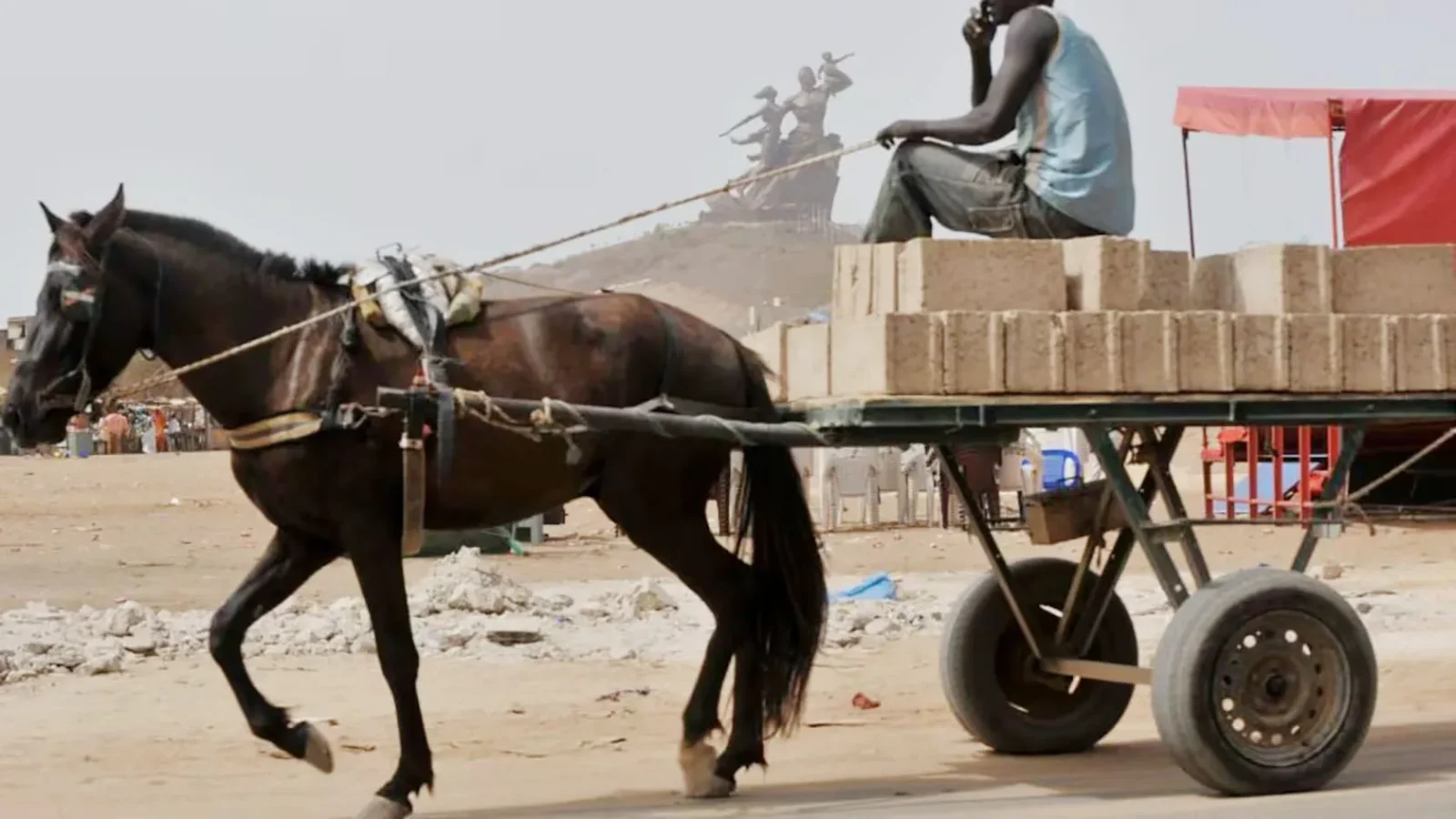
In the districts of Liberté 6, Parcelles assainies and Thiaroye, carts advance early in the morning on sandy tracks and congested roads. They transport sand, water, rubble, goods, etc. and provide essential travel in areas where motorized vehicles still cannot access. Around this activity, an informal economy is organized. Income varies depending on demand, horse-related charges, equipment rental and access to loading points.
Between Liberté 6, Parcelles assainies (Unit 15) and Thiaroye, the same presence crosses the sandy streets and the saturated roads of the Dakar suburbs. Carts, loaded with sand, water, rubble or goods, advance slowly, pulled by tired horses and guided by men whose work structures an invisible part of the urban economy. At Liberté 6, the morning begins before the city takes its rhythm. The streets are still quiet, but the carts are already in circulation. The wood of the structures creaks under the load, the wheels sink slightly into the sand of the irregular passages and the horses advance under the pressure of the first commands. Amadou Fall, a carter, finishes fixing a load of sand. He looks around quickly before speaking. “A delay, and the day is lost: customers don’t wait,” he confides. Here, the cart plays a functional role. It enters areas where trucks do not pass, where access is too narrow or too fragile. It transports water for households, sand for construction sites, rubble after demolition, goods from markets and sometimes furniture during moves. It is an essential logistics relay in a district in constant transformation. The pace of work depends entirely on demand. Some days, the carters carry on the races without a break; others, they wait long hours before finding a client. This instability defines the entire economy of the profession.
Moussa Ciss, sitting on his cart, observes the street. “When there is work, you can move forward. When there isn’t one, you stay there waiting,” he slips. Economically, income varies between 5,000 and 20,000 FCfa per day. It depends on the routes, distances and frequency of orders. But, this sum is not a stable income; the costs of the activity must be anticipated. A large part is used to feed the horse, repair the cart and buy the necessary equipment.
The good deal with construction sites
The rest goes towards the personal needs and care of the animal when it becomes ill or injured. A carter takes the reins while looking at his horse: “When the day is good, you can breathe a little. But the next day you have to start again. Otherwise with the charges, it’s zero.”
The horse represents the center of the economic system. It is also the main daily expense and the very condition of activity. Its food costs between 1,000 and 2,500 FCfa per day, depending on the period. It is based on hay or grass, sometimes supplemented with bran or cereals. Water is essential, especially in hot weather. Added to this is care. An injury or illness can immobilize the animal for several days and completely interrupt the carter’s income. In this case, all activity stops.
A silent man briefly strokes his horse’s neck before setting off again. “If the horse doesn’t work, the house doesn’t run,” he explains. Leaving Liberté 6 to join Unit 15 of the Sanitized Parcels, the urban landscape gradually changes.
The sand becomes more present, the spaces more open and the proximity of the beach directly influences activity. Here, carts move between homes and the coastal strip. They mainly transport sand and construction materials intended for construction sites. The sound of the waves accompanies that of the wheels, creating a permanent contrast between nature and human activity. A carter stops for a few moments near the sea to let his horse breathe. He observes the horizon, then slowly resumes his route. “Here, it’s the construction sites that decide. When it starts, we work without a break,” he suggests. Demand strongly depends on construction periods. When the construction sites are active, the races come one after the other and the income increases. But when activity slows down, carters remain out of work for long hours. Continuing towards Thiaroye, the urban density becomes greater. The roads are saturated, the markets very active and traffic difficult. The carts must fit between cars, motorcycles and passers-by, in a heavily congested space.
A first carter waits at the edge of a main axis. He monitors vehicles before crossing. “Here, you have to know the times. Otherwise you can stay stuck all day,” he warns. Another, older, observes the constant flow around him. “Before, it was simpler, now everything is quick. We continue with our means,” he confides.
A young driver, loaded with sand, advances cautiously in traffic. He talks while bargaining next to his horse. “I do this work for my family. There is no fixed salary. Every day is different,” he finally said.
In Thiaroye, carts play an essential role in the transport of materials and in market activities. They make it possible to maintain economical circulation in a space where needs are numerous, but formal means of transport are insufficient for certain tasks. In these three areas, the same reality connects the carters. Their activity depends on the movement of the city, the demand of residents and the projects in progress. It remains fragile, unpredictable, but deeply integrated into the daily economy. The horse is still moving forward in the dust. The wood continues to creak. In this journey between Liberté 6, Unit 15 of the Assainished Parcels and Thiaroye, an economy continues to operate part of Dakar, quietly, but without interruption.
Value chain
The work of carters is not limited to transporting goods. It is also part of a local economy which supports several players around the activity. The carter often pays an informal parking fee at the loading point. Depending on the area, this can range from 100 to 500 FCfa per trip or per day, paid to intermediaries or charging point organizers. To this is sometimes added the rental of the cart itself. Not all carters are owners. Some rent the equipment by the day or week; which greatly reduces their net income. Cart repairers and sellers of wood, nails and worn parts also make a living from this activity. A broken wheel, a weakened axle or a worn rope create an immediate expense and turn around a small local business network. Horse feed sellers also play an important role. They supply hay, grass and bran, with prices that vary depending on the season and availability.
Moussa Ciss summarizes this economic chain while waiting for a race. “Beyond our work, there is an entire ecosystem that revolves around the cart,” explains the carter. It is an urban micro-economy which links transport, commerce, repair and animal feeding, and which constantly adapts to the needs of the city.
By Amadou KÉBÉ
