
The art of making silences speak July 21, 2026
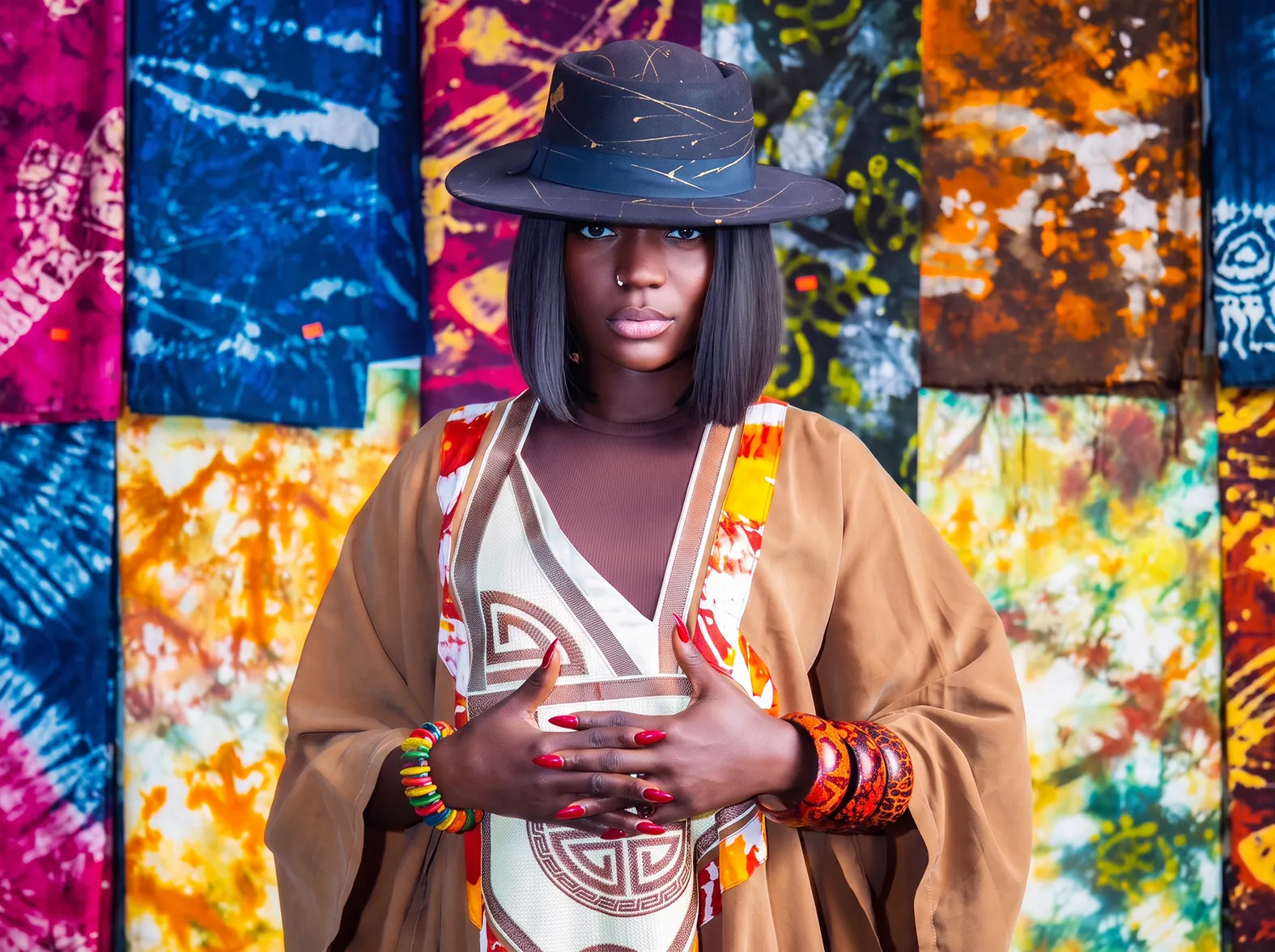
On screen, she inhabits the characters as one inhabits a memory. Revealed to the general public by her interpretation of Ndiss in EvenProd’s Timis-l’Or noir, Fatwa Fall, known as Black Fatwa, belongs to this generation of actresses who consider cinema less as a profession of light than as an inner discipline. Behind the success of the series lies the journey of an artist who prefers the truth of the game to the brilliance of celebrity, and who dreams of offering Senegalese cinema a fully sovereign voice.
Actress Fatwa Fall is a pure talent. In his game, everything is there: the facial expression, the intensity of the emotions, the power of the gaze, the accuracy of the gesture.
From his appearance in season 1 of the EvenProd series “Timis- l’Or noir”, it is his presence that seduces the most, an infinitely rare quality that great directors of photography track down throughout their careers.
In the shoes of Ndiss, his character advances on a crest line, somewhere between injury and redemption. Like the twilight to which the word “Timis” refers, it evolves in a light between dog and wolf, where certainties fade to give way to nuances.
Fatwa Fall inhabits her character with an emotional precision which gradually dissolves the boundary between fiction and reality. With the young actress, a look sometimes has more force than a long dialogue. A breath, a slight withdrawal of the face, a tiny variation in the voice is enough to move an entire scene. His playing comes less from exuberance than from restraint.
However, when we meet her, nothing suggests this dramatic intensity. The smile is frank, the laughter spontaneous, the words calm. Behind this serenity, however, lies a long-held conviction because cinema has never been a simple dream.
“I always understood that it was more than a passion. It’s this flame that has always driven me,” she says.
This sentence illuminates his entire journey. Where many talk about passion as a feeling, it speaks of a responsibility. His vocabulary surprises with its depth. It summons work, spirituality, learning, rebirth. For her, art is neither folklore nor glitter: “I’m not a star. I want to become an accomplished artist. »
Solid experience
The nuance is fundamental. At a time when visibility sometimes seems to take the place of talent, Fatwa Fall claims exactly the opposite. She prefers mastery to notoriety, discipline to permanent exhibition, work to image.
This quest takes root very early. Long before film sets, there is dance, school shows, theater, cultural festivals. As a child, she already explored the multiple languages of the body. At college, she joined a theater troupe, discovered the stage as a laboratory of emotions and multiplied her experiences. Contemporary dance refines its relationship to movement; the theater teaches him the breathing of the text; travels, particularly to Germany and Portugal, broadened his artistic horizons.
Then came the studies at the Beaux-Arts, the passage to the Sorano National Theater, the castings, the refusals, the endless rehearsals and this patient companionship with the profession which shapes true actors.
Nothing, however, will be offered to him. She talks about obstacles without emphasis. First of all, its size. “I only missed out on roles because I was short. I had the game of an adult, but I was the size of a ten-year-old girl,” she recalls, smiling.
In an industry where image sometimes decides before talent, this remark could have discouraged more than one vocation. The actress chooses the opposite attitude. She learns very early that the real adversary is not competition, but renunciation.
To this first test is added another: that of the social gaze. Be an artist. To be a woman. Be Muslim. In Senegal, this equation sometimes remains loaded with prejudice. She does not make a militant speech: “We are directly stuck with a label. These are battles that we fight in silence. »
Added to this are the temptations of a job where shortcuts always exist. During a stay abroad, certain offers may promise faster advancement. She refuses. “The main thing for me is that I didn’t succumb to all that. I try to stay the course and focus on my goals,” she confides.
This loyalty to his principles also informs his interpretation of Ndiss. Because if the character fascinates so much, it is precisely because he is never reduced to a dramatic function. Beneath the appearance of an opaque woman lies a story of hurt, loyalty, protection and a stubborn quest for freedom.
“I share with her the sense of family, loyalty. She is a young woman who wants to free herself from societal chains. She is looking for herself,” explains the actress.
However, identification is never complete. Fatwa Fall takes care to maintain this essential distance between the performer and the character. She refuses confusion. The actress borrows from her own emotional memory without ever abandoning her personality: “There is real Fatwa as there is falsehood in the incarnation of this character. »
“I was born to transmit”
The success experienced by Timis could have pushed her towards the ease of the spotlight. Here again, his speech surprises. She almost never talks about popularity. She prefers to talk about the responsibility that recognition creates.
“I was born to transmit,” she says.
Just three words. But his entire vision of the profession lies in this profession of faith.
This desire to transmit undoubtedly explains the multiplicity of his commitments. Fatwa Fall is not only an actress. She is also an artistic director, an entrepreneur, evolves in the world of aesthetics and participates in the dynamics of the “Artiste Du Daanu” Hub. The horizon she draws goes far beyond her own career.
When she talks about her dreams, Fatwa doesn’t list the roles she would like to land or the awards she hopes to one day receive. Its ambition embraces a broader geography. She is already imagining the films she will make, the artists she will support, the aesthetics she will help bring to light and, above all, the image she wishes to offer of Senegal to the world.
“I want to become one of the greatest artistic directors and directors in the world. I want to contribute to the cultural development and conditions of artists in my country,” she says.
For the artist, Senegalese cinema must no longer seek its legitimacy elsewhere; it must itself become a center of gravity: “We have stories, languages, aesthetics, traditions, imaginations and talents that belong only to us. »
She is right to say that because great cinematographies have always stood out by assuming their singularity. Italian neorealism never sought to imitate Hollywood. The French New Wave didn’t ask anyone’s permission to revolutionize cinematic language. More recently, South Korean, Iranian and Nigerian cinemas have conquered their global position by asserting their identity.
“The future of our cinema rests on three pillars: training, discipline and transmission,” lists Fatwa.
Three words that come back like a refrain. Training to master the art. Discipline to last. Transmission to build an industry rather than a succession of individual careers.
The mark she would like to leave? His response surprises once again: “This mark will not be measured by the number of films in which I have acted nor by the number of awards I have received. I would like to leave a way of thinking about cinema. »
Few artists already talk about legacy at the start of their rise. Even rarer are those who consider this heritage from the angle of ideas rather than glory.
At a time when Senegalese cinema is looking for new faces capable of combining artistic excellence, depth of acting and cultural vision, Fatwa Fall appears less like a passing revelation than like a lasting promise.
An actress, certainly. An artistic director in the making, certainly. But above all a woman who understood that the seventh art is not just about telling stories. We have to give them a soul.
By Adama NDIAYE
