
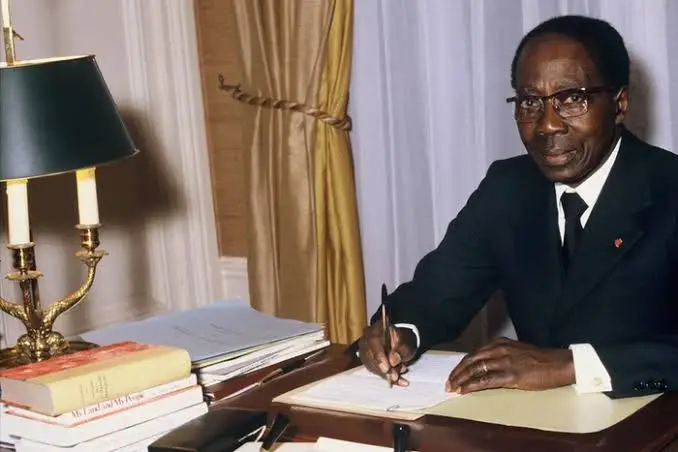
Senghor: the Foundation calls for his legacy to be passed on to younger generations
The Léopold Sédar Senghor Foundation celebrated, Friday in Dakar, the 120th anniversary of the birth of its sponsor and the 25th anniversary of his death, around the theme “Roots and openness, legacies, news and horizons”. A meeting dedicated to the topicality of his thoughts and the transmission of his work.
The Léopold Sédar Senghor Foundation commemorated, according to the APS, Friday October 9, at its headquarters in Dakar, the 120th birth anniversary and the 25 years of the disappearance of the former President of the Republic of Senegal. This meeting brought together administrative and political authorities, diplomats, writers, book industry players, members of civil society as well as those close to the former head of state.
Placed under the theme “Senghor 120/25: Rooting and opening – Legacies, news and horizons”, the ceremony served as a framework for discussions on the scope of the political, literary and intellectual work of Léopold Sédar Senghor, born October 9, 1906 in Joal and president of Senegal from 1960 to 1980.
At the opening of the meeting, the Secretary General of the Foundation, Professor Amadou Ly, explained that the chosen theme intends to articulate the memory of the past, the challenges of the present and the prospects for the future. “Rooting is the past, openness is today and the horizon is the future,” he declared.
He also recalled the role of the Foundation, created in 1974, in promoting research and intellectual production. As such, he highlighted the Éthiopiques magazine, devoted to literature and the human sciences, published twice a year and recognized in academia. According to him, this publication is among those to which the African and Malagasy Council for Higher Education (CAMES) places its trust for the dissemination of scientific work.
Evoking the different facets of his godfather, Professor Amadou Ly highlighted his contributions to political life, economic thinking and literature, particularly through his collections of poetry and his critical writings brought together in the Liberté series.
Speaking as a discussant, Professor André-Marie Diagne Bonané, a retired teacher, for her part, insisted on the links between Senghorian work, education and cultural transmission.
She notably cited La Belle Histoire de Leuk-le-Lièvre, a work written by Léopold Sédar Senghor and Abdoulaye Sadji, which introduces children to African tales, their values and the modes of organization of the continent’s societies. “It’s a book that I recommend to all students who want to root themselves in our culture,” she said.
The professor also recalled the place of blackness in the defense of equality between peoples and the promotion of black cultures. She highlighted Senghor’s contribution to the international influence of Senegal and the creation of La Francophonie, seen as a space for dialogue between peoples and the promotion of culture.
Beyond the commemoration, André-Marie Diagne Bonané called for strengthening the preservation and transmission of this heritage to younger generations. She particularly insisted on the need to make more known the journey and struggles of the pioneers who contributed to the defense and valorization of black peoples.
Through this double commemoration, the Foundation intends to put at the heart of the debate the place of Senghorian thought in contemporary reflections on culture, education and openness to the world.
