
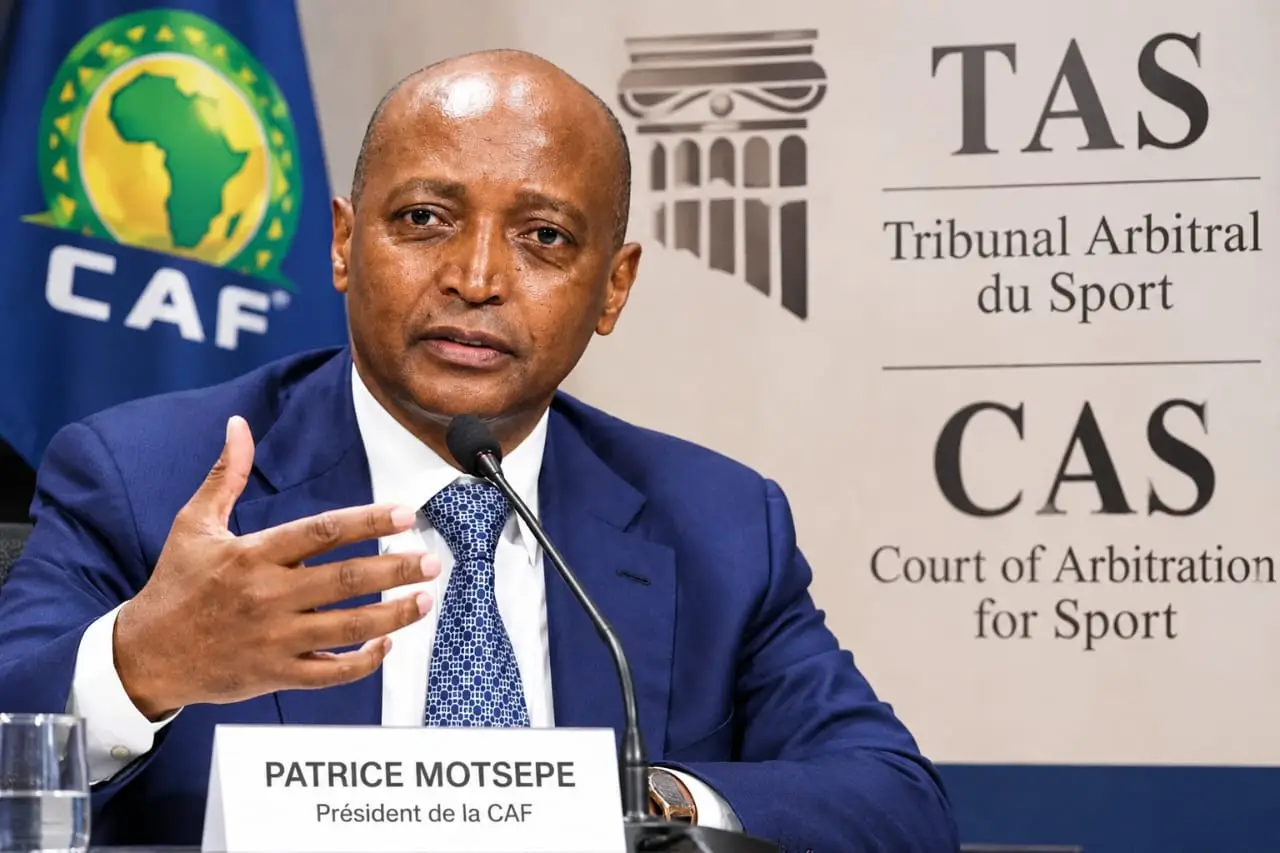
Senegal-Morocco: the CAS exposes the judicial failings of the CAF, the first measures are taking shape
The CAS decision shook CAF to its institutional foundations. First sign of the shocks caused by this verdict: the announced departure of Cédrick Aghey, director of legal affairs and compliance of the African body. But will this first head that could fall be enough to settle the responsibilities in such a mess?
The Lausanne verdict continues to make waves at CAF. On November 24, 2026, the three CAS arbitrators unanimously accepted the appeal of the Senegalese Football Federation (FSF)annulled the decision of the Appeal Jury and reinstated that of the Disciplinary Jury. Senegal thus retains its victory (1-0), obtained on January 18 in Rabat. A legal setback for CAF, whose appeal body had awarded the trophy to Morocco on the green carpet (3-0).
Read also: CAN 2025: the “field of play”, legal key to the Senegalese coronation at the CAS
According to several information relayed by the media, CAF is considering parting ways with Cédrick Aghey. The director of legal affairs and compliance was notably involved in the management of the case and the constitution of the Appeals Jury which ruled in favor of the Royal Moroccan Football Federation (FRMF). His possible departure, which remains to be confirmed, would be a first consequence of the turmoil caused by the sentence.
Aghey, the fuse of a faulty system?
A question arises: should Aghey be the only one to jump into this institutional mess? Blaming CAF’s failures on a single person would be a convenient way to close a file that calls for explanations at several levels.
Read also: Global sports justice: Kéba Mbaye, the Senegalese who gave birth to CAS
The constitution of the Appeal Jury, its operating conditions, the role of the administration and the validation of the procedures deserve in-depth examination. Who supervised the different stages? Who must answer for the choice of members and the conditions in which they exercised their mandate?
The CAS’s disavowal does not only concern a director or a jury. It calls into question the credibility of an entire institution. In June 2026, CAF nevertheless organized a consultation with the heads of its legal and jurisdictional bodies to review its statutes and regulations. The Lausanne verdict reminds us that these reforms must go beyond declarations of intent and translate into concrete changes.
Morocco enters into a legal impasse
Rejected by the CAS, the FRMF intends to explore avenues of appeal before the Swiss Federal Court. She notably mentions an alleged contact between the president of the FSF, Abdoulaye Fall, and the referee Ulrich Haas. Allegations firmly denied by the Senegalese side and which must be substantiated.
But Morocco risks suffering a new setback. The Swiss Federal Court is not a CAS appeal court. He cannot rejudge the facts of the final nor reinterpret the CAN regulations. Its control is limited to specific reasons: irregularity in the composition of the court, violation of the right to be heard or disruption of public order.
Read also: CAN 2025: why Morocco will not be able to recover the title before the Swiss Federal Court
The FRMF will therefore have to demonstrate a real violation of the fundamental guarantees of arbitration. A simple challenge to the legal reasoning of the CAS will not be enough. In view of these demands and the unanimity of the sentence, the prospects of a reversal seem particularly weak. A possible cancellation would not automatically mean that the title would return to Morocco.
Senegal retained its coronation, but CAF remains faced with its responsibilities. Aghey’s departure, if confirmed, will not be enough to dispel the questions. It will be necessary to establish responsibilities at all levels and guarantee the independence of judicial bodies. Morocco lost a final on the field, then a battle in front of the CAS. The CAF, for its part, risks paying the price of its institutional failures for much longer.
Sheikh Gora DIOP
